



Most people understand they should save money. They get the basics — emergency fund, retirement, maybe something for a vacation they keep pushing back. But execution falls apart when real life hits. Car breaks down, income dips, priorities shift, and suddenly that neat spreadsheet feels completely disconnected from what's actually happening.
The savings ladder fixes this by creating a structured progression of accounts that work together — not just random buckets, but a system with specific percentages, trigger points, and rebalancing rules that adapt as your income changes.
People who build wealth consistently use some version of a tiered system, whether they call it that or not. The ones who struggle bounce between accounts without clear rules about when to move money or how much belongs where.
Why traditional saving advice breaks down
Standard financial advice tells you to save 20% of income. Great in theory. But what happens when you earn $2,800 one month and $5,200 the next? Or when you're earning $35k annually versus $85k? The flat percentage approach just ignores how financial pressure actually changes across income levels.
A contractor I worked with a while back illustrated this well. Making around $65k annually, he dutifully saved 15% each month — sometimes $600, sometimes more. His emergency fund would swell, then he'd raid it for things that weren't really emergencies because "there's plenty in there." Meanwhile, his retirement account sat neglected and he had no real approach for medium-term goals.
The core issue is single-bucket thinking. Even when people have multiple accounts, they treat them as isolated pools rather than connected stages. Money sits idle in checking while credit cards rack up interest. Emergency funds get bloated while investment accounts starve. No flow, no triggers, no movement between levels.
Understanding the ladder structure
A savings ladder creates intentional tiers with specific purposes and capacity limits. Money flows upward through the system based on clear rules, not gut feelings or rough estimates.
Take charge of your finances with clarity and confidence.
Savioly gives you real-time visibility and actionable steps to improve your money management.
- Automated expense tracking
- Goal-based saving plans
- Personalized financial insights
No credit card required
Think of it like water filling connected chambers. The first chamber has to reach a certain level before it overflows into the next. Each chamber serves a different purpose, has different accessibility, and carries different growth expectations.
A simple visual can help make the flow clear.
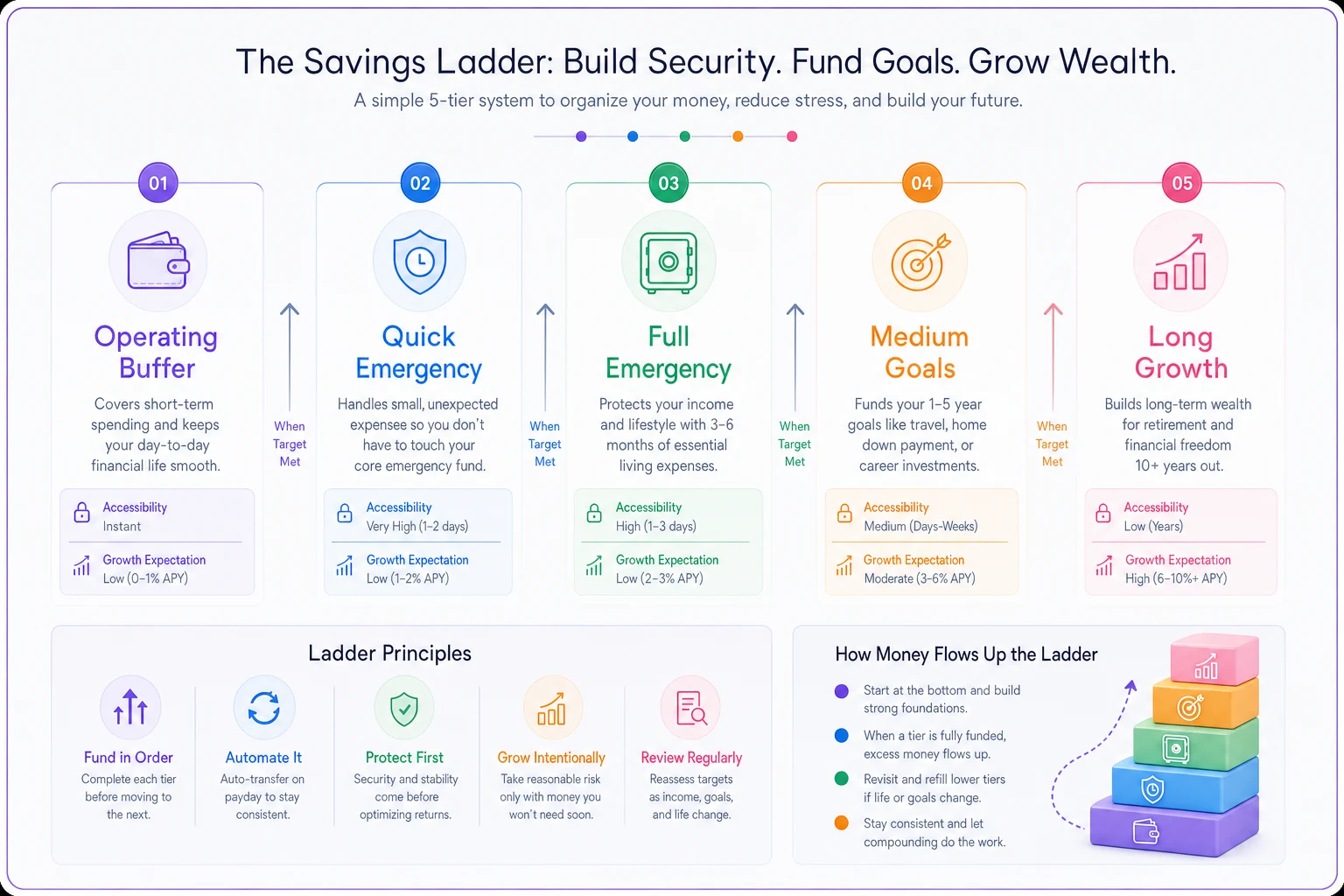
The basic ladder has five rungs:
Rung 1: Operating Buffer This stays in checking. Not really savings — it's operational liquidity. Size it to handle timing gaps between income and expenses without triggering overdrafts.
Rung 2: Quick Emergency High-yield savings, instantly accessible. Handles unexpected expenses that can't wait for transfers or liquidations.
Rung 3: Full Emergency Another high-yield account or money market fund. Combined with Rung 2, this is your complete emergency fund. Keeping them separate prevents casual raids on the full balance.
Rung 4: Medium Goals Short-term bonds, CDs, or stable value funds. Money for goals one to three years out. Less liquid than savings, more stable than investments.
Rung 5: Long Growth Investment accounts for retirement and long-term wealth building. Maximum growth potential, minimum accessibility.
Sizing rules by income band
This is where most advice falls flat — telling everyone to use the same percentages regardless of income. Someone making $30k annually faces completely different constraints than someone at $90k. The math just doesn't translate.
Band 1: Under $40k annually
| Rung | Target Size | Fill Priority |
|---|---|---|
| Operating Buffer | 2 weeks expenses | 1st |
| Quick Emergency | $1,000 flat | 2nd |
| Full Emergency | 2 months expenses | 3rd |
| Medium Goals | $500–1,000 | 4th |
| Long Growth | 3% of gross | 5th |
At this income level, even small disruptions can spiral fast. The focus stays on protection. The quick emergency uses a flat $1,000 rather than a percentage — this covers most true emergencies without overwhelming the system.
Band 2: $40k–$70k annually
| Rung | Target Size | Fill Priority |
|---|---|---|
| Operating Buffer | 3 weeks expenses | 1st |
| Quick Emergency | $2,000 flat | 2nd |
| Full Emergency | 3 months expenses | 3rd |
| Medium Goals | 5% of gross | 4th |
| Long Growth | 8% of gross | 5th |
The key shift: medium goals become percentage-based and long-term savings jump meaningfully. This band can start building real wealth while keeping the safety structure intact.
Band 3: $70k–$120k annually
| Rung | Target Size | Fill Priority |
|---|---|---|
| Operating Buffer | 1 month expenses | 1st |
| Quick Emergency | $3,000 flat | 2nd |
| Full Emergency | 4–5 months expenses | 3rd |
| Medium Goals | 8% of gross | 4th |
| Long Growth | 15% of gross | 5th |
The operating buffer extends to a full month because irregular expenses hit harder in absolute dollars at this level. Investment contributions become substantial enough to generate meaningful compound growth over time.
Band 4: Above $120k annually
| Rung | Target Size | Fill Priority |
|---|---|---|
| Operating Buffer | 1.5 months expenses | 1st |
| Quick Emergency | $5,000 flat | 2nd |
| Full Emergency | 6 months expenses | 3rd |
| Medium Goals | 10% of gross | 4th |
| Long Growth | 20%+ of gross | 5th |
The percentages might look aggressive, but at this income level, living expenses shouldn't scale proportionally with income. Someone making $150k shouldn't be spending three times what someone at $50k spends on necessities — but a lot of people quietly do, which is where lifestyle inflation quietly destroys wealth.
Trigger rules and rebalancing mechanics
Static targets mean nothing without clear rules about when and how to move money. Most people set up automatic transfers then never revisit them — which leads to overfunded checking and underfunded investments years later.
Fill triggers
Trigger 1: Operating buffer full → excess to Quick Emergency Check weekly. Any amount above buffer maximum moves immediately.
Trigger 2: Quick Emergency full → excess to Full Emergency Check biweekly. Move amounts above target to the next rung.
Trigger 3: Full Emergency full → split to Medium and Long Check monthly. Use your band's percentage split (for example, 40/60 for Band 2).
Trigger 4: Rebalancing needed → redistribute Check quarterly. This is where the system stays calibrated over time.
Rebalancing cadence
Steady salary: Quarterly rebalancing works fine. Automated transfers should keep things roughly aligned, with quarterly checks catching any drift.
Variable monthly: Rebalance after income settles at month-end. If you're a freelancer getting paid irregularly, waiting until you actually know what you made that month is smarter than guessing mid-month.
Seasonal patterns: Rebalance after high-income periods. Retail workers might rebalance in January after holiday earnings. Tax preparers in May or June.
The rebalancing process itself takes maybe 20 minutes:
-
Calculate current vs target for each rung
-
Move excess from overfunded rungs
-
Fill underfunded rungs in priority order
-
Note any deliberate variations and why
Match your rebalancing cadence to an existing habit (like payday) so it actually gets done.
The rebalancing process itself takes maybe 20 minutes:
Sample ladders in action
The $35k teacher
-
Operating Buffer
$600 (about one week of expenses)
-
Quick Emergency
$1,000
-
Full Emergency
$2,400 (two months)
-
Medium Goals
$500
-
Long Growth
$90/month ongoing
She started with $800 in checking and $200 in savings. Month one, she kept $600 in checking and moved $200 to the quick emergency fund. Each paycheck she added around $100 until it hit $1,000, then redirected that $100 to the full emergency fund.
Eight-ish months in, her foundation is complete and she starts the $90 monthly investment contribution. The medium goals fund builds slowly through small windfalls — tax refunds mostly, and one unexpected birthday check from her aunt that she almost spent on something stupid before catching herself.
She's not building wealth fast. But she's building it, which is more than she was doing before.
The $65k marketing manager
-
Operating Buffer
$2,100 (three weeks)
-
Quick Emergency
$2,000
-
Full Emergency
around $6,300 (three months)
-
Medium Goals
roughly $270/month ongoing
-
Long Growth
roughly $430/month ongoing
Because income swings so much, he doesn't use fixed dollar transfers. After bills, 40% of whatever's left goes to savings until the emergency rungs fill — then that 40% splits between medium and long-term goals. A good month might push nearly $2,000 into savings. A rough month might add $400. The percentage approach stops him from over-saving in flush months or under-saving in tight ones.
He's maybe 14 months into this. The full emergency fund isn't quite there yet — he had to pull from it in month six when a client canceled unexpectedly. He's rebuilding it, but that setback was actually a useful stress test of the whole system.
The $95k consultant
-
Operating Buffer
$3,500 (one month)
-
Quick Emergency
$3,000
-
Full Emergency
roughly $14,000 (four months)
-
Medium Goals
~$630/month ongoing
-
Long Growth
~$1,200/month ongoing
She treats salary and bonuses as two different things. Salary fills the ladder through automated transfers. Bonuses follow a rough 20/30/50 rule: 20% to operating buffer top-off (until full, then it redirects), 30% to medium goals, 50% to investments.
This took some experimenting to get right — she originally had the bonus split reversed and was loading too much into medium-term goals she didn't really have a clear plan for. After adjusting, the investment side accelerated. About two years in, her investment account is sitting around $38k, though one of those quarters had a smaller bonus than expected and she made a conscious decision to put less toward investments and more into the emergency fund instead. That flexibility mattered.
Adjustment protocols for income changes
Income rarely stays static, but most people don't adjust their savings systems until a crisis forces the issue. The ladder needs clear protocols for both increases and decreases.
Income increases
-
Maintain current expense levels for at least three months
-
Increase emergency fund targets first
-
Boost investment percentage before lifestyle inflation sneaks in
-
Upgrade operating buffer last
A client who jumped from $55k to $75k after a promotion wanted to immediately scale everything proportionally. Instead, he kept expenses flat and pushed most of the raise toward investments for about six months, then gradually increased his emergency targets. The difference in wealth accumulation was significant compared to what happens when people inflate their lifestyle in lockstep with their income.
Income decreases
-
Stop all contributions to rungs 4–5 immediately
-
Check whether current expenses can realistically drop 15–20%
-
Calculate actual runway with existing emergency funds
-
Set a specific review date — not an open-ended panic mode
The ladder structure helps here in a way people don't always appreciate upfront. You can systematically draw from higher rungs while preserving your operating buffer. Someone with a properly built ladder can weather several months of reduced income without touching investment accounts.
Band transitions Moving up: Don't immediately adopt the new band's percentages. Increase gradually over roughly six months to avoid the whipsaw of adjusting everything at once. Moving down: Immediately adopt the lower band's emergency targets, but maintain the higher band's investment percentage if you can swing it. Preserving momentum while acknowledging new constraints is the goal.
Common ladder mistakes
Mistake 1: Skipping rungs Jumping straight to investments with an inadequate emergency fund. Markets drop, emergency hits, investments get liquidated at a loss. It happens constantly.
Mistake 2: Over-funding lower rungs Keeping $15k in checking "just in case" while carrying credit card debt. The operating buffer should be minimal — just enough to avoid overdrafts, nothing more.
Mistake 3: Static automation Setting up transfers and ignoring them for years. A ladder calibrated at $40k income will be wrong at $60k. Quarterly reviews prevent this kind of drift.
Mistake 4: Treating it as rigid law The ladder provides structure, not imprisonment. Major opportunities or genuine emergencies might require temporary variations. The key is documenting why you're deviating and when you plan to return.
Mistake 5: Wrong account types Using checking accounts for emergency funds or investment accounts for medium-term goals. Each rung needs account characteristics that match its purpose — accessibility, yield, and stability aren't interchangeable.
Optimization through operational tools
Manual ladder management works, but it requires a level of discipline most people can't sustain consistently over months and years. Spreadsheets break, memory fades, and good intentions drift.
AI-powered financial operations platforms can genuinely help here. Instead of manually checking balances and calculating percentages, operational software can monitor the ladder continuously — flagging when rebalancing is needed or when a trigger point gets hit. The automation handles the tedious stuff: tracking multiple account balances, calculating allocations, monitoring triggers. You make the strategic decisions about targets and timing while the platform handles execution monitoring.
Small business owners tend to benefit from this more than most, since they're already managing business and personal finances simultaneously. A platform that handles business cash flow can also keep an eye on the personal ladder — so the two systems work together rather than competing for your attention on the same Sunday afternoon.
Making the ladder sustainable
The perfect ladder that never gets maintained becomes worthless within a few months. Sustainability means matching the system to how you actually behave, not how you wish you behaved.
Start with partial implementation if needed. Build just the first three rungs, get comfortable with the mechanics, then add complexity. Someone who actually maintains a three-rung ladder will accumulate more wealth than someone who sets up a perfect five-rung system and abandons it by March.
Pick rebalancing triggers that connect to existing habits. If you already think about finances when you pay rent, make that your rebalancing moment. If you check accounts every payday, use that rhythm.
After a few months, the flow starts to feel intuitive. After a year, managing money without it feels weirdly disorganized. More than anything, the ladder removes decision fatigue. When money comes in, you know exactly where it goes based on which rungs need filling — no guilt about spending when they're full, no agonizing over whether to save or invest.
Building wealth isn't about finding perfect investments or timing markets. It's about creating systematic processes that turn irregular income into consistent progress. The savings ladder does exactly that — specific enough to be actionable, flexible enough to survive real life, and structured enough to actually work when things get complicated.
Ready to master your money?
Join thousands of users leveraging Savioly to build smarter budgets, save more efficiently, and plan for a secure financial future.