Actionable personal finance tips, budgeting strategies, saving habits, investment basics, debt management, and money mindset advice for modern financial wellness.
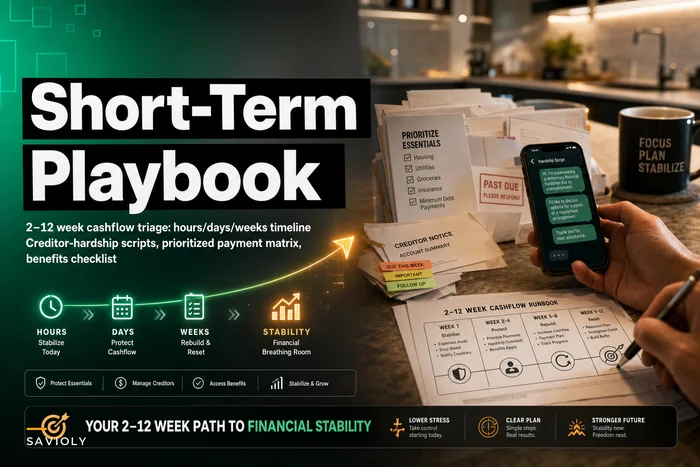
An hour-by-hour triage for the first 48 hours after payment fraud, with evidence templates, bank/dispute cadence, and monthly reconciliation habits to detect fraud early.
Juan CabreraFounder of SoftWorks Global & Business Systems Researcher
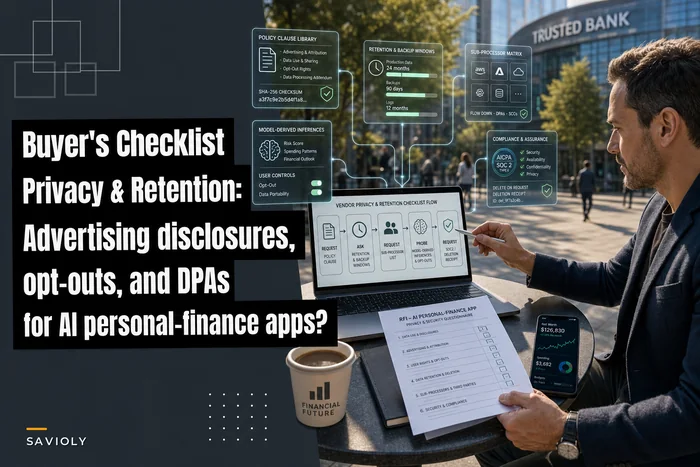
Short evergreen buyer’s guide for consumers, product managers, and small‑business procurement teams evaluating AI‑driven personal‑finance apps. Includes a concise checklist of technical and policy features (model‑training use, third‑party sharing, deletion policies, encryption, auditability, advertising disclosures, consent/UI controls) plus a compact “typical vendor answers” bank you can use when interviewing providers. Structure: 1) Why this matters (privacy, regulatory risk, model drift/repurposing risk). 2) One‑page checklist (see highlights below). 3) Typical vendor answers to expect and red flags. 4) How to frame vendor questions and a short template RFI snippet. Estimated length: 800–1,200 words; include a downloadable one‑page checklist PDF.
Checklist highlights (to appear as a clear visual checklist in the article):
- Model training use: Explicit policy stating whether customer PII/transactional data is used to train internal or third‑party models; an opt‑out mechanism; examples of allowed uses (e.g., improving personalization) and disallowed uses (e.g., training public models).
- Data minimization & purpose limitation: Clear delimitation of what data is collected and why, retention schedules tied to purposes, and automatic minimization where possible.
- Third‑party sharing: Inventory of categories of third parties (analytics, payment processors, advertisers), purposes for sharing, contract safeguards (DPA), and whether data is sold.
- Deletion & retention policy: Retention periods for raw, derived, and aggregated data; deletion request workflow (time to deletion, what remains in backups, proof of deletion).
- User controls & consent UX: Granular consent controls (model training opt‑out, targeted ads opt‑in), easy account export (machine‑readable format), and account/API endpoints for data access.
- Advertising disclosures: Whether targeted ads are served, whether ads use transaction data or model inferences, and how ad partners receive data.
- Security & access controls: Encryption in transit and at rest, tenant separation for multi‑tenant models, role‑based access, and SOC/ISO attestations.
- Auditability & transparency: Logs, data lineage, and periodic transparency reports describing model use and data-sharing practices.
- Compliance & certifications: GDPR/CCPA mapping, financial‑services rules (GLBA if relevant), and any third‑party audits.
Typical vendor answers to expect (short examples to include inline):
- Model training: “We do not use customer‑identifying data to train our general ML models. We may use aggregated, de‑identified aggregates for model improvement; customer data used in training only with explicit opt‑in and contract terms.” (GOOD)
- Third‑party sharing: “We share payment card and ACH data only with processors under contract; we do not sell PII to advertisers. Analytics events are sent to vendor X under a DPA.” (ACCEPTABLE — verify DPAs)
- Deletion: “Upon deletion request we remove data from primary systems within 30 days; backups may retain encrypted snapshots for up to 90 days; we provide a confirmation receipt.” (COMMON — ask for backup/retention specifics)
- Advertising: “We do not serve targeted advertising based on raw transaction data. We may show non‑personalized ads or use anonymized segments; advertisers never receive PII.” (VERIFY with logs/contract)
- Security: “TLS in transit, AES‑256 at rest, yearly SOC 2 Type II audit.” (EXPECTED — request recent report)
Red flags to call out: blanket “we use data to improve our models” without de‑identification detail; vendor refuses to describe backup retention or proof of deletion; statement that data is ‘‘shared with partners’’ without categories or contracts; inability to opt out of model training or ad personalization.
Call to action: download one‑page checklist and an RFI snippet to paste into vendor questionnaires.
Juan CabreraFounder of SoftWorks Global & Business Systems Researcher
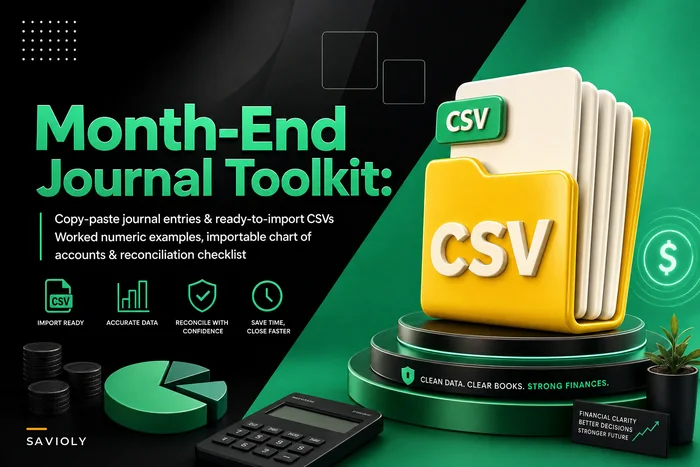
Deliver a hands‑on companion to the parent cashflow system: 1) a short, copy‑paste list of common month‑end journal entries with numeric worked examples (tax provision, owner draw/transfer, accrual for unpaid invoices, payroll liabilities, merchant fee split, refunds/chargebacks, remediation of commingled funds); 2) a minimal 18‑account chart of accounts CSV (exact account names mapped to P&L/BS rows) ready to import into ledger software or a spreadsheet; 3) a downloadable CSV/Excel journal import template prefilled with the worked examples and formulas; 4) a one‑page reconciliation workpaper checklist showing what to save in the month‑end folder and how to name files; 5) short step‑by‑step notes on posting each entry and what supporting document to attach for audit readiness. The piece includes bank/merchant timing notes and a short troubleshooting table for common mismatches (timing, splits, refunds).
Juan CabreraFounder of SoftWorks Global & Business Systems Researcher
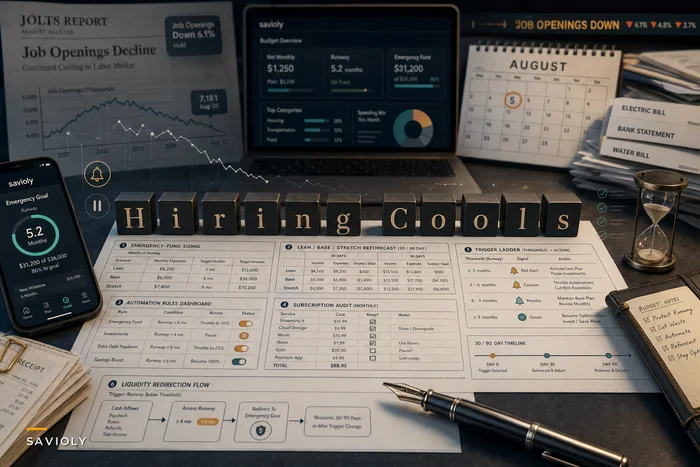
The August JOLTS release shows a meaningful drop in U.S. job openings. This post translates that labor‑market signal into an operational household playbook: size/update emergency reserves, run fast 'lean/base/stretch' reforecasts, retune savings automations and subscription audits, and set trigger‑based rules for goal prioritization and job‑loss scenarios.
Juan CabreraFounder of SoftWorks Global & Business Systems Researcher
Three defensive household playbooks for inflation scenarios (short-term shock, persistent inflation, stagflation) with buffer-size heuristics, real-return buckets, variable spending triggers, and reforecast frequencies including worked household examples.
Juan CabreraFounder of SoftWorks Global & Business Systems Researcher
Operational behavioral governance for families: household contracts, meeting cadences, veto/override ladders, cooling-off templates, and measurable behavioral KPIs tied to financial outcomes with templates to scale across members.
Juan CabreraFounder of SoftWorks Global & Business Systems Researcher
Month-by-month household tax calendar tying withholding, estimated payments, Roth-conversion windows, and tax-loss-harvest seasons to decision checkpoints, income-band thresholds, and automation templates with thresholds for action.
Juan CabreraFounder of SoftWorks Global & Business Systems Researcher