



Most household budgets are built for one weather condition: normal. Prices creep up 2–3% a year, wages roughly keep pace, and the plan you set in January still basically works in December. Then something breaks that assumption—a supply shock, a wage-price spiral that won't quit, or the ugly combination where prices climb but the job market stalls—and suddenly the whole thing needs rewiring on the fly.
The problem isn't that people lack a budget during high inflation. It's that they run the same budget regardless of what kind of inflation they're facing. A short-term price spike and grinding multi-year inflation are completely different animals, and they demand different defensive moves. Treating them the same is how households either overreact to a blip or underreact to a structural shift until it's genuinely painful.
So instead of one generic "inflation guide," this is three playbooks. Each has a different buffer-sizing rule, a different way of splitting your cash into real-return buckets, different spending triggers, and a different reforecast frequency. The whole point of financial planning in high inflation is matching your response to the actual scenario in front of you—not panicking uniformly.
Why one budget can't cover three different inflation scenarios
The mistake that shows up constantly: someone reads that inflation is up, slashes discretionary spending, dumps cash into a "safe" account earning almost nothing, and freezes all their goals. That's a reasonable move for a two-month price shock. It's a terrible move for stagflation, where you might actually need more liquidity flexibility and a different income strategy—not just aggressive cost-cutting.
-
Short-term shock stresses your buffer. Prices jump for a defined stretch—energy spikes, a supply disruption—then normalize. The danger is temporary cash-flow strain and knee-jerk decisions.
-
Persistent inflation stresses your real returns and income. Prices keep rising 5–8% for years. The danger is silent erosion—your cash and fixed income lose purchasing power while you barely notice it month to month.
-
Stagflation stresses your whole coordination system. Prices rise, growth stalls, job security wobbles. The danger is compound: costs up, income fragile, and traditional "safe" moves failing at the same time.
If you don't name which one you're in, you default to gut feeling. And gut feeling during scary economic headlines almost always overweights the short-term and ignores the slow structural stuff—which is exactly backwards from where the real damage lives.
Playbook 1 — Short-term shock
The situation
Take charge of your finances with clarity and confidence.
Savioly gives you real-time visibility and actionable steps to improve your money management.
- Automated expense tracking
- Goal-based saving plans
- Personalized financial insights
No credit card required
A defined, likely-temporary price spike. Think energy costs jumping for a season, or a specific category—groceries, fuel, a supply-constrained good—running hot for a few months before mean-reverting. Headline CPI might look alarming, but the underlying driver is expected to fade.
Buffer-size heuristic
For a short shock, your emergency fund does the heavy lifting. You're absorbing, not restructuring. If you normally run a 3-month buffer, temporarily size it to 4–5 months of inflated expenses—not your old expense number. That distinction matters more than it seems. A household spending roughly $4,200/month in normal times might be spending $4,600 during the shock. Sizing your buffer off the old number quietly underfunds you by 8–10% right when you need it.
Real-return buckets
You don't need to get fancy here because the shock is temporary. Keep it simple:
| Bucket | Allocation | Purpose |
|---|---|---|
| Operating cash | 1 month of inflated expenses | Pay the elevated bills without drama |
| Shock buffer | 3–4 months | Absorb the spike, avoid selling anything |
| Untouched long-term | Everything else | Do not touch—this is not the scenario to change your investments |
The key insight: a short-term shock is exactly when people most want to rearrange their portfolio and least should. Selling investments to cover a two-month energy bill spike locks in a loss to solve a temporary problem your buffer already handles.
Variable spending triggers
-
Category trigger If the hot category (say, fuel) exceeds its normal share by more than 25% for two consecutive months, temporarily pull that overage from a named discretionary line—dining out, subscriptions—not from savings.
-
Duration trigger If the shock runs past 4 months, stop treating it as short-term. Graduate to Playbook 2. This is the trigger people most often forget, and it's arguably the most important one.
Reforecast frequency
Monthly, lightweight. You're just checking: is the hot category still elevated, and have I crossed the 4-month duration line? Fifteen minutes. Don't over-engineer a temporary event.
Playbook 2 — Persistent inflation
The situation
Prices keep climbing 5–8% year over year and it's not fading. This scenario does the most damage precisely because it's boring. No crisis headline every week—just relentless erosion. A household that feels fine month to month can lose serious purchasing power over 24–36 months without a single dramatic moment.
Buffer-size heuristic
Static buffers rot in persistent inflation. A 3-month fund set two years ago might now be a 2.4-month fund in real terms. The fix is an indexed buffer: recompute your target every quarter against current expenses and top it up. The rule is straightforward—buffer target equals current monthly expenses multiplied by your month-count, recalculated quarterly. If expenses rose from $4,200 to $4,550 over a year, your 3-month target moved from roughly $12,600 to roughly $13,650. That ~$1,050 gap isn't optional. It's just keeping your buffer at the size you already decided you needed. This kind of trigger-based topping-up is exactly the logic behind a proper savings ladder with prescriptive sizing rules and rebalancing cadences, where each rung is designed to hold its purchasing power rather than just its dollar value.
Real-return buckets
This is where you actually change your allocation, because the enemy is negative real return on idle cash.
| Bucket | Target | Real-return job |
|---|---|---|
| Operating (0–1 mo) | Checking + high-yield | Convenience; accept slight real loss |
| Near buffer (1–6 mo) | High-yield savings, T-bills | Match or beat short-rate inflation |
| Mid horizon (6mo–3yr) | I-bonds, short TIPS, ladder | Explicitly inflation-protected |
| Long horizon (3yr+) | Diversified equities/real assets | Grow above inflation over time |
The mistake here is leaving 12+ months of expenses parked in a checking account earning near-zero "because it's safe." In persistent inflation, that cash is guaranteed to lose ground. Safe from volatility isn't the same as safe from erosion.
Variable spending triggers
-
Real-income trigger If your income isn't rising at least at your personal inflation rate—track your basket, not headline CPI—start a cost-reduction pass and revisit income. That means raise conversations, side income, or repricing your work.
-
Fixed-cost creep trigger When any recurring bill renews above +7%, it goes on a challenge list for renegotiation or replacement before you accept it.
-
Savings-rate defense If your savings rate—not dollar amount—drops for two consecutive quarters, that's your signal to cut before the slide compounds.
Reforecast frequency
Quarterly, full. Recompute the indexed buffer, re-check bucket balances against inflation-protected targets, and rerun your personal inflation basket. Persistent inflation rewards steady recalibration over dramatic single moves.
Playbook 3 — Stagflation
The situation
The hard one. Prices rise and growth stalls, meaning elevated costs collide with fragile income and shaky job security. The moves that work in isolation—cut costs, chase yield, hold cash—can all backfire when they happen together. This scenario stresses coordination more than any single number.
Buffer-size heuristic
Stagflation is a two-variable problem: cost erosion and income risk. So the buffer stretches in both directions. Size to 6–9 months of inflated expenses, weighted toward the higher end if your income is concentrated—single earner, one industry, commission-heavy. A household that could run a 3-month buffer in normal times should be targeting closer to 8 months here. Not because prices alone demand it, but because the probability of needing it went up at the exact moment it costs more to fund. This is really where scenario planning earns its keep. Building explicit lean/base/stretch versions of your household spending—and knowing which triggers flip you between them—turns stagflation from a vague dread into a set of pre-decided moves. If you haven't set those tiers up yet, a multi-year living plan with lean/base/stretch scenarios and trigger-based rules is the backbone this whole playbook sits on.
Real-return buckets
You're balancing two competing needs: inflation protection and deep liquidity for income shocks. That tension is the whole game.
-
Deep liquidity (larger than usual) 6+ months, split between high-yield savings and short T-bills. Yes, some real erosion—accept it as insurance against needing to sell into a bad market.
-
Inflation-protected core I-bonds and TIPS to keep the middle of your reserves from quietly rotting.
-
Long-term, held not touched Equities and real assets—but critically, not money you'd need in the next 2–3 years, because stagflation is exactly when you don't want to be a forced seller.
Variable spending triggers
-
Any signal of income risk—hiring freeze, reduced hours, client loss—means immediately shifting from base to lean spending tier. Don't wait for the actual income drop.
-
If liquid runway drops below 4 months, pause all non-essential goal funding and redirect to buffer rebuild.
-
If costs are up and income is flat or falling in the same quarter, that's the full stagflation signal. Activate every defensive tier at once.
-
Define the upside too. When income stabilizes for two quarters and the buffer is back to target, step spending back up. Households that only build "cut" triggers stay in crisis mode long after the crisis passes.
Reforecast frequency
Monthly, focused on income and runway. Costs you can review quarterly, but income risk in stagflation moves fast enough that a monthly runway check is non-negotiable.
A worked household example across all three
Take a two-income household with combined take-home around $8,400/month, normal expenses roughly $6,000/month, and a 3-month buffer of about $18,000.
Short-term shock hits—energy and groceries spike roughly 12%. Expenses jump to about $6,700. They resize the buffer target to somewhere between $27k–$33k (4–5 months of the inflated number), pull an extra $700/month temporarily from dining out and two paused subscriptions, and set a 4-month duration trigger. Nothing in investments gets touched. Monthly 15-minute check. Four months later prices normalize and they stand down.
It doesn't normalize—persistent inflation sets in. The duration trigger fires. Now they index the buffer quarterly, which drifts from an $18k target toward roughly $20k as expenses rise. About $15k of idle checking moves into I-bonds and short T-bills. One earner's compensation isn't keeping pace with their personal inflation basket, so the real-income trigger pushes a raise conversation and a small freelance income stream. Full quarterly reforecasts from here.
Then growth stalls—stagflation. One earner's hours get risk-signaled by a hiring freeze. The income-watch trigger flips them to their lean tier before the income actually drops, trimming roughly $900/month. They stretch the buffer target toward 8 months (around $48k) and pause new goal funding to get there. Deep liquidity gets prioritized over yield. Monthly runway checks. When hours stabilize for two quarters, the recovery trigger steps spending back toward base.
Same household. Three completely different responses—because the scenario, not the headline, drove the plan.
When each playbook is a bad idea
Don't run Playbook 1 past its expiry. The most common failure is treating a persistent trend as a temporary shock for way too long because "it'll pass" is comforting. The 4-month duration trigger exists specifically to stop that.
-
Don't run Playbook 1 past its expiry. The most common failure is treating a persistent trend as a temporary shock for way too long because "it'll pass" is comforting. The 4-month duration trigger exists specifically to stop that.
-
Don't run Playbook 2's allocation moves during a genuine short shock. Rearranging into I-bonds and TIPS ladders for a two-month blip creates friction and possible losses solving a problem your buffer already covers.
-
Don't run Playbook 3's giant buffer if your income is genuinely stable and diversified. Over-hoarding 8–9 months of cash when you don't need it is its own quiet erosion. Match the buffer to real income risk, not to anxiety.
Match the buffer to real income risk, not to anxiety.
Who should NOT over-engineer this
If your income is highly stable, your buffer is solid, and your recurring costs are mostly fixed—owned home, locked-in rates—you probably need the indexed-buffer discipline from Playbook 2 and not much else.
The heavy stagflation machinery is for households with income concentration or fragility. Building elaborate trigger systems you'll never actually activate just adds maintenance work you'll eventually abandon.
Keeping the whole thing runnable
The reason most of these plans fail isn't the logic—it's the follow-through. Nobody remembers to recompute an indexed buffer every quarter, or notices that a category has been elevated for four straight months, or catches that their savings rate slipped two quarters in a row. The triggers are only as good as your ability to actually check them on schedule.
A household financial system that tracks your real expense trend, flags when a trigger condition is met, and reminds you to reforecast on the right cadence turns these playbooks from a nice idea into something you actually run. Not because it replaces the decisions—you still choose lean vs. base, you still decide which bills to challenge—but because it removes the "I forgot to look" failure that quietly sinks most inflation defenses.
Set calendar recurring reminders for quarterly buffer checks and monthly runway reviews to avoid the "I forgot" failure.
Here's a simple workflow for running the triggers and reforecasts.
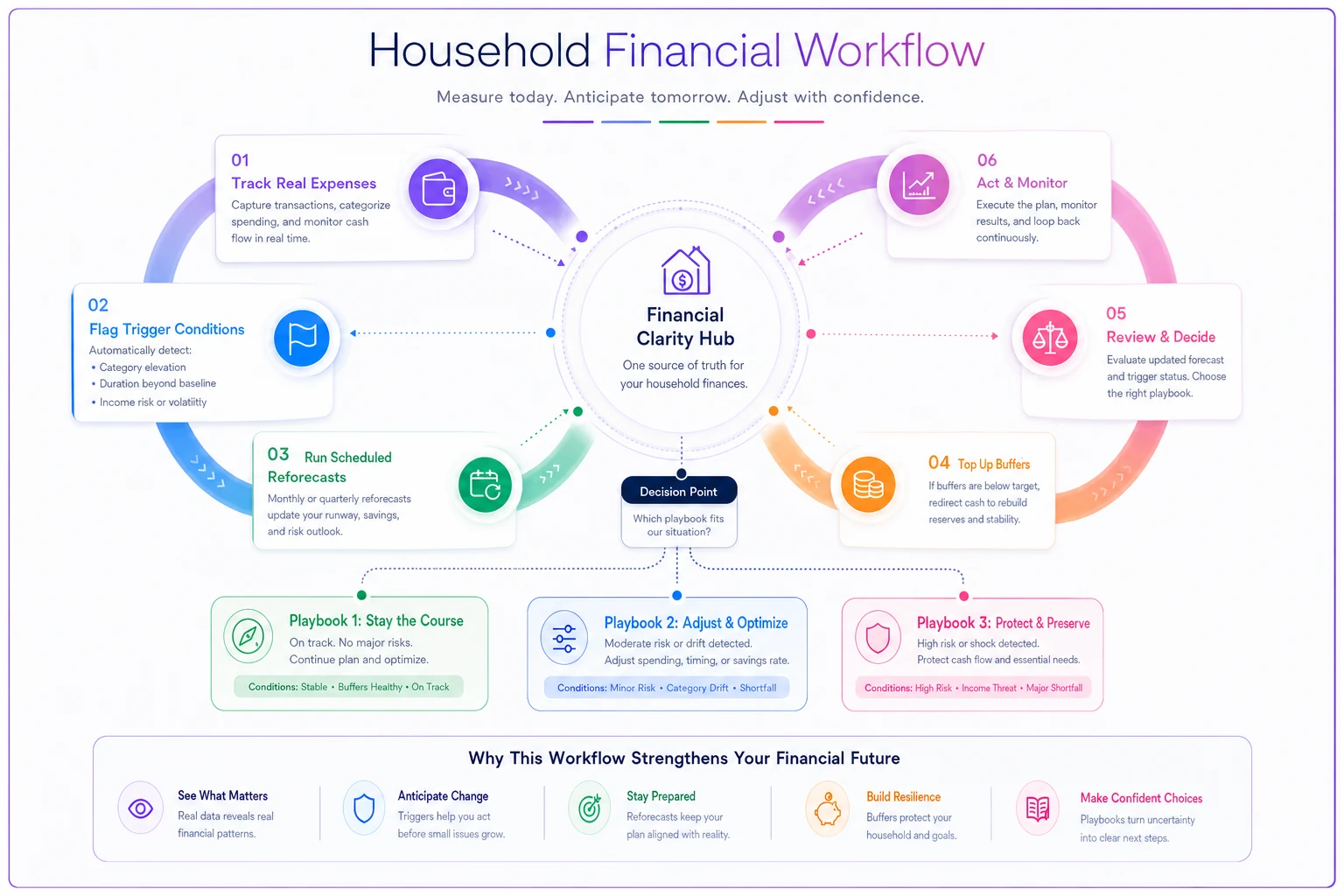
The plan you set is worthless if the review never happens.
The bottom line
High inflation isn't one problem with one answer. A short-term shock wants a bigger buffer and a steady hand. Persistent inflation wants indexed buffers, inflation-protected buckets, and an income conversation. Stagflation wants deep liquidity, income-risk triggers, and pre-decided spending tiers you can flip fast.
The households that come through these periods intact aren't the ones who cut hardest or hid in cash—they're the ones who correctly identified which scenario they were actually in and ran the matching playbook. Name the weather first. Then run the plan built for it.
Name the weather first. Then run the plan built for it.
Ready to master your money?
Join thousands of users leveraging Savioly to build smarter budgets, save more efficiently, and plan for a secure financial future.