



Most household money conflicts don't come from a shortage of cash. They come from a shortage of process. Two people (or three, or five if the teenagers count) making financial decisions with no agreed-upon rules for who decides what, when a decision needs a second opinion, and what happens when someone blows past a spending guardrail at 11pm on a Tuesday.
You can build the most beautiful budget in the world, but without a governing structure around behavior, it collapses the first time someone overspends and the other person finds out three weeks later on the statement. The budget wasn't the problem. The missing decision-making system was.
This is what behavioral governance for families actually is — not a lecture about self-control, but an operational layer that sits on top of your money. Contracts, meeting rhythms, escalation ladders, cooling-off rules, and a handful of metrics that connect behavior to dollars. It's the difference between "we should really talk about money more" and a system that runs whether or not anyone feels like having that conversation this week.
Below I'll walk through how the whole thing fits together, where it breaks as households grow, and how you actually make it scale past two adults.
The core problem: behavior is invisible until it shows up on a statement
There's a pattern that shows up in almost every household that fights about money.
Decisions happen constantly and quietly. Someone signs up for a $22/month app. Someone says yes to a $340 impulse purchase. Someone lends $500 to a sibling and mentions it later. None of these are catastrophic on their own. But there's no shared visibility into the behavior at the moment it happens — only the consequence, later, on a statement.
By the time it surfaces, it's not a decision anymore. It's a fait accompli. And now the conversation isn't "should we spend this?" — it's "why did you spend this?" That's a fundamentally worse conversation, and it's the one most couples end up having over and over.
The insight most people miss: financial conflict is a timing problem before it's a values problem. You disagree about the purchase, sure, but you're really fighting about the fact that the decision was made without you. Governance fixes the timing. It moves the conversation before the money moves, and it does that through structure, not willpower.
The five components that actually hold together
A working household governance system has five moving parts. Skip any one and the others start to sag.
Take charge of your finances with clarity and confidence.
Savioly gives you real-time visibility and actionable steps to improve your money management.
- Automated expense tracking
- Goal-based saving plans
- Personalized financial insights
No credit card required
| Component | What it does | What breaks without it |
|---|---|---|
| Household contract | Defines who decides what, and spending thresholds | Every decision becomes a negotiation from scratch |
| Meeting cadence | A recurring rhythm to review, decide, and adjust | Decisions pile up until they explode in an argument |
| Veto/override ladder | Escalation rules for bigger or contested decisions | One person quietly controls everything, or nobody does |
| Cooling-off templates | A forced pause on emotional or large purchases | Impulse spending and reactive fights |
| Behavioral KPIs | Metrics tying habits to financial outcomes | You can't tell if any of it is working |
Think of these as a workflow, not a checklist. The contract sets the defaults. The cadence is when you review and revise. The ladder handles edge cases the contract didn't anticipate. Cooling-off handles the emotional spikes. And the KPIs tell you whether the whole apparatus is producing results or just producing meetings.
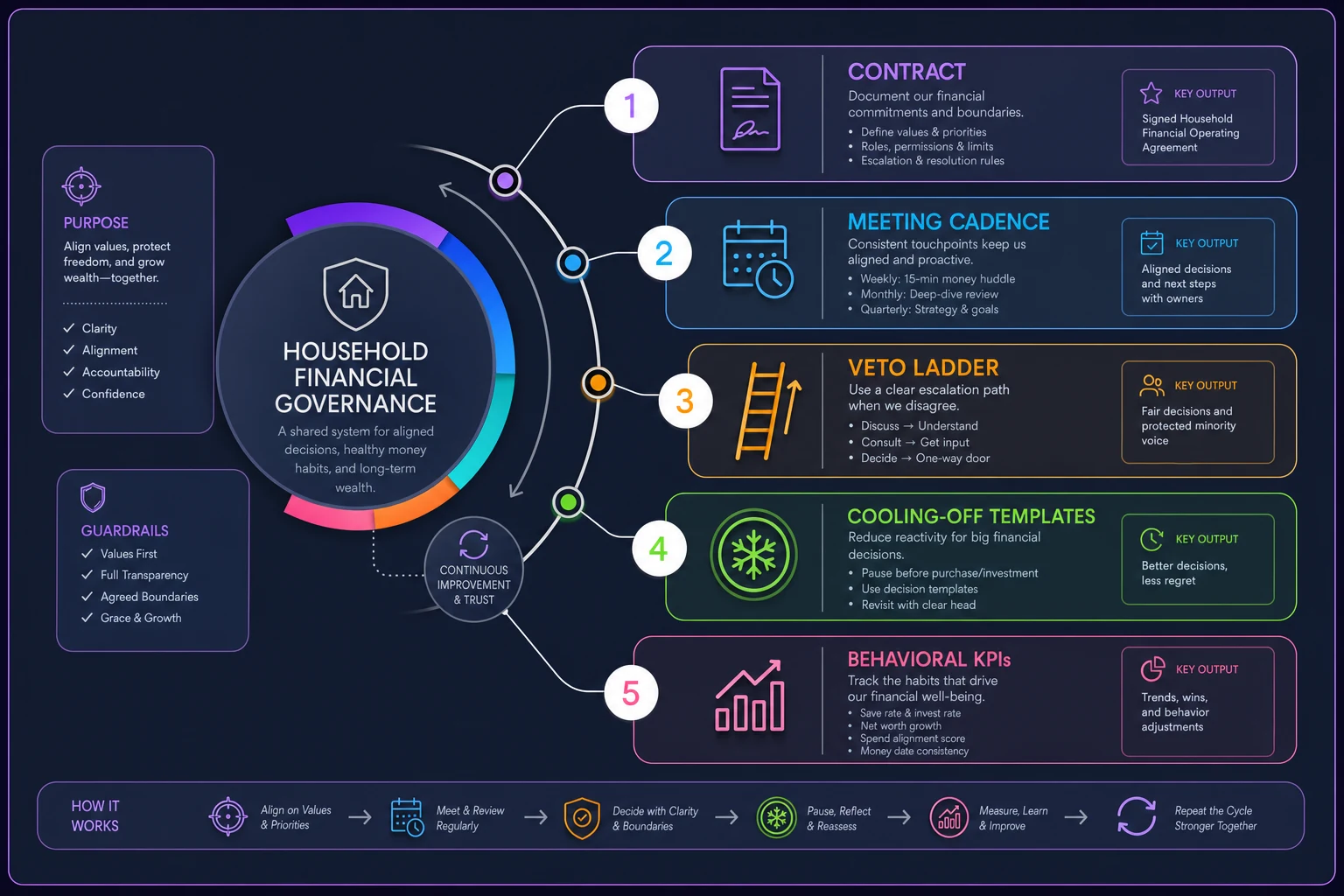
A simple visual like this helps people see how the parts interact and where decisions flow when an exception occurs.
Start with the household contract — but keep it embarrassingly small
The mistake people make with a household financial contract is writing a novel. Twelve pages of "we agree to communicate openly and respect each other's financial autonomy." That document gets signed once and never opened again because it doesn't actually decide anything.
-
What can each person spend without checking in? Pick a real number. Maybe $150. Maybe $400. It's not about the size — it's about having a line.
-
What requires a heads-up (not permission)? Purchases between the solo threshold and the joint threshold.
-
What requires a joint decision? Anything above the joint threshold, plus specific categories — new recurring subscriptions, lending money, anything touching shared debt.
-
What are the non-negotiables? Things you've agreed never happen without a full conversation. New debt above X. Touching the emergency fund. Cosigning anything.
Pick round numbers for thresholds so they're easy to remember.
A typical example looks like this: solo discretionary up to $200, heads-up between $200–$600, joint decision above $600, and a hard stop on any new recurring commitment over $30/month without both signing off. Those numbers are yours to set — the point is that they exist and both people know them cold.
The reason thresholds work is they remove the ambiguity that fuels resentment. "Was I supposed to ask you about that?" disappears when the answer is a number on a shared page. If you want a deeper structure for the meeting-and-decision side of this, the household financial governance playbook for meeting agendas and decision ladders goes further into agenda design specifically for couples.
Meeting cadence: the rhythm that keeps decisions from stacking up
A contract without a cadence is a car without a gas pedal. The cadence is what keeps decisions flowing at a healthy pace instead of accumulating into one giant, tense quarterly showdown.
-
Weekly (10–15 min) A fast pass. Any upcoming purchases that cross thresholds? Anything surprising this week? This is not a deep review — it's a pressure-release valve.
-
Monthly (45–60 min) The real close. Review the month, check the KPIs, adjust guardrails, decide on anything pending. This is where actual governance happens.
-
Quarterly (90 min) Zoom out. Are the thresholds still right? Did income change? Any goals shifting?
-
Annually Re-negotiate the contract itself. Incomes change, kids get older, priorities move.
The weekly meeting is the one everyone skips, and it's the one that prevents the most damage. When you catch a decision on a Sunday instead of on a statement, the emotional temperature is completely different. No defensiveness, because nothing has happened yet. You're planning, not litigating.
The failure mode here is over-engineering the cadence and then abandoning all of it. A household that tries to run four meeting tiers perfectly usually collapses to zero within two months. Better to run a solid 15-minute weekly and a real monthly, and let the quarterly and annual happen loosely.
The veto/override ladder: for when the contract runs out of answers
Contracts handle the routine. The ladder handles the contested and the unexpected — and it's the part almost nobody builds, which is exactly why most fights keep happening.
-
Level 0 — Default Within contract thresholds. No escalation needed.
-
Level 1 — Heads-up Notify, but don't need sign-off. If no objection within an agreed window (say 48 hours), it proceeds.
-
Level 2 — Joint sign-off Both parties must actively agree. Silence is not agreement here.
-
Level 3 — Override with cooling-off If one person feels strongly and the other blocks, the decision goes into a mandatory pause before it can be revisited.
-
Level 4 — Outside input For genuinely stuck decisions — big ones — you agree in advance to bring in a neutral third party (a planner, a spreadsheet, an agreed-upon rule).
The subtle part is Level 1. Making "silence = approval" explicit for small things frees up enormous mental bandwidth. Making "silence ≠ approval" explicit for big things prevents the "well, you didn't say no" trap that quietly wrecks trust.
One override rule worth writing down: either person can pull any decision up one level. If something feels off, even if it's technically within threshold, you can escalate it. That single clause prevents a lot of "technically I was allowed to" arguments, which are among the most corrosive kinds.
Cooling-off templates: engineering the pause
Impulse is the enemy of good financial decisions, and it doesn't respond to logic in the moment. So you don't fight it with logic — you fight it with a pre-agreed delay.
-
The 72-hour rule for any discretionary purchase over your joint threshold. Add it to a list, revisit in three days. Most of it evaporates.
-
The overnight rule for anything triggered by a sale or deadline pressure. "Limited time" is designed to bypass your governance — the overnight rule reinstates it.
-
The one-in-one-out pause for recurring subscriptions. New subscription requires either canceling an old one or a joint conversation.
-
The emotional-state flag. If a purchase impulse follows a fight, a hard day, or a couple of drinks, it auto-triggers a cooling-off, no questions asked.
The reason these work is behavioral, not moral. You're not trusting yourself to be disciplined in a weak moment — you're building the discipline into the system beforehand, when you're calm. It's the same principle behind making good money habits stick through defaults rather than motivation, which the behavioral design playbook on making money habits stick covers in depth.
Behavioral KPIs: connecting habits to actual dollars
This is where most household governance falls apart. People run meetings, they have rules, but they never measure whether any of it changes outcomes. So the whole thing starts to feel like bureaucracy, and eventually they drop it.
-
Threshold breach count — how often someone spent past their solo limit without escalating.
-
Cooling-off adherence rate — of purchases that should have paused, how many actually did.
-
Meeting completion rate — did the weekly and monthly actually happen?
-
Surprise ratio — how much of the statement was "we knew about this" vs "wait, what's that?"
-
Decision latency — how long contested decisions sit unresolved.
Then you tie them to outcomes. A household that drops its surprise ratio from roughly 30% of transactions to under 10% over a few months almost always sees real dollar impact too — fewer redundant subscriptions, fewer impulse buys, more savings hitting the account on schedule. The behavioral metric moves first; the money follows a month or two later.
Keep it to three or four KPIs. A dozen metrics is a dashboard nobody looks at.
A real scenario: two incomes, one recurring blowup
Consider a dual-income household — combined take-home somewhere around $9k/month, no serious debt problems, decent savings — and a recurring monthly argument about spending. Neither person was reckless. But small independent decisions kept surprising the other, and every statement review turned into an interrogation.
They built a lightweight governance layer. Solo threshold at $175, heads-up to $500, joint above that. A 15-minute Sunday check-in and a real monthly close. A 72-hour cooling-off on anything above the joint line. And three KPIs: breach count, surprise ratio, and meeting completion.
The first month was rough — they logged five or six breaches, mostly from forgetting the rules existed. By the third month, breaches were down to one, the surprise ratio had dropped from roughly a third of transactions to under 10%, and — this is the part that mattered — the monthly argument stopped. Not because they agreed on everything, but because disagreements now happened before money moved, in a scheduled 15-minute window, instead of after the fact in the kitchen.
The dollar effect was real but secondary: a couple of duplicate subscriptions clawed back, impulse spending down a few hundred a month. The bigger win was that money stopped being a source of ambient tension.
Scaling past two people: contracts for kids, aging parents, and blended households
Everything above works for two adults. The system starts to strain when you add more people — teens with debit cards, an adult kid moving back, aging parents whose finances you're now partly managing.
-
Kids/teens get a stripped-down contract
their own solo threshold, a required heads-up above it, and simple KPIs like "did you log it." The goal is teaching the muscle, not perfect compliance.
-
Adult children in the household get their own contract layer — clear on what's shared vs personal, what they contribute, what requires a joint conversation. Ambiguity here is where the worst family money conflicts live.
-
Aging parents flip the model. You may be applying governance to their accounts, which needs its own escalation ladder and documented authority.
The coordination challenge at scale is that information gets fragmented across people and accounts. What breaks isn't the rules — it's visibility. With two people and shared accounts, you can eyeball it. With five people and a dozen accounts, you can't. This is where a shared system to centralize the ledger, the thresholds, and the KPIs stops being a nice-to-have. Whether that's a shared workspace, a dashboard, or a household financial operating system, the job is the same: everyone sees the same numbers and the same rules, so governance runs without one person becoming the bottleneck who tracks everything in their head.
When this makes sense — and when it's overkill
Governance isn't free. It costs time and a little friction. So it's worth being honest about fit.
When it genuinely helps:
-
Recurring money conflict despite adequate income
-
Combined finances with mismatched spending styles
-
Multiple decision-makers (kids, extended family)
-
A history of "I didn't know you bought that" surprises
When it's overkill:
-
A single person with no shared decisions — you just need good defaults, not a ladder.
-
A household where money conversations already flow easily and nothing's breaking. Don't add process to fix a problem you don't have.
Who should not do this the heavy way: brand-new couples still figuring out basic trust. Start with just the weekly 15-minute check-in and thresholds. Adding a five-tier override ladder to a relationship that hasn't established basic financial transparency yet is like installing traffic lights on a road with no cars — it signals a level of formality that can actually create tension. Build the muscle first, add the machinery later.
The bigger point
The households that stop fighting about money aren't the ones with the most discipline or the highest income. They're the ones who stopped relying on discipline entirely and built a system that makes good decisions the default and bad ones require effort to sneak through.
Behavioral governance is unglamorous. It's contracts nobody wants to write and meetings nobody wants to hold. But the payoff is that money stops being an emotional landmine and becomes something you operate — with rules, a rhythm, and a couple of numbers that tell you whether it's working. Start with two thresholds, one weekly check-in, and one KPI. Get that running for a month. Then add a layer. The system compounds the same way the savings do.
Ready to master your money?
Join thousands of users leveraging Savioly to build smarter budgets, save more efficiently, and plan for a secure financial future.