



Most people who "fail" at budgeting didn't fail at math. They built a system that required discipline, alertness, and motivation every single day — then blamed themselves when those things ran out. That's a design flaw, not a character flaw.
The uncomfortable truth about behavioral design money habits is that the tactics people reach for first are usually the weakest ones available. Reminders, spreadsheets, guilt, budgeting apps that ping you after you've already spent the money — all of these fight against how humans actually make decisions. They put the burden on the moment of temptation, which is exactly when you have the least self-control.
What actually works is boring and almost invisible once it's running. You set it up once, when you're calm and thinking clearly, and then your future self inherits an environment where the right choice is the easy one. This piece is about building that environment — the defaults, the commitment structures, the automations you won't rip out in a panic, and the monthly rules that keep the whole thing from quietly rotting.
The core mistake: designing for your best self instead of your average self
The pattern shows up constantly. Someone reads about a great budgeting method, gets excited, and builds a plan calibrated to the version of themselves that exists right after reading a personal finance article. Motivated. Focused. Optimistic.
Then real life happens. A rough week, a work deadline, a sick kid — and the plan that required daily manual effort collapses. The problem was never the method. It was that the method assumed peak-motivation-you would show up every day. Peak-motivation-you shows up maybe four days a month.
Good behavioral design does the opposite. It assumes you're tired, distracted, and slightly annoyed. It assumes you'll forget. So instead of asking you to do the right thing repeatedly, it changes the setup so the right thing happens whether you're paying attention or not. The difference between these two philosophies is the difference between a habit that lasts three weeks and one that lasts three years.
A useful gut-check: any money habit that depends on you remembering to do something is fragile. Any habit that happens by default unless you stop it is durable. Flip as many habits as possible from the first category to the second.
Defaults: the highest-leverage lever you have
Defaults are what happens when you do nothing. And because most of us do nothing most of the time, defaults quietly run our financial lives. The whole game is making your "do nothing" outcome a good one.
Take charge of your finances with clarity and confidence.
Savioly gives you real-time visibility and actionable steps to improve your money management.
- Automated expense tracking
- Goal-based saving plans
- Personalized financial insights
No credit card required
Think about how much of your money situation is already default-driven. Your 401(k) contribution rate is a default. Whether your paycheck splits automatically into savings is a default. Whether you reach for a card or cash is shaped by which one is easier to grab. None of these require ongoing effort — they just need to be set correctly once.
The classic example is auto-escalation on retirement contributions. Set your contribution to rise 1% every time you get a raise, and you never feel the cut because the money was never in your checking account to begin with. Someone at 6% who escalates 1% a year quietly hits 12–13% within several years and barely notices. Someone who plans to "increase it manually when things settle down" is still at 6% five years later. Same intention, wildly different outcome — because one person changed the default and the other relied on memory.
Some defaults worth setting once and forgetting:
-
Paycheck routing — savings and investing transfers fire on payday, before the money hits your spending account
-
Contribution escalation — retirement and savings rates step up automatically on a schedule
-
Card selection — the card you want to use lives in your wallet's easy slot; the one you're trying to avoid gets frozen in a drawer or removed from saved checkout profiles
-
Bill timing — recurring bills cluster right after payday so you never budget around a mid-month surprise
-
Sweep rules — leftover checking balance above a threshold sweeps to savings automatically at month-end
The insight most people miss: you don't need willpower to maintain a default, only to set it. That's a one-time cost. Spend your discipline once, in a calm moment, and let the structure carry the rest.
Commitment devices: locking in decisions before temptation shows up
A commitment device is anything that lets present-you make a binding choice that future-you can't easily undo in a weak moment. The point is deliberate friction — making the bad choice slightly harder right when you'd be most tempted to make it.
These get a bad reputation because "make it harder to access my money" sounds unpleasant. Used carefully, though, commitment devices are what separate people who hit goals from people who perpetually restart. The trick is matching the strength of the device to the strength of the temptation.
| Temptation strength | Example situation | Right commitment device |
|---|---|---|
| Mild | Impulse online purchases | 24-hour cart delay, remove saved cards |
| Moderate | Dipping into savings for wants | Savings in a separate bank, 1–2 day transfer delay |
| Strong | Raiding long-term goals | Account at a different institution, no linked debit card |
| Severe | Chronic overspending pattern | Accountability partner sign-off, hard-capped spending account |
A few commitment templates that work in practice:
-
The separate-bank savings account. Not a sub-account at your main bank where you can transfer in ten seconds — a genuinely separate institution where moving money back takes a day or two. That delay kills most impulse withdrawals.
-
The pre-committed splurge fund. Instead of banning fun spending (which fails), you fund a "guilt-free" account on a schedule. When it's empty, it's empty. This removes the moral drama entirely.
-
The accountability sign-off. For big discretionary purchases above a threshold — say, anything over $300–$400 — you agree to run it past a partner or friend first. Not for permission, just for a 60-second pause.
-
The removed-payment-method rule. Delete stored cards from your most-tempting shopping sites. Re-entering a 16-digit number is a small friction, but it's enough to break the autopilot buy.
When commitment devices are a bad idea: if you have genuinely unstable income or a thin emergency buffer, locking money too far away can backfire and force you into high-interest borrowing when a real emergency hits. Liquidity has to come first. Commitment devices are for behavioral leaks, not for money you might legitimately need next week.
Reversible automations: the part people get wrong
The mistake that quietly wrecks otherwise good systems is building automations that are too aggressive. People feel the pinch, panic, and then disable everything — including the automations that were working fine. One bad transfer nukes the whole setup.
The fix is designing automations to be reversible and adjustable rather than all-or-nothing. When something feels off, you dial it down instead of shutting it off. A system you can tune is a system you keep. A system you can only switch on or off is a system you'll eventually switch off.
-
Throttled transfers, not fixed ones. Instead of a rigid "$800 to savings on the 1st," use a rule that saves a percentage of what's actually in the account, or a smaller base amount plus a variable top-up. Tight months automatically save less; you never overdraft, so you never rage-quit.
-
A visible pause button, not a delete button. Set up automations so pausing for one cycle is a single tap. When money's tight, people who can pause for a month keep the system. People who have to fully dismantle it don't come back.
-
Guardrails on both ends. A minimum checking balance the automation won't cross (so it never triggers overdrafts) and a ceiling that sweeps excess into savings (so surplus doesn't just get spent).
-
Staged rollout. Start automations smaller than you think you should, and increase them only after two or three cycles of no pain. Ramping up feels like winning; ramping down after being too aggressive feels like failing.
This is exactly where a good money-management platform earns its place. The value isn't the transfer itself — any bank can move money. It's being able to see all your rules in one view, adjust a percentage with a slider instead of tearing down an account, and set guardrails that prevent the overdraft that would've made you quit. When your automations live scattered across four different banking apps, you can't tune them, so you eventually abandon them. Centralizing them is what makes them adjustable, and adjustable is what makes them last.
The deeper point: durability beats intensity. A modest automation you keep for three years crushes an aggressive one you abandon in six weeks. Design for the version that survives.
How the pieces connect into one system
None of these levers work great alone. Defaults without commitment devices leak through impulse spending. Commitment devices without reversible automations feel like a prison and get abandoned. Automations without monthly review drift out of sync with your actual life. The system is the point.
On payday, your defaults fire — savings and investing transfers happen before you can touch the money, bills route automatically, and your spending account gets funded with a deliberate amount. Your commitment devices sit around the edges, adding friction to the leaks: separate savings, removed payment methods, a capped splurge fund. Your reversible automations handle the ongoing flows with guardrails, so a tight month self-corrects instead of blowing up. A monthly audit keeps the whole thing honest as your income, expenses, and goals shift.
Here's a quick view of how these layers interact.
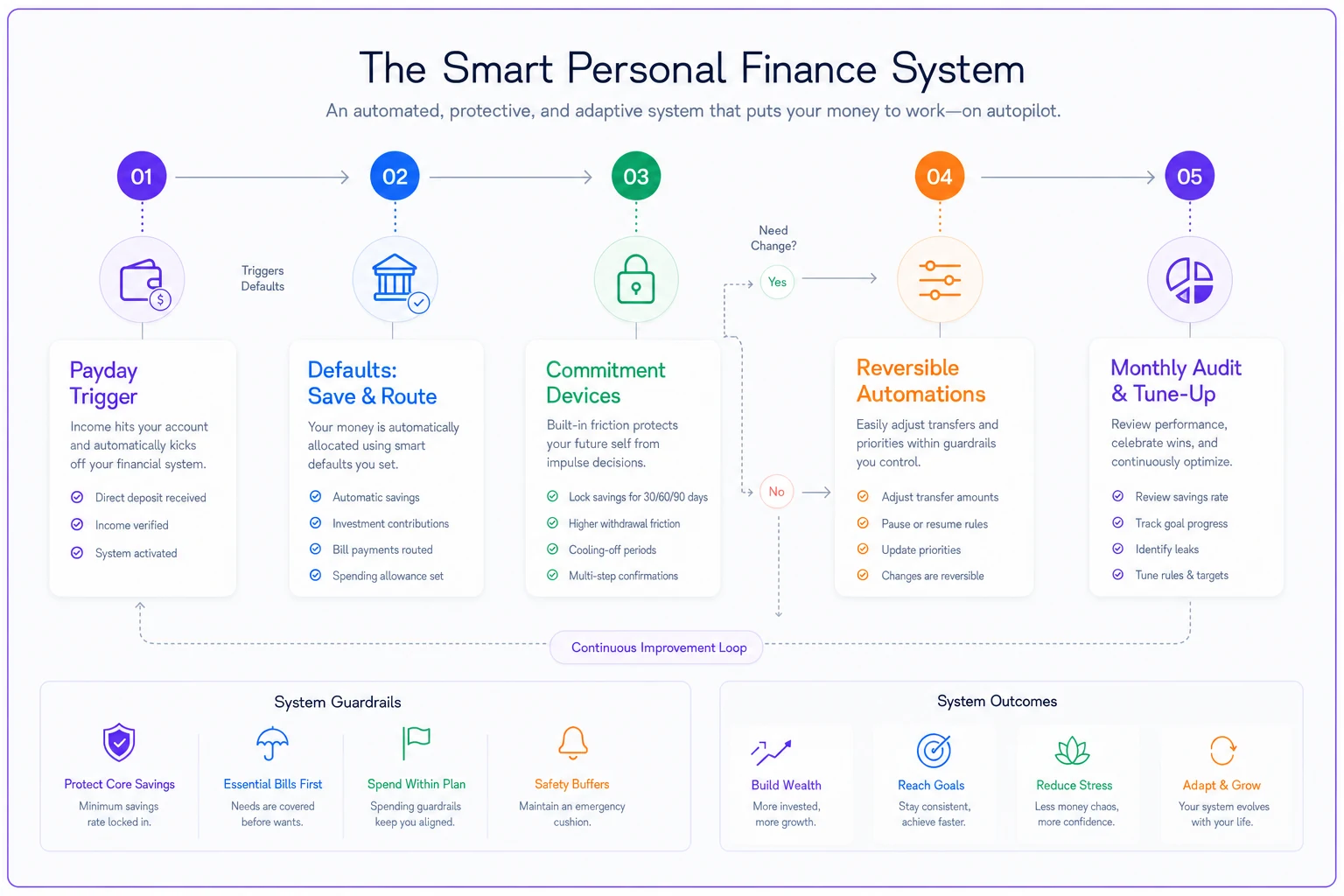
The failure points are predictable when any layer is missing:
-
No defaults → every decision is manual, and manual decisions erode under stress
-
No commitment devices → the defaults get overridden by impulse
-
No reversibility → one tight month kills the entire system
-
No audit → the system slowly drifts until it's optimizing for a life you no longer live
Most people who "can't stick to a budget" are running one or two of these layers and wondering why it keeps collapsing. It collapses because the missing layers are where the leaks and the panic live. The system only holds when all four are in place and reinforcing each other.
The monthly audit that keeps it all alive
Automations rot. Not dramatically — quietly. A subscription creeps back. A raise makes your old savings rate too conservative. A move changes your fixed costs. Without a review rhythm, your well-designed system slowly optimizes for a past version of your life.
The audit doesn't need to be long. Twenty to thirty minutes a month, same day each month, is enough. What matters is that it's a rule, not a mood. Put it on the calendar as a recurring event and treat it like a default of its own.
-
Check the guardrails held. Did any automation push you near an overdraft or leave too much idle cash sitting in checking? Adjust the floor or ceiling.
-
Reconcile actual vs. intended. Did money flow where you meant it to? Catch the transfer that silently failed or the one that fired twice.
-
Scan for new leaks. New recurring charges, creeping subscription costs, a category that quietly grew.
-
Re-check your rates against your income. After a raise or a rough patch, is your savings percentage still right? Bump it or throttle it deliberately.
-
Confirm goals still match reality. Did a goal complete, change, or become irrelevant? Redirect that flow instead of letting it pile up aimlessly.
-
Test one commitment device. Is any friction now too much (causing workarounds) or too little (not stopping the leak)? Tune it.
The audit is where you deliberately adjust so you never have to panic-adjust. People who skip the monthly check end up making emergency changes under stress — and stressed changes are almost always overcorrections. A calm monthly tune-up is what prevents the frantic teardown.
A real scenario
A mid-career freelancer with irregular income — some months around $4k, some closer to $9k — kept "failing" at saving. Her old setup was a fixed $1,000 monthly transfer. In good months it was fine. In lean months it overdrafted, she'd panic, cancel the transfer entirely, and forget to restart it. Over a year she saved maybe $2,300 despite earning well above that in slack.
The redesign kept the same intention but changed the structure. The fixed transfer became a percentage-based rule — around 20% of whatever landed that month — with a guardrail that kept a minimum floor in checking so it never overdrafted. Savings moved to a separate bank with a one-day transfer delay to kill impulse withdrawals. A small capped "fun" fund got funded automatically so she stopped raiding savings for wants. And she set a recurring 25-minute monthly review.
Nothing about the new plan required more willpower. But because it flexed with her income and never triggered an overdraft, she never disabled it. Over the next year she set aside somewhere north of $9k — not because she got more disciplined, but because the system stopped punishing her in lean months and stopped tempting her in flush ones. The behavior change came from the design, not from trying harder.
When this approach isn't the answer
Behavioral design fixes behavioral problems. It does not fix a genuine income-vs-expenses gap. If your fixed costs actually exceed your income, no amount of clever defaults or commitment devices will save you — that's a math problem, and it needs a different fix: raising income, cutting large fixed costs, or restructuring debt. Dressing up a shortfall with automations just hides it for a while.
It's also the wrong first move if you have no liquidity buffer at all. Locking money into commitment devices before you have any accessible cushion is how people end up borrowing at 24% APR to cover a car repair. Build a small accessible buffer first, then layer in the friction and the commitment devices. Sequence matters.
And if your income is deeply unpredictable — genuinely feast-or-famine — lean hard on the reversible and percentage-based side of this playbook and go light on rigid commitment devices. Flexibility keeps you solvent; rigidity forces overdrafts. Match the tool to your actual volatility, not to the tidy example in an article.
The bottom-line shift
The real move here isn't any single tactic. It's changing who does the work. Stop asking daily-you to be disciplined and start asking one-time-you to build an environment where good outcomes are the default and bad ones require effort. Set your defaults once. Add friction where the leaks are. Automate in a way you can tune instead of tear down. Review monthly so nothing rots.
Do that, and the question stops being "why can't I stick to my budget?" The budget sticks to you — quietly, in the background, on the days you're motivated and, more importantly, on all the days you're not.
Do that, and the question stops being "why can't I stick to my budget?" The budget sticks to you — quietly, in the background, on the days you're motivated and, more importantly, on all the days you're not.
Ready to master your money?
Join thousands of users leveraging Savioly to build smarter budgets, save more efficiently, and plan for a secure financial future.