



Most couples think their financial problems stem from not having enough money. After working with dozens of couples on household financial systems, the real issue is almost always coordination failure. One partner handles the bills, the other manages investments, nobody tracks the whole picture, and both feel like they're carrying the load alone.
The couples who successfully build wealth don't have higher incomes or better investment returns. They have operational systems that turn financial management from a source of conflict into a coordinated process. Think of it like running a small business where both partners are co-CEOs — without clear roles, regular meetings, and decision frameworks, even profitable businesses fail.
Why Traditional Budget Conversations Break Down
Traditional financial advice tells couples to "communicate about money" and "make a budget together." That's like telling a struggling restaurant to "cook better food" and "be nice to customers." The advice isn't wrong, it's just operationally useless without specific systems behind it.
What tends to happen: one Saturday morning you sit down with bank statements spread across the kitchen table. You argue about whether that Amazon purchase was necessary. Someone brings up a financial mistake from three years ago. Two hours later, you're both exhausted, nothing's resolved, and you avoid the topic for another six months.
The breakdown happens because couples try to solve governance problems with ad-hoc conversations instead of structured processes. You wouldn't run a business with random meetings whenever someone feels anxious. Household finances need that same operational rigor.
The Monthly Governance Meeting Structure
The first component of household financial governance is a structured monthly meeting. Not a budget review, not a spending interrogation — an operational meeting with a specific agenda and clear outcomes.
Take charge of your finances with clarity and confidence.
Savioly gives you real-time visibility and actionable steps to improve your money management.
- Automated expense tracking
- Goal-based saving plans
- Personalized financial insights
No credit card required
Standing Agenda Template:
Part 1: Dashboard Review (15 minutes)
-
Current account balances
-
Monthly spending vs. plan
-
Progress on annual goals
-
Upcoming large expenses
Part 2: Decision Queue (20 minutes)
-
Purchases requiring joint approval
-
Investment changes
-
Account adjustments
-
Service cancellations or additions
Part 3: Forward Planning (15 minutes)
-
Next month's unusual expenses
-
Quarterly goal check-in
-
Annual planning items
Part 4: Process Improvements (10 minutes)
-
What's working
-
What needs adjustment
-
System updates needed
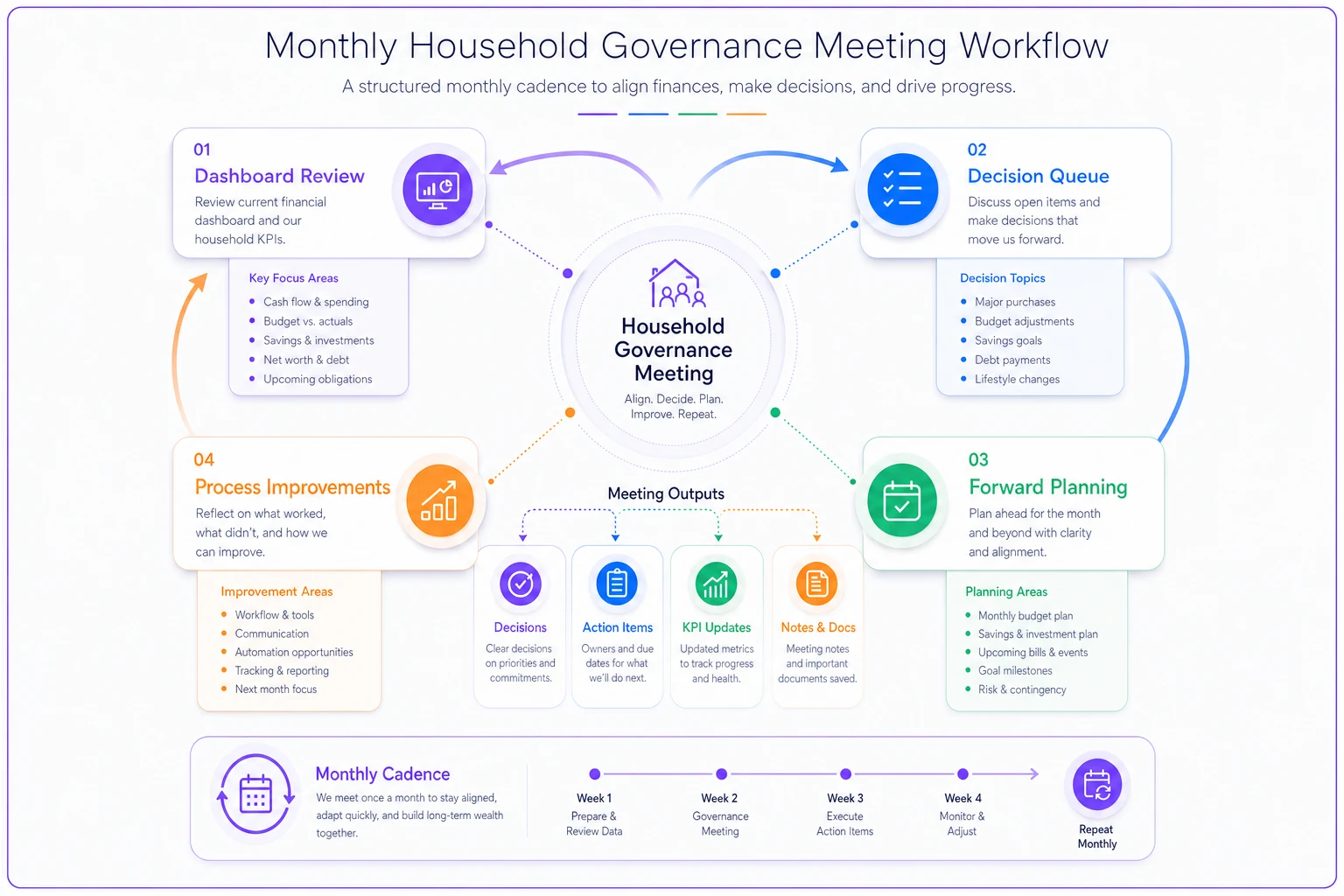
Consistency is what makes this work. Same time each month, same agenda structure, same duration. One couple scheduled theirs for the first Sunday morning of each month at 9am, right after coffee. They protect that time like a critical business meeting.
Keep a short "parking lot" note for items that need deep analysis so the meeting stays under an hour.
Keep the meeting under an hour. If something needs deeper discussion, schedule a separate working session. The monthly governance meeting is for decisions and alignment, not deep analysis.
Decision Ladders by Purchase Size
The second major breakdown in household finances is around spending decisions. Either every purchase becomes a negotiation, or one partner makes decisions the other resents. You need clear decision rights based on purchase size.
The Purchase Authority Framework:
| Amount Range | Decision Type | Process | Documentation |
|---|---|---|---|
| Under $100 | Individual discretion | No approval needed | Appears in monthly review |
| $100-$500 | Notify partner | Text/message before purchase | Note category in tracking |
| $500-$2,000 | Next meeting approval | Add to decision queue | Include reasoning in agenda |
| $2,000-$10,000 | Special meeting required | Schedule within 72 hours | Written pros/cons list |
| Over $10,000 | Full analysis process | Multi-meeting discussion | Formal decision document |
These thresholds aren't universal. Adjust them based on your household income. A couple earning $50k annually might lower all thresholds by half, while a $200k household might double them.
The key point: decision friction should match financial impact. A $50 purchase shouldn't require committee approval, but a $5,000 purchase shouldn't happen on impulse either.
The Account Titling Matrix
Account ownership creates more problems than most couples expect. Joint accounts seem simple until someone needs to act quickly and can't. Individual accounts can feel like trust issues. The solution is intentional titling based on what each account is actually for.
Operating Accounts:
-
Joint checking for household expenses
-
Individual checking for personal spending (funded monthly)
-
Joint savings for short-term goals
Investment Accounts:
-
Individual retirement accounts (IRAs) by definition
-
Joint taxable investment account for shared goals
-
Individual taxable accounts for personal investment strategies
Emergency Accounts:
-
Primary emergency fund
joint high-yield savings
-
Secondary emergency fund
individual accounts (smaller)
The personal spending accounts eliminate most money fights. Each partner gets a monthly allocation for discretionary spending — no questions asked, no judgment passed. One couple set theirs at $400 each per month. She bought craft supplies, he bought video games, nobody argued about "waste."
KPI Dashboard Templates
Running household finances without metrics is like driving with your eyes closed. But most financial dashboards track the wrong things, or just too many things. Five to seven KPIs that actually drive behavior is plenty.
Core Household KPIs:
-
Savings Rate = (Monthly Savings / Monthly Gross Income) × 100 - Target: 20% minimum - Review: Monthly
-
Expense Ratio = (Fixed Expenses / Monthly Net Income) × 100 - Target: Under 50% - Review: Monthly
-
Emergency Fund Months = Emergency Fund Balance / Monthly Expenses - Target: 6+ months - Review: Quarterly
-
Debt-to-Income Ratio = Total Debt Payments / Monthly Gross Income - Target: Under 36% - Review: Quarterly
-
Investment Growth Rate = Year-over-year portfolio change - Target: Beats inflation + 3% - Review: Quarterly
-
Goal Progress Percentage = Current Savings / Goal Amount - Target: On track for timeline - Review: Monthly
Track these on a simple spreadsheet or dashboard. Update them before each monthly meeting. The trend matters more than the absolute number — is your savings rate improving? Is your expense ratio dropping?
Monthly and Quarterly Rituals
Beyond the governance meeting, there are simple, repeatable operational rituals that prevent problems before they start. None of these are complex — they just need to be consistent.
Monthly Rituals:
First Weekend:
-
Governance meeting
-
Update KPI dashboard
-
Review and categorize last month's spending
-
Adjust next month's automated transfers
Mid-Month Check-in (15 minutes):
-
Quick account balance review
-
Flag any unusual expenses coming
-
Confirm all bills paid properly
Last Day of Month:
-
Download all statements
-
Quick scan for errors or fraud
-
Move excess from checking to savings
Quarterly Rituals:
Investment Review:
-
Rebalancing check
-
Fee analysis
-
Performance vs. benchmarks
-
Adjust automation rules if needed
Goal Calibration:
-
Progress against annual goals
-
Adjust targets if life changed
-
Update multi-year scenarios
-
Revise quarterly priorities
System Optimization:
-
What processes are breaking?
-
What decisions keep recurring?
-
Where are we losing time?
-
What needs automation?
Systematic rituals keep small problems from becoming big ones. The point is consistency, not perfection.
The Spending Category Framework
Most couples fail at budgeting because they use categories that don't match how they actually think about money. "Food" as a category mashes together groceries (necessary), restaurants (discretionary), and coffee shops (habitual). No wonder the numbers never make sense.
Instead, use decision-aligned categories:
Fixed Commitments (must pay):
-
Mortgage/rent
-
Insurance
-
Utilities
-
Debt minimums
-
Childcare
Variable Necessities (must buy, amount varies):
-
Groceries
-
Gas
-
Medical costs
-
Home maintenance
-
Pet care
Improvement Investments (future benefit):
-
Education
-
Health/fitness
-
Career development
-
Home improvements
Lifestyle Choices (conscious trade-offs):
-
Restaurants
-
Entertainment
-
Hobbies
-
Travel
-
Personal care
Individual Discretion (no questions asked):
-
Partner A personal
-
Partner B personal
This framework makes trade-offs visible. You're not cutting "food" — you're choosing between restaurants (lifestyle) and groceries (necessity). That's a much more honest conversation.
Conflict Resolution Protocols
Even with solid systems, financial conflicts come up. The difference between couples who handle them well and those who don't is having predetermined protocols instead of heated negotiations.
The 24-Hour Rule: Any financial decision causing disagreement gets tabled for 24 hours. No exceptions. This prevents emotional purchases and resentment-driven vetoes.
The Three-Option Framework:
-
Partner A's preference
-
Partner B's preference
-
A creative middle ground
Often the third option ends up being better than either original position.
The Veto System: Each partner gets two "financial vetoes" per year — absolute ability to stop a purchase or decision. Use them wisely. This prevents the feeling of being steamrolled while limiting endless blocking.
The Outside Opinion Protocol: For decisions over $10,000 where agreement seems impossible, bring in a neutral third party — financial advisor, trusted friend, or therapist. Sometimes an outside perspective is all it takes to break the deadlock.
Technology Stack for Household Operations
Manual tracking fails. Excel sheets get abandoned. The couples who succeed use technology to handle routine operations while they focus on decisions and planning.
The Basic Stack:
-
Account Aggregation
Personal Capital or Mint for real-time net worth
-
Expense Tracking
Credit card apps with category exports
-
Bill Management
Bank auto-pay for fixed expenses
-
Investment Tracking
Brokerage native apps
-
Document Storage
Google Drive folder with organized statements
The Advanced Stack:
For couples ready to level up, AI-powered operational software can genuinely change how you manage money together. These platforms don't just track spending — they identify patterns, flag unusual expenses before they become bigger problems, and automatically generate KPI dashboards ahead of your monthly meetings.
The more useful features are the ones that handle the tedious work: categorizing transactions, reconciling accounts, catching subscription creep, and flagging when a category is trending over budget mid-month. That way your monthly governance meeting stays focused on decisions, not data cleanup. It shifts the whole thing from reactive to proactive, which is where the real value is.
Annual Planning Sessions
Monthly meetings handle operations. Annual planning sessions set strategy. Block out half a day, go somewhere outside your house, and work through the big decisions.
Annual Planning Agenda:
Hour 1: Year in Review
-
What went well financially?
-
What created stress?
-
Which systems worked?
-
What goals did we hit or miss?
Hour 2: Goal Setting
-
Three-year vision
-
One-year targets
-
Quarterly milestones
-
Monthly KPIs
Hour 3: System Design
-
Decision threshold adjustments
-
Account structure changes
-
Automation updates
-
Process improvements
Hour 4: Implementation Planning
-
Who owns what?
-
What changes this month?
-
What technology do we need?
-
How do we track progress?
Annual planning turns operational improvements into multi-year strategy.
Real-World Implementation
A couple in Denver implemented this full governance system after fighting constantly about money despite earning around $165k combined. She felt he spent impulsively. He felt she was overly restrictive. They had roughly $12k in credit card debt despite their income.
They started with the monthly meeting structure. The first one was rough — two hours, some tears, a lot of blame. But they stuck to the agenda. By month three, meetings were running 45 minutes.
The purchase decision ladder eliminated most of the daily friction. He could buy video games under $100 without asking. She could buy plants without justification. Anything in the $500–$2,000 range went to the monthly meeting, which cut down on impulse purchases on both sides.
Their KPI dashboard revealed the actual problem: their expense ratio was sitting at 72%. Fixed costs were eating their income before they could save anything. They refinanced their car loans, cut three subscriptions, and negotiated lower insurance rates. Six months later, the expense ratio had dropped to 58%.
The individual discretionary accounts made the biggest difference personally. Each got $500 monthly to spend however they wanted — no judgment, no tracking, no discussion required. The money fights essentially stopped.
After one year, here's where they landed:
-
Credit cards paid off
-
Three-month emergency fund established
-
Savings rate increased to 18%
-
Monthly meetings down to 35 minutes
-
Zero fights about daily purchases
The money fights essentially stopped.
Common Implementation Mistakes
Couples typically make three mistakes when setting this up:
Starting Too Complex: Don't implement everything at once. Start with monthly meetings and decision ladders. Add KPIs in month two. Build from there.
Treating It Like Punishment: Governance isn't about restriction — it's about coordination. The individual discretionary accounts should feel like freedom, not an allowance.
Abandoning After Mistakes: You'll miss meetings. You'll break decision thresholds. You'll forget to update KPIs. That's normal. Systems need adjustment, not abandonment.
Making It Sustainable
Household financial governance only works if both partners actually buy in. This isn't one person imposing structure on another — it's two people building something together.
The monthly meeting should feel like planning a vacation, not visiting the principal's office. Order good coffee or pour wine. Make it pleasant. Some couples do theirs over brunch at their favorite spot.
Celebrate wins during the meeting. Hit your savings rate target? Say so. Stayed under budget in a tough category? Acknowledge it. Positive reinforcement drives behavior better than criticism every time.
And remember — the system serves you, not the other way around. If decision thresholds feel off, adjust them. If meetings are dragging, shorten them. If a KPI isn't driving any real behavior, swap it out for one that does.
Strong household financial governance doesn't mean rigid control or endless spreadsheets. It means clear systems that reduce friction, enable coordination, and align both partners toward shared goals.
The couples who build wealth together don't have perfect harmony or identical money values. They have operational systems that turn potential conflict into structured decision-making. Monthly meetings replace random money fights. Decision ladders eliminate daily negotiations. KPI dashboards give both partners something objective to look at. Start with the monthly meeting. Same time, same place, same agenda. Everything else builds from that foundation. Within six months, you'll wonder how you ever managed finances without it. The goal isn't perfection — it's progress through process. When both partners know their roles, understand the boundaries, and trust the system, household finances stop being a source of stress and start actually working.
Ready to master your money?
Join thousands of users leveraging Savioly to build smarter budgets, save more efficiently, and plan for a secure financial future.