
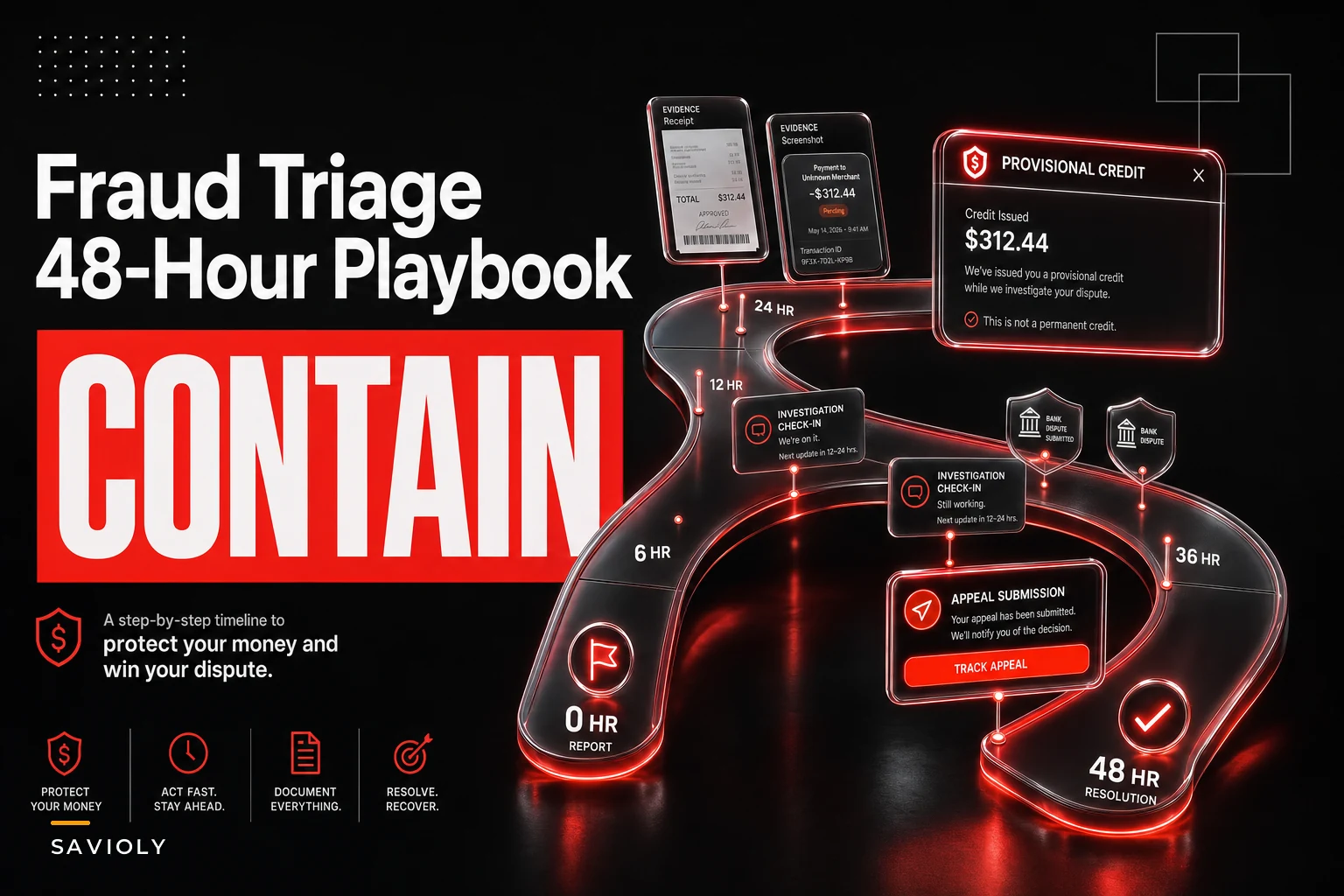

The window that matters most in payment fraud isn't the lawsuit or the dispute letter three weeks later. It's the first 48 hours. That's when banks make their fastest provisional-credit decisions, when fraudsters are still draining the card, and when the evidence you need is either captured cleanly or gone.
Most people lose money not because the fraud was sophisticated, but because they spent the first critical hours panicking, calling the wrong number, or screenshotting things in a way that doesn't hold up later. The dispute gets filed, denied on a technicality, and by the time they appeal, the trail is cold.
This is a timeline-based runbook — not a "what is fraud" explainer. You already know your card got hit. This is what to do, in order, with the exact evidence to capture and the cadence to follow with your bank. There's also a reconciliation habit at the end that catches the next one in week one instead of month three.
First, understand what the clock is actually counting down
The deadlines aren't arbitrary. Under Regulation E (debit cards and bank transfers), your maximum liability shifts based on how fast you report:
| When you report | Your maximum liability (debit/EFT) |
|---|---|
| Within 2 business days of learning | $50 |
| After 2 business days, within 60 days | Up to $500 |
| After 60 days of statement | Potentially unlimited |
Credit cards run under Regulation Z and cap liability at $50 regardless — and most issuers waive even that for fraud. This is the single biggest reason to route recurring and risky payments through a credit card rather than a debit card. The clock is far more forgiving.
The practical takeaway: debit fraud is a stopwatch, credit fraud is a calendar. If a fraudulent charge hits your checking account directly, you're on a 2-business-day sprint to stay under the $50 cap. That urgency should shape the order of everything below.
Hour 0 to Hour 2: Stop the bleeding
The instinct is to call the bank and start explaining everything. Don't lead with the story. Lead with containment.
Take charge of your finances with clarity and confidence.
Savioly gives you real-time visibility and actionable steps to improve your money management.
- Automated expense tracking
- Goal-based saving plans
- Personalized financial insights
No credit card required
-
Freeze or lock the affected card first. Most banking apps have an instant card-lock toggle. Use it before you're even on hold with anyone. This stops new charges while the old ones are still being investigated.
-
Check every account tied to that card or login. Fraud rarely stays in one lane. If your debit card was compromised, check linked savings, any account sharing the same password, and your payment apps — PayPal, Venmo, Cash App, Apple Pay.
-
Change the password and enable 2FA on the compromised account — but only after confirming your email itself isn't compromised. If the attacker owns your email, resetting the bank password just hands them the reset link. Secure email first.
-
Write down the exact time you discovered it. This timestamp becomes the anchor for your "within 2 business days" clock. In real disputes, the question "when did you first notice?" gets asked repeatedly, and a vague answer weakens your claim.
A pattern worth naming: people lock the card, feel relieved, and stop there. But a locked card doesn't reverse charges that already posted, and it doesn't protect the account number if the fraud came from a stored credential rather than the physical card. Containment means closing every door, not just the obvious one.
Hour 2 to Hour 6: Build the evidence before you call
The mistake that sinks more disputes than anything else — people call the bank, file verbally, and never document their own case. The bank opens a file. They don't. When the provisional credit gets reversed 45 days later with a one-line "transaction appears authorized," there's nothing to fight back with.
-
Full-screen screenshots of every suspect transaction showing amount, merchant name, date, and transaction/reference ID.
-
The running account balance at the moment you discovered the fraud.
-
Any texts or emails from the bank's fraud alerts — these corroborate the timeline.
-
The last legitimate transaction you recognize, so you can clearly mark where fraud starts.
-
If it's a merchant dispute rather than stolen-card fraud, save order confirmations, cancellation emails, and tracking numbers.
A reusable evidence template
Keep this as a plain note or spreadsheet row per incident. Filling in the blanks forces a clean, consistent story:
INCIDENT LOG — Payment Fraud Discovery date/time: How discovered: (alert / manual check / declined card / statement) Account & last 4: Card status: Locked at (time) DISPUTED TRANSACTIONS Date | Merchant | Amount | Ref/Trans ID | Reason (unauthorized / not received / duplicate) _ | | $ | | Last transaction I DO recognize: Total disputed amount: $ ACTIONS TAKEN [ ] Card locked [ ] Password changed (email secured first) [ ] 2FA enabled [ ] Linked accounts checked BANK CONTACT LOG Date/time | Rep name | Case/claim # | What was said | Promised follow-up date
The contact log at the bottom is what almost everyone skips and later wishes they had. Every call, every rep name, every claim number. When a dispute drags on, the person with a dated call log almost always gets better treatment than the person relying on memory.
Hour 6 to Hour 24: File formally and get it in writing
Now you call. With evidence staged, the call is short and precise instead of a rambling reconstruction.
-
State that you are reporting unauthorized transactions — use that exact phrase for Reg E/Z protection. "I don't recognize this charge" is weaker than "this charge was unauthorized."
-
Get a claim or case number and write it in your log immediately.
-
Ask directly
"Will I receive provisional credit, and by what date?" For debit disputes, Reg E generally requires provisional credit within 10 business days if the investigation runs long.
-
Ask whether they're reissuing the card and whether any recurring payments attached to it will now fail.
-
Request that they send written confirmation of the dispute. Verbal-only claims are where things quietly disappear.
That last point about recurring payments is a real-world gotcha. A reissued card number breaks every legitimate subscription and autopay tied to it. People fix the fraud, then get hit with late fees on their electric bill or insurance because those charges silently failed. Before you hang up, ask for the list of merchants with stored credentials on that card. If the bank can't provide it, you'll need to rebuild that list yourself — which is far easier if you already keep a clean inventory of recurring charges. If you don't have one, the approach in stopping subscription leakage with detection scans and a renewal cadence doubles as a ready-made list of exactly which autopays to re-point.
Hour 24 to Hour 48: Lock the perimeter and escalate if needed
With the dispute filed, day two is about preventing the next wave and tightening everything the fraudster might still reach.
-
Place a fraud alert with one credit bureau — it notifies all three, it's free, and it lasts a year. Do a full credit freeze if the compromise involved your SSN or you suspect identity theft rather than a one-off card skim.
-
Review your payment apps' linked funding sources. A compromised debit card attached to three wallet apps is three more attack surfaces.
-
Check for new accounts or address changes in your bank and bureau records — fraudsters sometimes change the mailing address first so replacement cards go to them.
-
If any transaction was a wire or ACH push (money you effectively "sent"), understand these are much harder to reverse than card charges. Call within hours and ask about a recall request — the success window is often less than 24 hours.
-
File an FTC report at IdentityTheft.gov if identity theft is involved. The generated report is an official document banks accept as evidence and it strengthens every downstream dispute.
When to escalate beyond the first rep
Front-line reps follow scripts. Escalation makes sense when:
-
The rep refuses provisional credit on a debit dispute inside the Reg E window.
-
You're told a clearly unauthorized charge is "authorized" with no explanation.
-
The 10-business-day provisional credit deadline passes with nothing posted.
In those cases, ask for the fraud/disputes department supervisor, reference the specific regulation, and — if still stuck — file a complaint with the CFPB. A pending CFPB complaint tends to accelerate internal review quickly, because the bank now has a regulator-facing deadline.
The dispute cadence after the first 48 hours
The sprint ends, but the case continues. Most disputes follow a predictable rhythm, and knowing it keeps you from either nagging uselessly or going silent at the wrong moment.
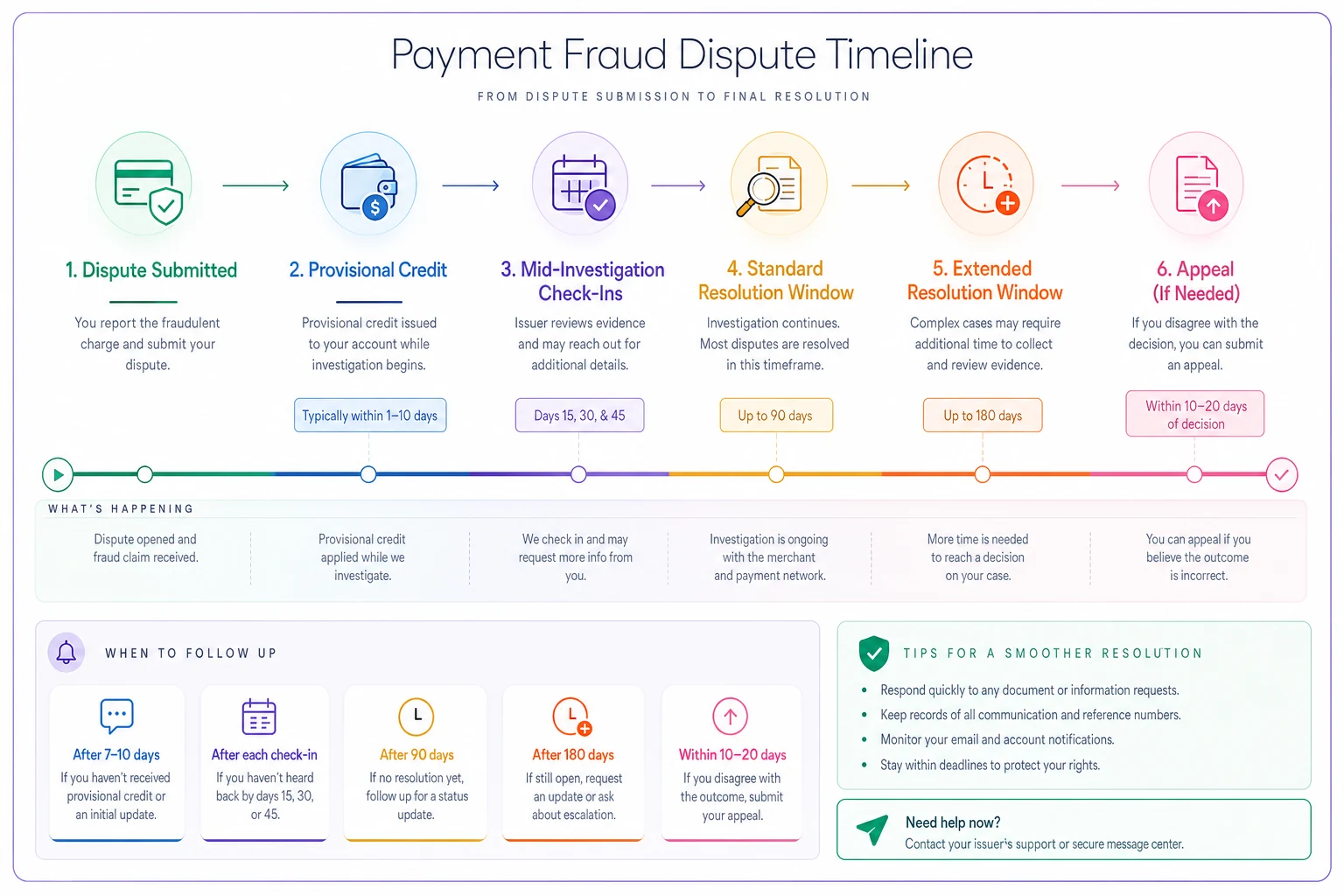
This visual maps the dispute workflow and key follow-up dates.
-
Days 1–10 Investigation opens; provisional credit should appear on debit. Mark the expected date in your log.
-
Day 10–15 If no provisional credit, call and reference the timeline. This is a scheduled check-in, not a random one.
-
Days 30–45 Banks typically resolve standard disputes here; complex ones can run to 90 days. Watch for a reversal of provisional credit — that means they're leaning toward denying, and it's your cue to submit additional evidence immediately.
-
On denial You have the right to request the documents the bank used to make its decision. Get that request in writing. Many denials are built on thin merchant responses that fall apart once you rebut them with your evidence template.
-
Appeal window Resubmit with your incident log, screenshots, and the FTC report. A clean, dated, organized packet wins appeals that a frustrated email never would.
The behavioral trap here is "set and forget." People file, get provisional credit, assume it's resolved, and don't notice the quiet reversal six weeks later. Put each check-in date on your calendar the same day you file. The dispute runs on their clock, but the follow-up runs on yours.
A real scenario
A freelance designer runs most of her spending through one debit card tied to her checking account. She notices three charges to a gaming platform she's never used — roughly $240, $310, and a pending $600 — spread across a Saturday night.
Because it's a weekend, her "2 business day" clock effectively starts Monday. She locks the card at 11 p.m. Saturday, screenshots all three charges with their reference IDs, and notes her balance. She checks her email first (it doesn't share a password with anything, fortunately), then resets her bank login. Sunday she checks two linked wallet apps and finds the same card loaded in both — she removes it from both.
Monday morning she calls, uses the phrase "unauthorized transactions," gets a claim number and a promise of provisional credit within 10 business days, and asks for the list of merchants with stored credentials so her rent autopay doesn't bounce. The pending $600 never posts because the card was already locked. Provisional credit for the $550 in posted charges lands on day 8.
Around day 40, the provisional credit on the $310 charge reverses — the merchant claimed the login was legitimate. She pulls her incident log, resubmits screenshots showing the charges came minutes apart from a platform she'd never touched, attaches her IdentityTheft.gov report, and references the original claim number. Credit is restored about two weeks later. Total out of pocket: $0. Total time: maybe three hours spread across two weeks — almost all of it saved by the first-night documentation.
The contrast case is the person who does everything the same except skips the evidence capture. When the $310 reverses, they have nothing to resubmit. The denial stands.
The reconciliation habit that catches the next one in week one
Triage is damage control. The real win is catching fraud at charge two instead of charge twelve. That's a reconciliation problem, and it's entirely about cadence.
A lightweight weekly routine:
-
Once a week, scan every transaction on every active card and account. Not categorize — just recognize. Any charge you can't instantly place gets flagged.
-
Investigate micro-charges you don't recognize. A mysterious $1.04 is not nothing; it's often reconnaissance.
-
Keep a running list of your legitimate recurring charges so anomalies stand out immediately. The faster you can say "that's not mine," the faster the clock works in your favor.
-
Reconcile across accounts, not just one. Fraud that starts on a card often shows up as a login attempt elsewhere within the same window.
-
Log any flagged item in your incident template immediately, even before you're sure it's fraud. If it turns out to be fraud, your clock already started with evidence attached.
This is where a clean expense taxonomy pays off beyond budgeting. When your transactions are already sorted into recognizable buckets, a rogue charge stands out immediately. The same structure described in building expense categories that actually change behavior makes weekly fraud scanning take five minutes instead of thirty, because you're reviewing against a baseline you already understand.
Keep a running list of your legitimate recurring charges so anomalies stand out immediately.
When weekly is overkill — and when it isn't
If you run almost everything through one or two credit cards with strong real-time alerts enabled, the alerts effectively are your reconciliation, and a lighter monthly review may be enough. The weekly scan earns its keep when you use debit cards for regular spending (shorter liability clock), juggle several accounts, or have experienced a compromise before. Fraudsters often resell card data, so a previously hit card is statistically more likely to be targeted again.
Bottom of the clock
Payment fraud recovery isn't about being clever. It's about sequence and documentation. Contain first, document second, file third — and keep a dated log so follow-up runs on your schedule instead of fading into a stack of forgotten claim numbers.
The people who get fully reimbursed aren't luckier. They locked the card before telling the story, screenshotted the charges before they re-sorted, and wrote down the claim number before hanging up. Build a habit of a weekly scan across your accounts, and most of the next incident is already handled before it ever reaches a dispute.
Ready to master your money?
Join thousands of users leveraging Savioly to build smarter budgets, save more efficiently, and plan for a secure financial future.