
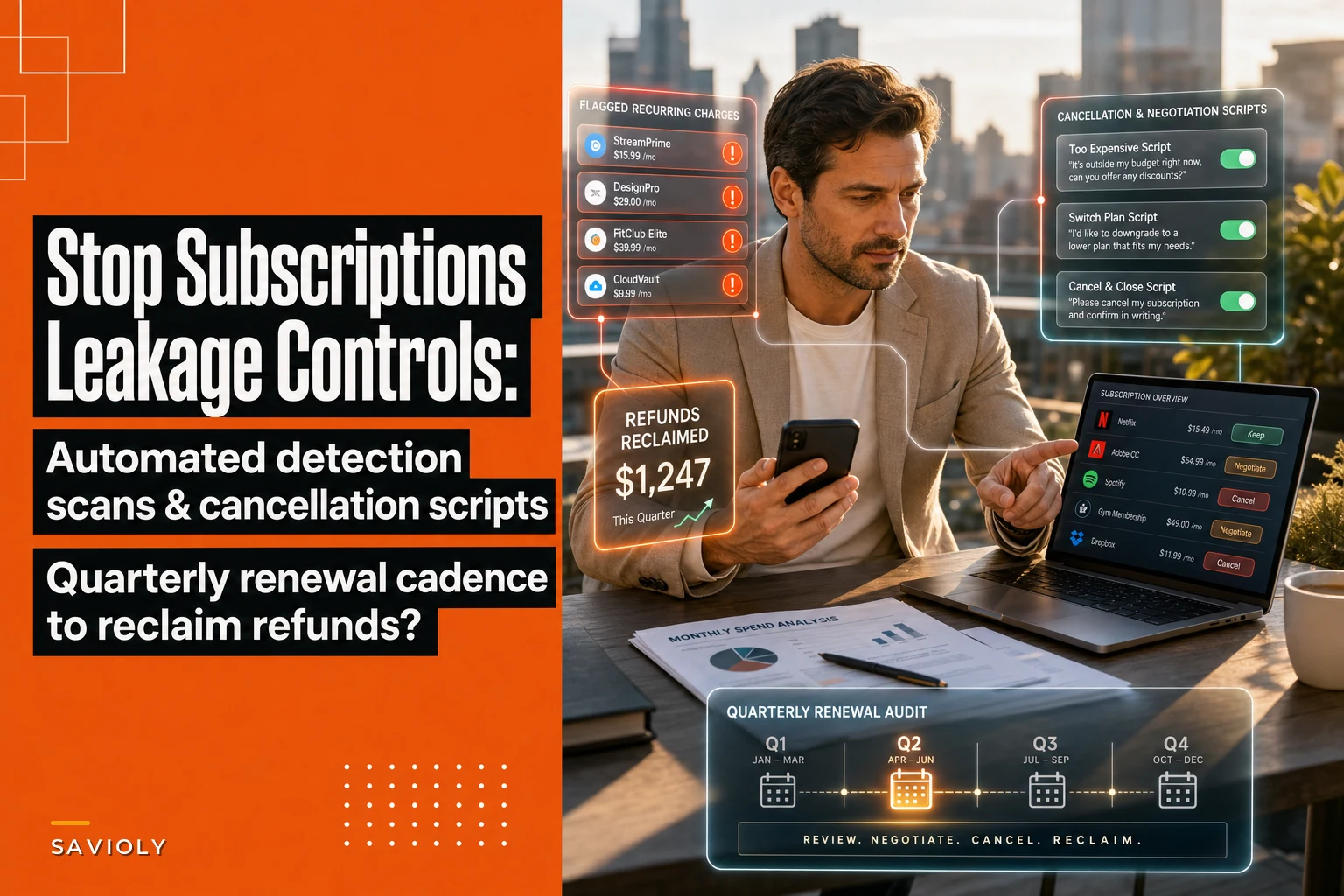

Subscription creep happens gradually. You sign up for a meditation app during a stressful week. Add a meal planning service when you're trying to eat healthier. Subscribe to three different streaming platforms because each one has that specific show you want to watch. Before you realize it, you're bleeding $400+ a month on services you barely touch.
The average person underestimates their monthly subscriptions by roughly 2.5x. Think you're spending $80? It's probably closer to $200. Most people discover forgotten subscriptions months after they stopped using them—Paramount+ from that football season, Adobe Creative Cloud from a one-off design project, multiple cloud storage services all backing up the same photos.
What makes subscription leakage so persistent is how companies design their billing. They know you'll forget. Annual subscriptions renew right when you're focused on something else. Free trials convert during busy weeks. Price increases slip through in emails you don't read. The whole system is built on your inattention.
Why traditional expense tracking misses subscription waste
Looking at your bank statement once a month doesn't catch subscription problems. By the time you see the charge, it's already processed. And next month, when that same charge appears again, your brain registers it as normal—just another recurring expense that must be necessary.
Subscription companies have gotten sophisticated about hiding in plain sight. Vague merchant names that don't match the service. Multiple services bundled under one charge. Payments processed at odd times of the month when you're less likely to notice. Some even break annual fees into monthly installments that feel smaller than the total cost.
The psychology works against you. Once a subscription becomes "normal" on your statement, your brain stops questioning it. That $15.99 charge from "TECH-SERV-MONTHLY" could be anything—cloud storage, password manager, VPN, some productivity app you downloaded six months ago. Without actively investigating each charge, zombie subscriptions live on indefinitely.
Manual tracking in spreadsheets sounds logical but rarely survives contact with real life. You'll maintain it for two or three months, then things get busy. The spreadsheet becomes another abandoned project while subscriptions keep processing in the background.
Building your subscription leakage playbook
Start with a comprehensive audit, but not the way most people do it. Don't just list current subscriptions—that approach misses the point. Instead, create what I'd call a "value timestamp" for each service.
Take charge of your finances with clarity and confidence.
Savioly gives you real-time visibility and actionable steps to improve your money management.
- Automated expense tracking
- Goal-based saving plans
- Personalized financial insights
No credit card required
Pull your last three months of statements. For every recurring charge, write down the last time you actually used that service. Not when you plan to use it—when you actually did. Netflix might process monthly, but if you haven't watched anything since that one series ended two months ago, that's your timestamp.
Then calculate your per-use cost. That $79 annual password manager you open every day? Roughly 22 cents per session—probably worth keeping. The $29 monthly language app you opened twice in three months? You just paid $14.50 per visit. This reality check immediately shows which subscriptions deserve to stay.
The quarterly renewal calendar system
Q1 (January-March): Entertainment and streaming services Right after the holidays when you're already thinking about spending habits. This is when most people naturally reassess entertainment expenses.
Q2 (April-June): Professional and productivity tools Tax season just wrapped, you're already thinking about what counts as a business expense. Good time to evaluate work-related subscriptions.
Q3 (July-September): Health, fitness, and lifestyle services Mid-year check on those New Year's resolutions. Are you actually using that meditation app? The meal delivery service?
Q4 (October-December): Shopping, memberships, and annual services Before Black Friday and holiday spending ramp up, clear out the subscription bloat. This also catches annual renewals that like to hide in November and December.
Set calendar reminders two weeks before each category's review date. That buffer gives you actual time to cancel or negotiate—not just think about it.
A simple quarterly-review workflow:
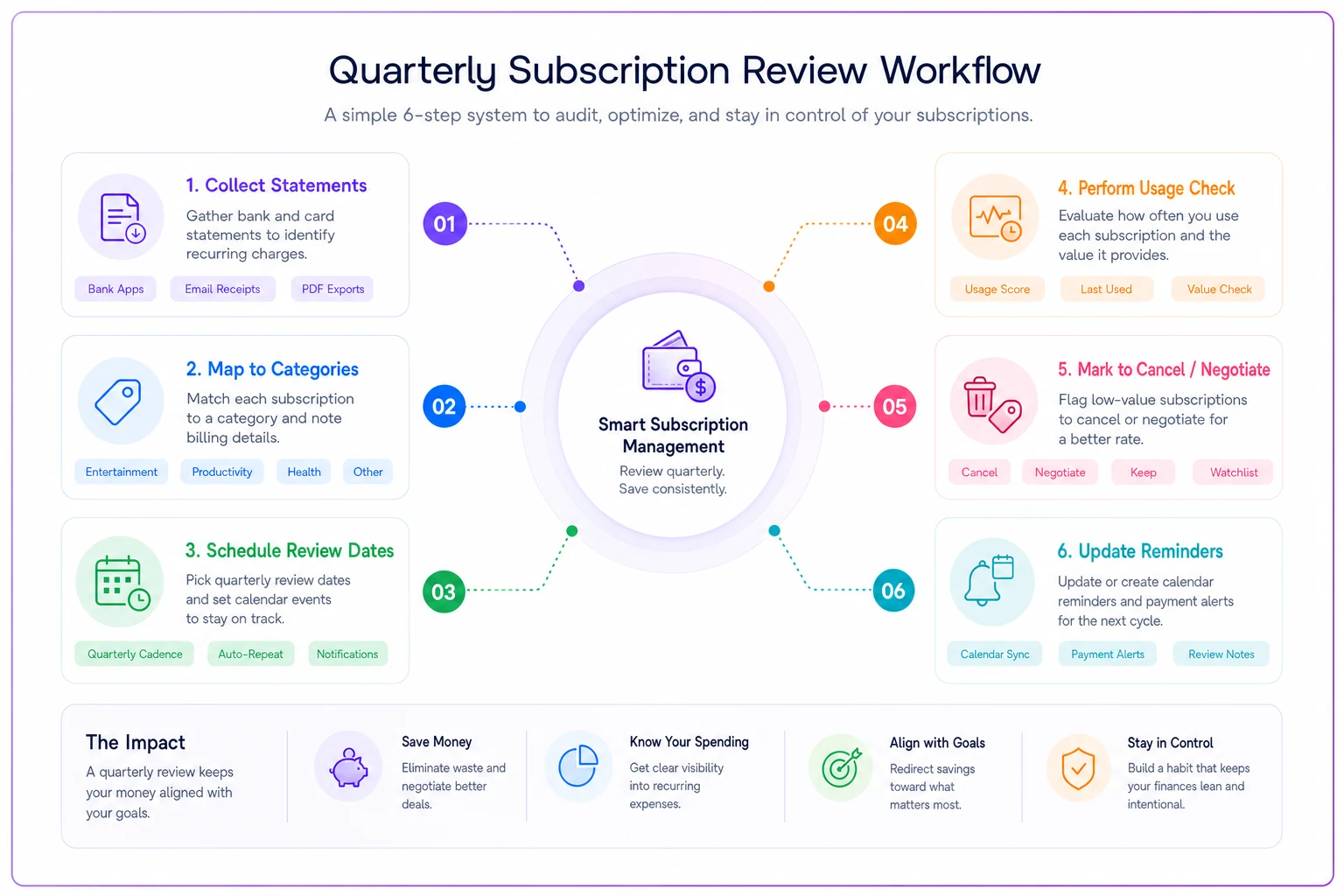
This keeps reviews timely and actionable.
Detection methods that actually work
Skip the subscription tracking apps that require manual entry. If you were organized enough to maintain those consistently, you probably wouldn't have a subscription leakage problem in the first place. You need detection that runs automatically.
Most banks now offer spending insights that categorize recurring charges. Turn on notifications for any new recurring charge detected. You'll get occasional false positives from regular coffee shop visits, but you'll catch new subscriptions immediately instead of months later.
For deeper detection, use your email as a subscription radar. Create a filter for keywords like "renewal," "subscription," "recurring," "membership," and "auto-renew." Route these to a dedicated folder you check weekly. Companies are legally required to notify you about renewals and price changes—they're just counting on those emails getting buried.
The nuclear option: once per quarter, report your credit card lost and get a new number. Every subscription you actually care about will email you when payment fails. The ones you don't hear from? Services you forgot existed. Let them die. It sounds extreme, but it's surprisingly effective for people with serious subscription creep.
The cancellation script bank
What most people don't realize about canceling subscriptions is that companies train retention teams specifically to save you at predictable psychological moments. They know when you're most likely to back down. Having scripts ready removes their advantage.
For immediate cancellations:
"I need to cancel effective immediately due to financial constraints. Please process this now and confirm the cancellation in writing."
For services pushing a discount to keep you:
"I appreciate the offer, but I need to cancel regardless of price. Please process the cancellation."
For annual subscriptions mid-cycle:
"I need to cancel and request a prorated refund for the unused portion of my subscription, which totals [X months]. According to your terms of service, refunds are available when [cite their specific policy]."
For negotiating better rates on services you want to keep:
"I've been a customer for [X time] but I'm reviewing all my subscriptions. I need to either reduce this to [$X] per month or cancel. What options do you have?"
Give them a specific number. This stops the slow inch-down negotiation tactic. Roughly 60% of the time, they'll match or get close to your number if it's at all reasonable.
Timing tactics for maximum recovery
Subscription companies hope you'll cancel right after you notice the charge—usually the same day it processes. That's the worst possible timing. The money's already gone, and you'll rarely get a refund.
Instead, track your renewal dates and set cancellation reminders for day 20 of your billing cycle. You still get most of the month's value, and cancellation processes before the next charge hits. For annual subscriptions, set the reminder 45 days out—enough buffer for retention offers and any back-and-forth.
Price increase notifications, usually sent 30 days before the change kicks in, are a golden window. Companies expect some churn from increases, so retention teams have more flexibility during that period. You can often lock in your old rate for another year just by calling and mentioning you're considering leaving because of the increase.
The best negotiation leverage also tends to come right before major shopping seasons. Call streaming services in early November before Black Friday deals. Contact software subscriptions in late August before back-to-school promotions start. Companies would rather retain you at a discount than lose you right before a competitor's promotional push.
Subscription categories that drain the most
Certain categories create the most leakage, consistently:
| Category | Why It Leaks | Common Example |
|---|---|---|
| Streaming services | Subscribe for one show, forget to cancel | 4–5 active, only 2 used regularly |
| Free trial conversions | Auto-convert without reminders | Most people forget they signed up |
| Professional tools | Tied to one project or previous job | Design software, PM tools, publications |
| Storage and backup | Multiple services backing up the same files | iCloud + Google One + Dropbox simultaneously |
| Fitness and wellness | Aspiration-driven stack | Meditation, sleep, nutrition, running apps |
Storage and backup is an underrated one. Paying for iCloud, Google One, Dropbox, and OneDrive simultaneously while they all back up the same files is more common than people admit. Professional tools are similar—design software from one project, a project management tool from a previous job, an industry publication you meant to read. They feel like career investments, so they survive longer than they should.
The proactive maintenance routine
Once you've cleaned up existing subscriptions, keeping future leakage in check is a simpler routine than people expect. This isn't about building complex expense categories—it's about catching subscriptions before they become zombies.
-
Check your designated email folder for renewal notifications
-
Review any new recurring charges your bank flagged
-
Open every subscription app on your phone (if the icon feels unfamiliar, it's probably time to cancel)
-
Update your quarterly renewal calendar with any new services added
If multiple household members sign up for services, make the subscription manager the billing contact so renewal notices land in one inbox.
This takes less time than a coffee run but saves hundreds annually. The key is actually doing it consistently—mark it as a recurring task wherever you track habits.
For couples or families sharing subscriptions, designate one person as the subscription manager. When multiple people randomly sign up for services, expensive duplicates pile up fast. That person tracks all household subscriptions and handles the monthly review. Yes, that includes the kids' gaming subscriptions and your partner's random monthly box services.
When subscription management software actually helps
Most people don't need dedicated subscription tracking software—that's just another subscription to manage. But AI-powered financial platforms that handle broader financial workflows can catch subscription issues automatically, which is a different value proposition entirely.
These platforms scan transactions and flag unusual patterns—spotting when you're paying for overlapping services, when prices increased unexpectedly, or when you're actively paying for something you haven't touched in months. Passive detection like this works better than active tracking because it doesn't require your constant attention to function.
The automation helps most with timing. Instead of manually tracking renewal dates across a dozen services, these platforms can monitor for optimal cancellation windows and surface them when they actually matter. That removes the friction that keeps zombie subscriptions alive month after month.
Some platforms now connect subscription management to broader expense optimization—identifying not just what you're paying for, but whether you're on the right plan tier based on actual usage patterns. That kind of intelligent automation is the difference between a one-time cleanup and maintaining long-term control over recurring expenses.
Building your implementation checklist
Start this weekend. Not next month when things calm down—they won't. Here's the immediate action plan:
Hour 1: Detection and mapping
-
Pull three months of statements
-
List every recurring charge
-
Note last actual usage date for each
-
Calculate per-use cost
Hour 2: Strategic cancellations
-
Cancel anything unused for 60+ days
-
Cancel duplicate services immediately
-
Schedule cancellations for poor-value services before next renewal
Hour 3: Calendar and systems
-
Build your quarterly renewal calendar
-
Set up email filters for subscription notifications
-
Create a monthly reminder for subscription review
-
Save cancellation scripts somewhere accessible
Week 2: Negotiations and optimizations
-
Call your three most expensive services and negotiate
-
Downgrade any plans you're clearly overusing
-
Consolidate duplicates to single providers
Month 2: Maintenance mode
-
Complete your first monthly review
-
Refine detection methods based on what slipped through
-
Adjust calendar timing based on actual renewal patterns
Start this weekend. Not next month when things calm down—they won't. Here's the immediate action plan:
The real math behind subscription leakage
The median person spends around $270 monthly on subscriptions but estimates they spend closer to $110. That gap is pure leakage—money disappearing without any real value in return.
Over five years, that adds up to somewhere around $9,500 to $10,000. That's before factoring in the psychological weight of financial clutter or what that money could have done compounding somewhere else.
The number that actually matters: after implementing a proper subscription leakage playbook, most people reduce subscription spending by 35 to 40% while keeping every service they actually value. You're not living with less—you're paying for only what you use.
The quarterly renewal calendar alone typically saves $600 to $800 annually just from better timing of cancellations and negotiations. Detection scanning catches another few hundred in zombie subscriptions. Add negotiation scripts and the average person recovers somewhere between $1,400 and $2,000 annually from subscription leakage alone.
Moving forward
Subscription leakage isn't a moral failing or a sign of financial irresponsibility. It's an engineered outcome that companies invest heavily to create. Your attention is finite; their retention departments are not.
The playbook above flips that dynamic. With systematic detection, scheduled reviews, and prepared scripts, you're no longer playing defense against subscription creep—you're managing recurring expenses with the same deliberateness companies use to extract them.
Start with the comprehensive audit this weekend. Build the quarterly calendar. Set up detection. Save the cancellation scripts. Within 30 days, you'll have cut subscription fat while keeping everything that actually provides value.
The goal isn't to cancel everything—it's to make sure every subscription dollar is actually earning its place. The meditation app you open daily, the password manager protecting your accounts, the streaming service the whole family uses—those earn their spot. The dusty language learning app, the forgotten cloud backup, the premium tier you never needed—those don't.
Open your banking app right now, find one subscription you haven't used in the last 30 days, and cancel it.
Ready to master your money?
Join thousands of users leveraging Savioly to build smarter budgets, save more efficiently, and plan for a secure financial future.