

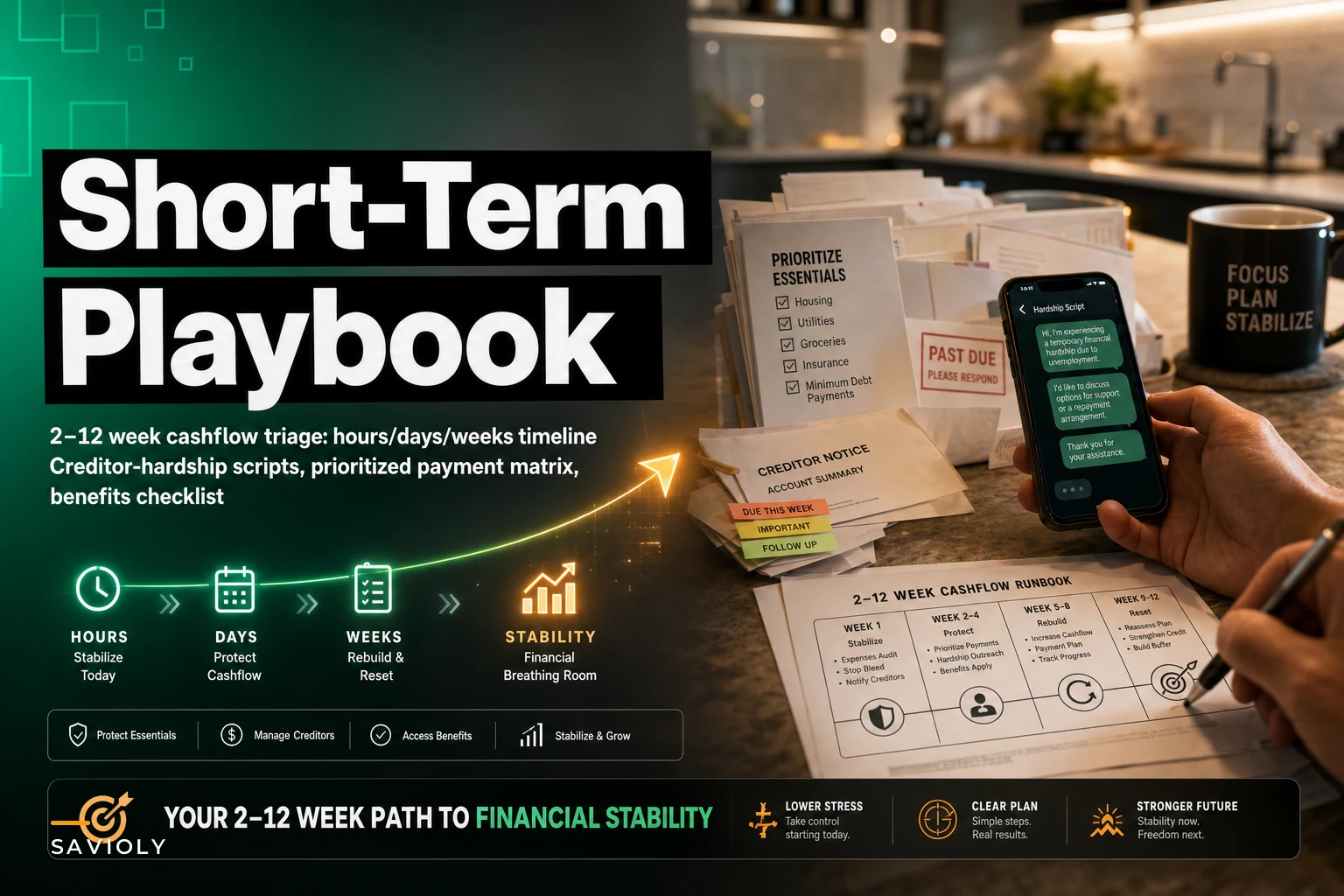

Losing income for two to twelve weeks is a fundamentally different problem than long-term unemployment, and treating it like one is where most people go wrong. The multi-year runway thinking — rebuilding your career, restructuring your whole budget, maybe relocating — doesn't apply here. You're not planning a new life. You're bridging a gap.
That distinction changes everything about how you move. When the gap is short, the costly mistakes aren't strategic. They're panic decisions made in week one: draining the account that was supposed to cover rent, paying the wrong creditor first because they called the loudest, or quietly skipping a bill that quietly triggers a chain reaction.
This runbook is scoped to that specific window. A severance gap, a contract ending between gigs, a layoff with a known rehire date, an unpaid medical leave that's temporary. Something with an end in sight, even a rough one.
The clock you're actually on
Before touching a single bill, figure out your real timeline. Not "I'll probably find something in a month" — the actual number of weeks your current cash covers your non-negotiable spending.
The math is blunt. Take your liquid cash (checking, savings, anything you can access without penalty), subtract anything already committed to bills clearing in the next few days, and divide by your weekly bare-minimum burn.
A typical example: someone with roughly $6,800 accessible and a stripped-down weekly burn of about $850 has eight weeks. Not "a couple months." Eight weeks, with a date on the calendar. That matters because eight weeks of runway means you can negotiate from a position of modest strength. Three weeks means you're triaging immediately.
This is where people lie to themselves. They calculate burn based on normal spending, not survival spending. Your survival number excludes everything you'd cut if things got bad — because things are bad. If you've already built a sustainable run-rate for irregular income, you're ahead; if not, the mechanics of calculating a bare-minimum run-rate and allocating buckets are worth reading before you go further.
Hours / Days / Weeks framing:
-
First 24 hours Stop all discretionary outflows. Pause automatic transfers to investments and non-essential savings. Confirm what's clearing in the next 72 hours.
-
First week File for benefits (more below), inventory every recurring charge, and build your payment matrix.
-
Weeks 2–12 Execute the matrix, send hardship requests where needed, and recheck your timeline weekly.
A typical example: someone with roughly $6,800 accessible and a stripped-down weekly burn of about $850 has eight weeks. Not "a couple months." Eight weeks, with a date on the calendar. That matters because eight weeks of runway means you can negotiate from a position of modest strength. Three weeks means you're triaging immediately.
The prioritized payment matrix
Most "budget during unemployment" advice tells you to cut expenses but never tells you which bills to keep paying when you can't cover all of them. That ordering is the whole game.
Take charge of your finances with clarity and confidence.
Savioly gives you real-time visibility and actionable steps to improve your money management.
- Automated expense tracking
- Goal-based saving plans
- Personalized financial insights
No credit card required
Not all missed payments are equal. Missing a credit card payment and missing your car payment produce wildly different outcomes, and the consequences arrive on different timelines. Prioritize by two factors: how fast the consequence hits and how badly it hurts.
| Priority | Bill type | Why it ranks here | Consequence if skipped |
|---|---|---|---|
| 1 | Housing (rent/mortgage) | Hardest to recover from, slow to unwind | Eviction/foreclosure process, but usually weeks of runway before filing |
| 2 | Utilities you can't live without | Shutoff timelines vary, some have winter moratoriums | Service loss, reconnection fees |
| 3 | Car payment (if needed for work) | Repossession can be fast — sometimes 30–60 days | Lose the asset you need to earn again |
| 4 | Insurance (health, auto) | A lapse exposes you to catastrophic risk | One accident or illness wipes out everything |
| 5 | Minimum credit card payments | Hurts credit, but slowly | 30-day late marks start after a full cycle missed |
| 6 | Unsecured personal loans / BNPL | Flexible, often negotiable | Late fees, collections eventually |
The non-obvious insight: secured debt outranks unsecured debt almost every time, even when the unsecured balance is larger and the collector is louder. A credit card company yelling at you can't take anything physical. A repo agent can take the car you need to get to your next job.
Second thing worth knowing — credit card lateness has a grace window baked in. A payment isn't reported to the bureaus as late until it's 30 days past due. So if you're genuinely tight in week one, the minimum card payment is one of the safer things to push by a couple weeks while you sort out higher-priority items. Don't make a habit of it, but in a triage situation it buys room.
File for everything in the first week — in the right order
Benefits and insurance checks are where short-gap people leave the most money on the table, usually because they assume they won't qualify or it feels like too much effort for a few weeks of coverage.
Run these as a sequence:
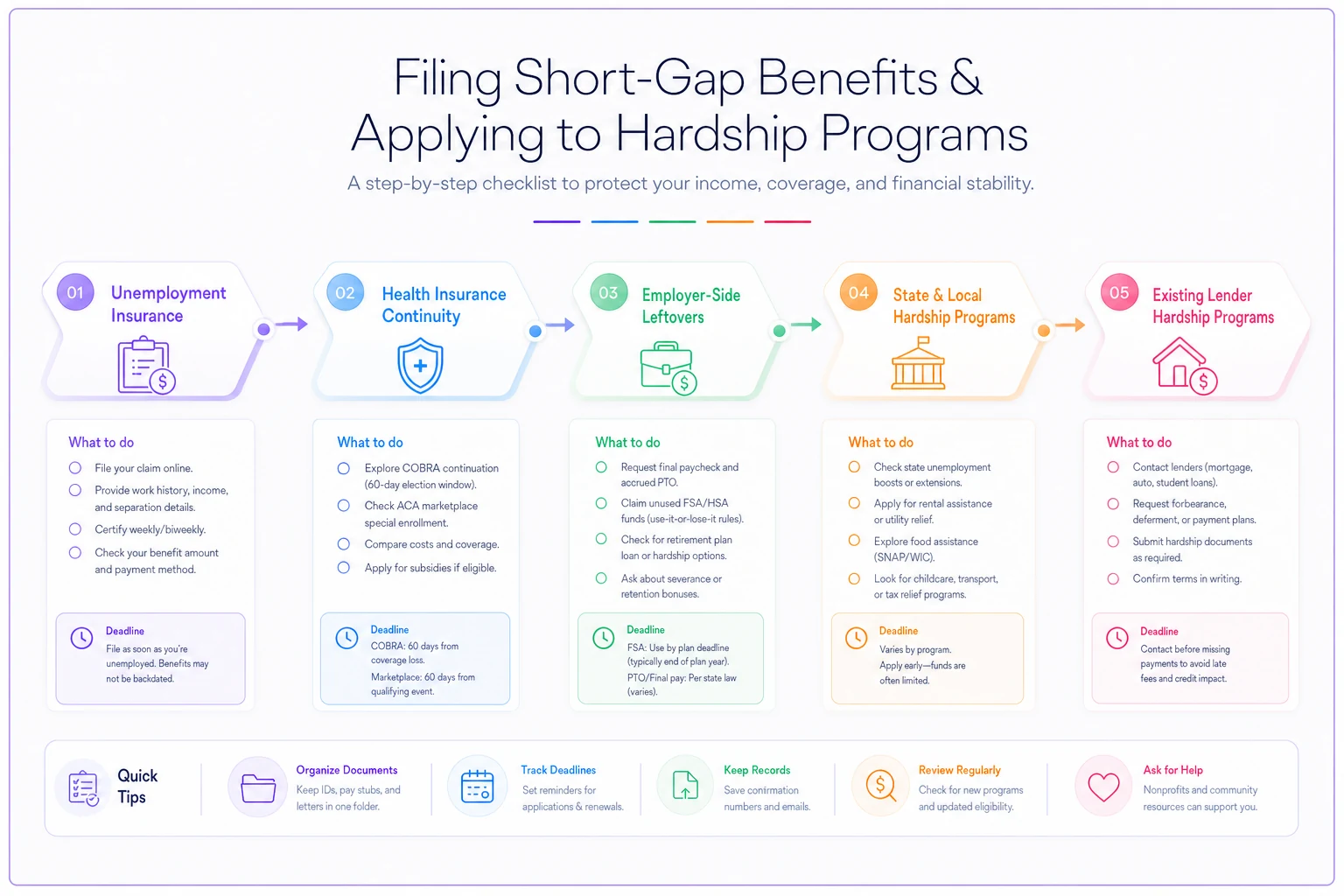
This visual shows the recommended filing order and the idea that some enrollments start waiting periods when you file.
-
Unemployment insurance. File the week you stop working, even if a rehire is coming. Many states have a waiting week, so delaying filing just delays your first check. Reduced-hours situations sometimes qualify for partial benefits — check even if you weren't fully let go.
-
Health insurance continuity. If you lost employer coverage, you have a limited special-enrollment window. Compare COBRA against a marketplace plan — for a short gap, a marketplace plan with a subsidy is often dramatically cheaper, since COBRA charges you the full unsubsidized premium.
-
Employer-side leftovers. Unused PTO payout, final paycheck timing, any pending reimbursements. Easy to forget, worth chasing.
-
State and local hardship programs. Utility assistance, rental relief, emergency funds — they exist in most areas and are chronically underused. The application friction is real, but a few forms can cover a utility cycle.
-
Existing lender hardship programs. Many auto lenders, mortgage servicers, and card issuers have formal deferral or forbearance options that don't surface unless you ask by name.
Most of these have enrollment windows or waiting periods that only start when you file. Every day you wait "until things are clearer" is a day the clock doesn't start.
Creditor hardship scripts that actually land
The mistake people make when calling creditors is leading with apology and vague desperation. Collectors deal with vague desperation all day. What works is being specific, naming the program you want, and giving a concrete end date.
For a card issuer (requesting a short hardship or deferral):
> "I've had a temporary loss of income and I expect it to last about [X] weeks. I want to stay current and avoid falling behind. Do you have a hardship program that can defer my minimum payment or lower it for one or two cycles? I can resume full payments by [date]."
Key phrases: temporary, specific duration, I want to stay current, concrete resume date. You're signaling you're a recoverable account, not a write-off.
For an auto lender (requesting a payment extension):
> "I need to avoid any risk of falling behind on this loan. Can I move one payment to the end of the loan term — a payment extension or deferral? My situation should resolve by [date]."
For a utility (requesting a payment arrangement):
> "I can't pay the full balance this cycle but I don't want service interrupted. What payment arrangement can we set up, and does that protect me from shutoff while I'm on the plan?"
Two things that improve your odds across all of these: ask early — before you're already late, not after — and get the agreement in writing. An email confirmation or reference number. A verbal "we'll note your account" evaporates when a different rep picks up next time.
Ask early — before you're late — and get the agreement in writing.
When to actually call vs. when to just pay late
Not every bill needs a phone call. Calling a creditor creates a record and sometimes a note that affects future offers. If you can cover a bill within the 30-day window anyway, skip the call. Reserve hardship conversations for bills where a missed payment causes real, fast damage — secured debt and anything with a short shutoff or repossession timeline.
A real scenario
A contract graphic designer's main client paused work, leaving roughly a ten-week gap before the next project started. Monthly fixed costs ran close to $3,400, and she had around $9k accessible.
On paper she had runway. But her instinct was to keep everything running normally and dip into savings — which would've burned through most of the cushion right as the next contract's first payment landed, net terms being what they are.
Instead she ran the triage. She filed for partial unemployment, which she qualified for and hadn't expected. She moved two card minimums into a two-cycle hardship deferral, paused about $240/month in non-essential subscriptions and transfers, and called her auto lender for a single payment extension. Weekly burn dropped to around $600.
Net effect: instead of draining roughly $8k over ten weeks, she spent closer to $3,500 of her own cash, with benefits covering a chunk of the rest. When the new contract's first invoice finally cleared, she still had most of her cushion intact — which mattered, because that gig paid on 45-day terms too.
Nothing here was clever. It was ordering, timing, and asking before she was behind.
Protecting the emergency fund — and knowing when to touch it
The reflex during a short gap is either to refuse to touch savings at all and rack up fees and late marks instead, or to drain it without any replenishment plan. Both are wrong for a two-to-twelve-week window.
For a short, defined gap, your emergency fund is exactly the tool for the job — that's what it's for. The discipline is drawing it deliberately, in tranches matched to your timeline, rather than in one anxious lump. If you're unsure about the trigger rules for when to pull and how to rebuild afterward, the framework for drawing your emergency fund and replenishing it without derailing your goals maps cleanly onto this situation.
The replenishment plan matters because short gaps tend to cluster. People who hit one often hit another within a year or two, especially in contract or seasonal work. Rebuild the cushion before resuming aggressive savings toward anything longer-term.
When this runbook does NOT apply
This is the wrong approach if:
-
Your income loss has no foreseeable end. That's a restructuring problem, not a triage. Hardship deferrals on cards only buy a cycle or two — they don't solve a permanent gap.
-
You're already several payments behind across multiple secured debts. At that point you likely need to talk to a nonprofit credit counselor, not just send hardship emails.
-
The "gap" is actually a permanent income reduction dressed up as temporary. Don't defer payments you'll never be able to catch up on.
This is the right approach if: the gap is bounded, you have some runway, and the problem is primarily about sequencing and timing rather than fundamental insolvency.
Be honest about which situation you're actually in, because using the wrong playbook costs you.
The weekly recheck
The single habit that separates people who come out of a short gap intact from people who stumble: they recalculate their timeline every week, not once at the start.
Each week, update your accessible cash, confirm what benefits actually landed, and re-divide by your current burn. If the gap is extending — the rehire date slips, the contract gets pushed — you'll catch it with weeks to spare and still have negotiating room, instead of discovering it when you're already short.
A short-unemployment stretch is survivable almost entirely through ordering and timing. Pay the bills that bite fastest and hardest first, file for everything the week it happens, ask for hardship arrangements before you're late rather than after, and draw your cushion in measured pieces against a real calendar. The gap ends. The goal is to reach the other side with your credit, your car, and most of your savings still intact.
A short-unemployment stretch is survivable almost entirely through ordering and timing. Pay the bills that bite fastest and hardest first, file for everything the week it happens, ask for hardship arrangements before you're late rather than after, and draw your cushion in measured pieces against a real calendar. The gap ends. The goal is to reach the other side with your credit, your car, and most of your savings still intact.
Ready to master your money?
Join thousands of users leveraging Savioly to build smarter budgets, save more efficiently, and plan for a secure financial future.