



Most people treat healthcare costs as a series of surprises. A knee that finally needs replacing. A parent who suddenly needs memory care. A 65th birthday that quietly flips your insurance rules overnight. Each one gets handled in isolation, usually under stress, usually with worse tax treatment than it could have had.
The households that handle this well aren't richer. They just stopped treating each health expense as a one-off emergency and started treating the whole arc—from your 40s through Medicare—as a connected system with predictable timing. That's what a real healthcare financing roadmap actually is: a sequence of decisions that line up with when the money is cheapest, most tax-advantaged, and least disruptive to everything else you're funding.
And these pieces interact in ways that aren't obvious. Your HSA strategy changes based on when you plan to retire. Your Medicare enrollment timing affects whether you can keep contributing to that HSA at all. Your long-term care reserve competes with your decumulation plan. Miss the connections and you end up overfunding one bucket while leaving another exposed.
The failure pattern: good individual decisions, terrible sequencing
What breaks for most people isn't ignorance—it's that they do several reasonable things that, combined, produce a bad outcome.
Someone maxes their HSA every year—good instinct. But they also reimburse themselves immediately for every CVS receipt, draining the account down to nearly zero each December. So when they hit 60 and finally understand the HSA was supposed to be a stealth retirement account, there's nothing left to have grown.
Or: a couple schedules an elective surgery in January because that's when the surgeon had an opening. They hit their deductible fresh in a new plan year, pay full freight, then have no other big expenses the rest of the year. Had they bunched it into the same year as a spouse's planned procedure, they'd have crossed the family out-of-pocket maximum once instead of chipping at two separate deductibles.
Or the big one: someone keeps working past 65 at a small employer, keeps contributing to their HSA because nobody told them to stop, then gets hit with tax penalties because enrolling in Medicare Part A retroactively disqualified those contributions.
These aren't really knowledge failures. Each person knew the individual rule. What they missed was the timing relationship between the pieces. A roadmap fixes sequencing, not knowledge.
The five moving parts and how they connect
Before the timeline, it helps to see the pieces together, because the whole point is that they're not independent.
Take charge of your finances with clarity and confidence.
Savioly gives you real-time visibility and actionable steps to improve your money management.
- Automated expense tracking
- Goal-based saving plans
- Personalized financial insights
No credit card required
| Component | What it's for | When it's most flexible | What constrains it |
|---|---|---|---|
| HSA contributions & growth | Triple-tax-advantaged medical reserve + stealth retirement | Mid-career, while on an HDHP | Must stop 6 months before Medicare enrollment |
| Planned-care scheduling | Elective/predictable procedures | Anytime, but tax-sensitive | Deductible & OOP max reset each plan year |
| LTC provisioning | Funding future custodial care | Your 50s, before health declines | Insurability drops with age; costs climb |
| Medicare transition | Primary coverage at 65 | Narrow enrollment windows | Hard deadlines, penalties for lateness |
| Receipts & reimbursement | Converting paid-out-of-pocket into future tax-free cash | Ongoing, indefinitely | Requires documentation discipline |
The column that matters most is "when it's most flexible." Almost every one of these has a window that closes. HSA contributions stop at Medicare. LTC insurability erodes with each year and each new diagnosis. Medicare enrollment has penalty cliffs. Planned care is the only truly flexible piece—which is exactly why it should flex to accommodate the rigid ones.
HSA timing: the engine, if you let it run
The HSA sits at the center of this whole roadmap because it's the only account that's tax-free going in, growing, and coming out—as long as it's used for medical expenses. The strategic move most people miss is decoupling contributions from reimbursements.
If you can pay current medical bills from cash flow, do that, and leave the HSA invested. Save every receipt. There's no deadline to reimburse yourself. A $900 dental bill you pay out of pocket at 48 can be reimbursed tax-free from your HSA at 68, after that money has compounded for two decades. The receipt is essentially a tax-free IOU to your future self.
The mechanics of when to pay out of pocket versus when to tap the account deserve their own deep treatment, and we've laid that out in the HSA optimization playbook covering out-of-pocket vs. invest decisions and receipts-tracking rituals. For the roadmap, the key timing rules are:
-
Mid-career (45–55) Max contributions. Pay current costs from cash flow if you can. Invest the balance like a long-horizon retirement account.
-
Pre-Medicare (56–64) Keep maxing, but start modeling your Medicare enrollment date—contributions must stop before it.
-
The six-month lookback When you enroll in Medicare Part A, it backdates up to six months. Stop HSA contributions at least six months before you enroll (or before you file for Social Security, which auto-enrolls you in Part A).
That last point trips up more people than anything else on this list. Someone planning to enroll in Medicare in July needs to have stopped contributing by January. Prorate your contribution for that final year carefully.
Planned-care scheduling: the flexible piece that absorbs the shocks
Because elective and predictable procedures are the one component with real timing freedom, use them strategically against the deductible and out-of-pocket maximum.
Say a couple knows one spouse needs a shoulder scope and the other is due for a long-postponed sinus surgery. Both are elective. Spread across two plan years, each procedure chips at a separate deductible, and neither year crosses the family out-of-pocket max. Bunched into the same plan year, the first procedure gets them most of the way to the family OOP max, and the second costs far less in out-of-pocket dollars because the insurer is covering a higher share.
The savings aren't trivial—on two mid-sized procedures, bunching can mean roughly $3k–$6k difference depending on plan design. The question to ask before scheduling anything non-urgent: What else is likely to hit this plan year, and does stacking or spreading cost less?
There's a behavioral trap worth naming. People schedule planned care based on convenience and emotional readiness, not plan-year math. "Let's just get it over with in January" feels responsible but often maximizes cost. Run the deductible math before you book the date.
LTC provisioning: the reserve nobody sizes correctly
Long-term care is where the biggest numbers live and where the least planning happens. The reason is uncomfortable: it forces you to picture your own decline, so people avoid it until insurability is gone or premiums are brutal.
Your 50s are the window. Traditional LTC insurance, hybrid life/LTC policies, and self-funding via an earmarked reserve all get meaningfully more expensive—or impossible—the longer you wait.
A reserve-sizing approach that holds up reasonably well:
-
Estimate annual care cost in today's dollars for your area—assisted living and in-home care vary wildly by region, often $60k–$110k+ a year.
-
Pick a planning duration. Most custodial-care episodes run a few years, though dementia cases can run much longer. Many planners model 3 years as a base and 5+ as a stretch scenario.
-
Multiply and inflate. Healthcare cost inflation has run ahead of general inflation, so apply a higher rate than you would for other goals.
-
Decide the funding split. Insurance for the catastrophic tail, self-funded reserve for the base case, or a blend.
When self-funding makes sense: households with enough investable assets that a 3-year care event wouldn't threaten the surviving spouse's standard of living. When it's a bad idea: single-earner-survivor situations where one long care event would consume the assets both spouses depend on. Who should probably not go bare: anyone whose family history includes early dementia, or who has no one to coordinate care if they can't.
The math for this is fundamentally the same provisioning problem as any other large irregular expense—build a reserve, size it against the realistic range of outcomes, and revisit it every few years as costs and health change.
The Medicare transition: triggers, not a single event
People think of Medicare as "the thing that happens at 65." It's actually a cluster of decisions with different triggers, and several carry lifetime penalties if you miss them.
The triggers that actually drive action:
-
Turning 65 while NOT covered by current employer insurance Enroll during your Initial Enrollment Period (the 7-month window around your 65th birthday). Miss it and Part B penalties are permanent—roughly 10% added for each full year you delayed, for life.
-
Turning 65 WHILE covered by a large employer plan (20+ employees) You can usually delay Part B without penalty and enroll later via a Special Enrollment Period when you leave the job. But confirm your plan qualifies.
-
Working past 65 at a small employer (under 20) Medicare often becomes primary whether you enroll or not—so delaying can leave you underinsured. This is the trap that collides with HSA contributions.
-
Losing employer coverage at any age 65+ Triggers an 8-month Special Enrollment window. Don't confuse this with COBRA—COBRA does not extend your Medicare enrollment window, and relying on it is a common, expensive mistake.
Your Medicare date is the hard anchor the rest of the roadmap bends around. It sets your last HSA contribution date. It can change whether delaying care into "next plan year" even makes sense, since Medicare's cost structure differs from a commercial plan. Decide the date first, then sequence backward.
Receipts and reimbursement: the quiet system that makes it all work
None of the HSA strategy functions without documentation. The whole "reimburse yourself decades later" play depends on being able to prove the expense was qualified and unreimbursed when it happened.
A workable receipts system doesn't need to be fancy, but it needs to be durable—digital, backed up, and searchable, because you may reference it 20 years out. A practical structure:
-
A single cloud folder per tax year for medical receipts.
-
A running ledger (date, provider, amount, whether paid out of pocket, whether reimbursed yet).
-
Scans or photos of every bill and EOB, named consistently.
-
A note on each entry
"paid OOP, NOT reimbursed" so future-you knows it's still an available claim.
The failure mode is predictable: people save receipts enthusiastically for a year, then drift. Five years later they have a $4,000 pile of qualified-but-undocumented expenses they can't confidently claim. Build the logging into an existing monthly money routine rather than treating it as a separate task that competes for attention. That's the part nobody warns you about—it's not the system that fails, it's the consistency.
Putting it on a timeline
Two realistic sketches, because the sequencing differs depending on where you are.
Mid-career household (late 40s, two incomes). They're on an HDHP, maxing the family HSA, and investing the balance rather than spending it down. Current medical bills—kids' orthodontics, a spouse's physical therapy—come out of cash flow, with every receipt logged. They've started pricing LTC options now rather than waiting, because premiums at 48 are meaningfully better than at 58. Planned procedures get scheduled around plan-year deductible math. Medicare is two decades off, so it's not driving decisions yet, but they've noted the six-month HSA lookback so it doesn't ambush them later.
Pre-retirement household (early 60s, one still working at a large employer). The working spouse keeps their employer plan, which lets them legitimately delay Part B without penalty. HSA contributions continue only for the spouse who's eligible, and they've mapped the exact month contributions must stop relative to planned Medicare enrollment. They're bunching two long-deferred elective procedures into the current plan year to cross the OOP max once. The LTC decision is now or never, so they've committed to a hybrid policy for the catastrophic tail and earmarked a reserve for the base case. And they've got a decade of logged receipts—a sizable pool of tax-free HSA withdrawals available to tap in early retirement.
Here's a simple visual to think about sequencing these five elements on a timeline so you can back into deadlines and flex planned care.
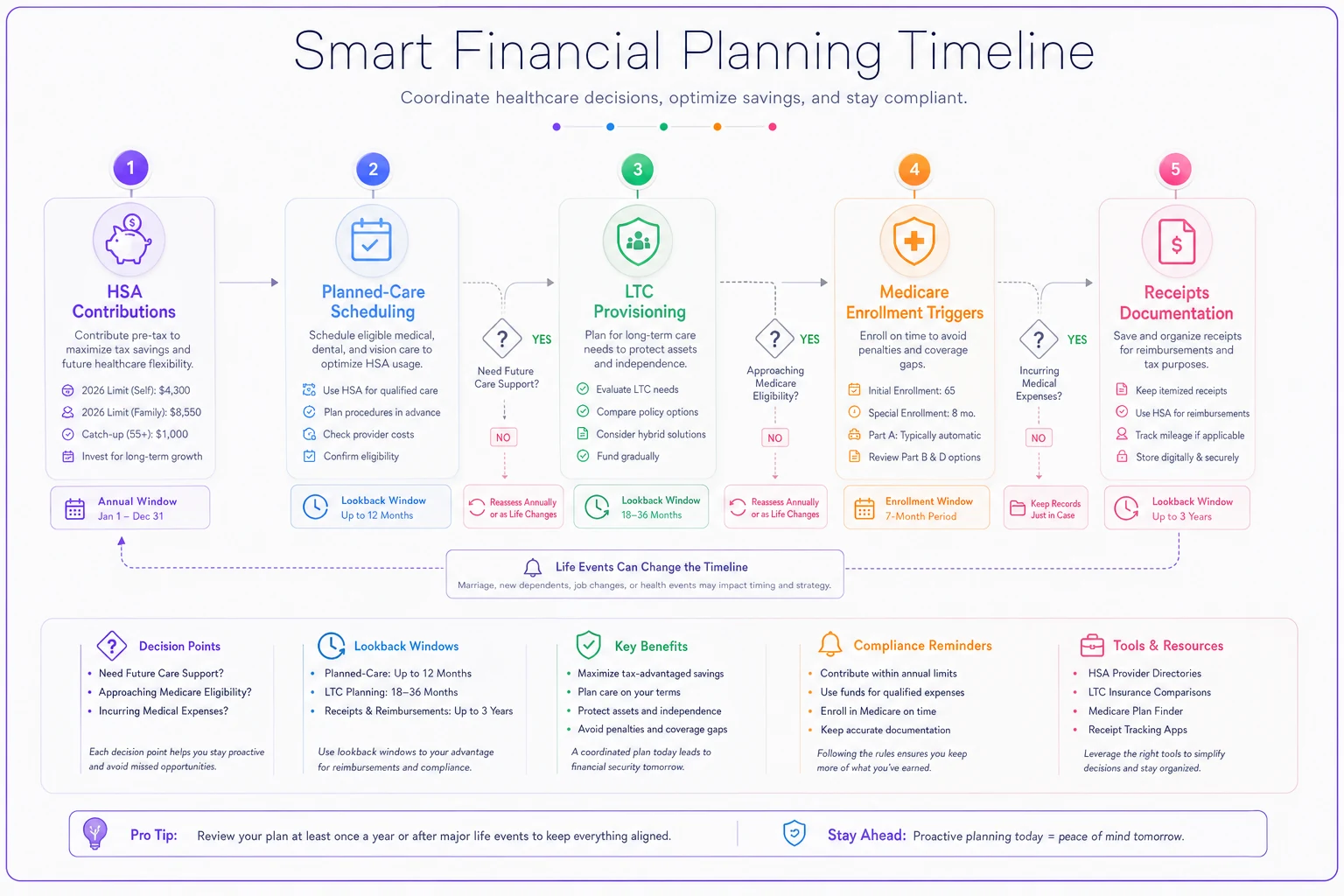
The same five components produce completely different action lists depending on where you sit. That's the whole argument for thinking in a roadmap rather than handling each expense as it arrives.
A short real scenario
A dual-income couple in their late 50s had done the "responsible" thing for years: maxed the HSA, then reimbursed themselves promptly for every medical expense to keep the account from just sitting there. The balance hovered around $4k–$5k perpetually.
When they actually sat down and ran the numbers, two changes reset their trajectory. First, they stopped auto-reimbursing and started paying current costs from cash flow, letting the HSA stay invested—roughly $7k a year now compounding instead of cycling out. Second, they dug up and logged about three years of old, unreimbursed receipts they'd never claimed, totaling somewhere around $6k–$8k of qualified expenses now available as tax-free withdrawals whenever they want them.
Nothing dramatic happened to their income. They just stopped leaking the HSA's biggest advantage and recovered claims they'd forgotten they were owed. Over the roughly 8 years until Medicare, that invested balance is projected to be a meaningful early-retirement cushion rather than a rounding error.
Where the reserve math ties into everything else
The piece people underestimate is how much of this is really a cash-flow and reserve problem wearing a healthcare costume. You're sizing reserves (LTC), timing tax-advantaged contributions (HSA), and smoothing lumpy expenses across years (planned care). That's the same provisioning discipline that governs taxes and every other predictable-but-irregular cost.
If you've already built a reserve formula for taxes, the same muscle applies here—the individual tax-provisioning approach with a runnable reserve formula and monthly checks is a solid template for how to carve a recurring reserve out of cash flow without it feeling like a constant drain. The structure translates almost directly: identify the liability range, fund it monthly, revisit the target when something changes.
The households that keep all of this coordinated usually aren't tracking it in their heads. They've got it centralized—one place where the HSA balance, logged receipts, Medicare date, planned-care schedule, and LTC reserve target all live together, so a decision in one area shows its effect on the others. That's less about any particular tool and more about refusing to let these five pieces drift into five separate mental folders that never get reconciled.
The bottom line
Healthcare spending across a lifetime isn't unpredictable—it just feels that way when you handle each piece in isolation and under stress. The timing rules are mostly knowable in advance: the six-month HSA lookback, the Medicare penalty cliffs, the plan-year deductible math, the fact that LTC insurability only gets worse with each passing year.
A real healthcare financing roadmap is just the decision to anchor on the rigid deadlines, flex the one piece you can (planned care), fund the reserves while the windows are still open, and keep documentation durable enough to cash in years later. Get the sequence right and the surprises shrink to the genuinely unforeseeable ones—which, it turns out, are a much smaller category than most people assume.
Healthcare spending across a lifetime isn't unpredictable—it just feels that way when you handle each piece in isolation and under stress. The timing rules are mostly knowable in advance: the six-month HSA lookback, the Medicare penalty cliffs, the plan-year deductible math, the fact that LTC insurability only gets worse with each passing year.
A real healthcare financing roadmap is just the decision to anchor on the rigid deadlines, flex the one piece you can (planned care), fund the reserves while the windows are still open, and keep documentation durable enough to cash in years later. Get the sequence right and the surprises shrink to the genuinely unforeseeable ones—which, it turns out, are a much smaller category than most people assume.
Ready to master your money?
Join thousands of users leveraging Savioly to build smarter budgets, save more efficiently, and plan for a secure financial future.