



Job openings slipped to around 7.08 million in the August 2026 JOLTS data—down roughly 256,000 from the prior month. According to Reuters' coverage, layoffs stayed low even as openings fell. That combination matters more than the headline number.
What most people miss: when openings drop but layoffs stay flat, the danger isn't mass job loss. It's slower re-hiring. If you lose income—through a layoff, a contract ending, a client cutting back—the time it takes to replace that income stretches out. The labor market cooling personal finance problem isn't "I'll get fired tomorrow." It's "if something happens, my gap period just got longer and more expensive."
That single shift—from short gaps to long gaps—changes almost every financial decision you'd normally make on autopilot.
Why a "cooling" market is sneakier than a recession
A recession is loud. People brace for it. A cooling labor market is quiet, and that's the trap.
When the BLS JOLTS report shows openings easing without a spike in layoffs, most households feel fine. The paycheck still shows up. Nothing feels urgent. So they keep savings on aggressive autopilot, keep eyeing a home purchase or car upgrade for "sometime soon," and treat their emergency fund like a number they set two years ago and never touched since.
That quiet period is exactly when you should be reconfiguring, because the cost of being wrong just went up. Replacing a mid-career role in a tight hiring market might take 6–8 weeks. In a cooling one, the same search can stretch to 3–5 months. A freelancer who used to backfill a lost client in a few weeks might now need two or three months of outreach. Your emergency fund probably wasn't sized for that longer runway.
So the whole exercise below comes down to one question: if income paused, how long could you hold your current life steady, and what would you change first?
Step 1: Recalculate your true runway (not your emergency fund balance)
People confuse "emergency fund" with "runway." They're not the same thing.
Take charge of your finances with clarity and confidence.
Savioly gives you real-time visibility and actionable steps to improve your money management.
- Automated expense tracking
- Goal-based saving plans
- Personalized financial insights
No credit card required
Your emergency fund is a dollar amount. Your runway is time—how many months you can cover essential spending if income stopped. Runway depends on three moving parts: liquid cash, your real monthly burn, and how fast you could cut spending if you had to.
A quick way to get the honest number:
-
Add up genuinely liquid money (checking, savings, money market). Don't count a brokerage you'd hate to sell at a loss, and skip retirement accounts.
-
Calculate your essential monthly burn—housing, utilities, food, insurance, minimum debt payments, childcare. Strip out everything discretionary.
-
Divide liquid cash by essential burn. That's your floor runway.
-
Then divide liquid cash by your total current spending. That's your comfortable runway.
The gap between those two numbers is your flexibility. If your floor runway is 9 months but your comfortable runway is only 4, you've got a lot of cushion you could unlock by cutting fast. If both numbers are close together, you're already living near your essentials and have less room to maneuver—which is the more fragile position.
A realistic example: a household with roughly $22k liquid, about $5,400/month in essential burn, and $8,100/month in total spending has a floor runway near 4 months and a comfortable runway of under 3. In a market where re-hiring might take 4–5 months, that's worth acting on now, while income is still coming in.
Step 2: Retarget your emergency fund to the *new* gap length
Once you know your runway, you can set a target that matches today's hiring reality instead of 2021's.
A rough sizing guide based on how replaceable your income is:
| Income profile | Old rule of thumb | Cooling-market target | Why |
|---|---|---|---|
| Dual-income, both stable fields | 3 months | 4–5 months | Two incomes lowers risk, but both searches slow at once |
| Single income, specialized role | 6 months | 8–9 months | Niche roles have fewer openings; longer search |
| Freelancer / commission-based | 6 months | 9–12 months | Client replacement lags; income is lumpy |
| Contract / project-based | 6 months | 10–12 months | Gaps between contracts widen in soft markets |
The mistake people make constantly: setting a flat "6 months" number regardless of how hard their specific income is to replace. A specialized engineer and a generalist admin should not be running the same emergency-fund math. The engineer earns more but may wait longer between offers.
You don't need to hit the new target overnight. You need a plan to get there, and that usually means Step 3.
Step 3: Throttle your savings automations before they drain your liquidity
This is the counterintuitive one. In a cooling market, aggressive long-term investing can quietly work against you.
Plenty of households have automations routing 20–25% of income straight into retirement and brokerage accounts. That's admirable in a strong market. But money locked in a 401(k) or a taxable account you don't want to sell at a loss doesn't help you survive a 4-month income gap. You can end up wealthy on paper and broke in the checking account.
The fix isn't to stop investing. It's to re-sequence temporarily:
-
Keep capturing any employer 401(k) match—that's free money, don't leave it behind.
-
Redirect the extra taxable-brokerage contributions into your liquid emergency fund until it hits the new target.
-
Once the emergency fund is retargeted, flip the automations back toward investing.
A household saving roughly $1,400/month beyond their match could redirect $900 of that to cash for a few months, rebuild their buffer to the new 8-month target, then switch back. You lose a little market exposure temporarily. You gain the ability to avoid selling investments at the worst possible moment.
The key is making this reversible and scheduled, not emotional. Set a rule—"redirect until emergency fund hits $X, then auto-resume investing"—so you're not relying on willpower when things feel uncertain.
Step 4: Surface the hidden liabilities that shrink your real runway
Your runway math from Step 1 is only as honest as your spending data. Two categories love to hide: recurring subscriptions and buy-now-pay-later plans.
BNPL is especially dangerous here because it doesn't show up as "debt" in most people's mental accounting. Four pay-in-four plans running at once can quietly commit $300–$500 of future months' cash flow that never appears in a budget. If income pauses, those obligations don't—and they're exactly the kind of thing that turns a manageable gap into a cascade of late fees.
Run a quick liability sweep this week:
-
Pull 90 days of transactions and flag every recurring charge, even the small ones.
-
List every active BNPL plan with its remaining balance and payoff date.
-
Cancel subscriptions you'd be embarrassed to defend out loud.
-
Note any annual renewals hitting in the next 90 days so they don't ambush your cash buffer.
-
Total your committed future outflows—these reduce your real runway more than people expect.
The goal isn't guilt. It's accuracy. You can't plan around obligations you've forgotten you have.
Step 5: Build trigger-based rules now, so you're not deciding under stress
The worst time to decide how to cut spending is the week after you lose income. You're stressed, you overcorrect, and you make choices you regret—like pausing childcare you actually need or canceling insurance you'll want back.
Write the rules ahead of time instead. Decide now, while you're calm, what happens if.
This is where mapping out lean, base, and stretch scenarios pays off. If you haven't built those out yet, the approach in this multi-year living-plan for uncertain incomes walks through how to define each tier and tie spending changes to specific triggers. The short version:
-
Base plan your normal spending while income is stable.
-
Lean plan the exact line items you'd cut, in order, if income dropped—written down in advance.
-
Trigger the specific event that flips you from base to lean (for example, "contract not renewed" or "runway drops below 3 months").
When the trigger is pre-defined, switching modes becomes mechanical instead of emotional. You already know the first five things to cut, so you cut them on day one instead of bleeding cash for three weeks while you figure it out.
Here's a quick diagram of the trigger-to-action workflow.
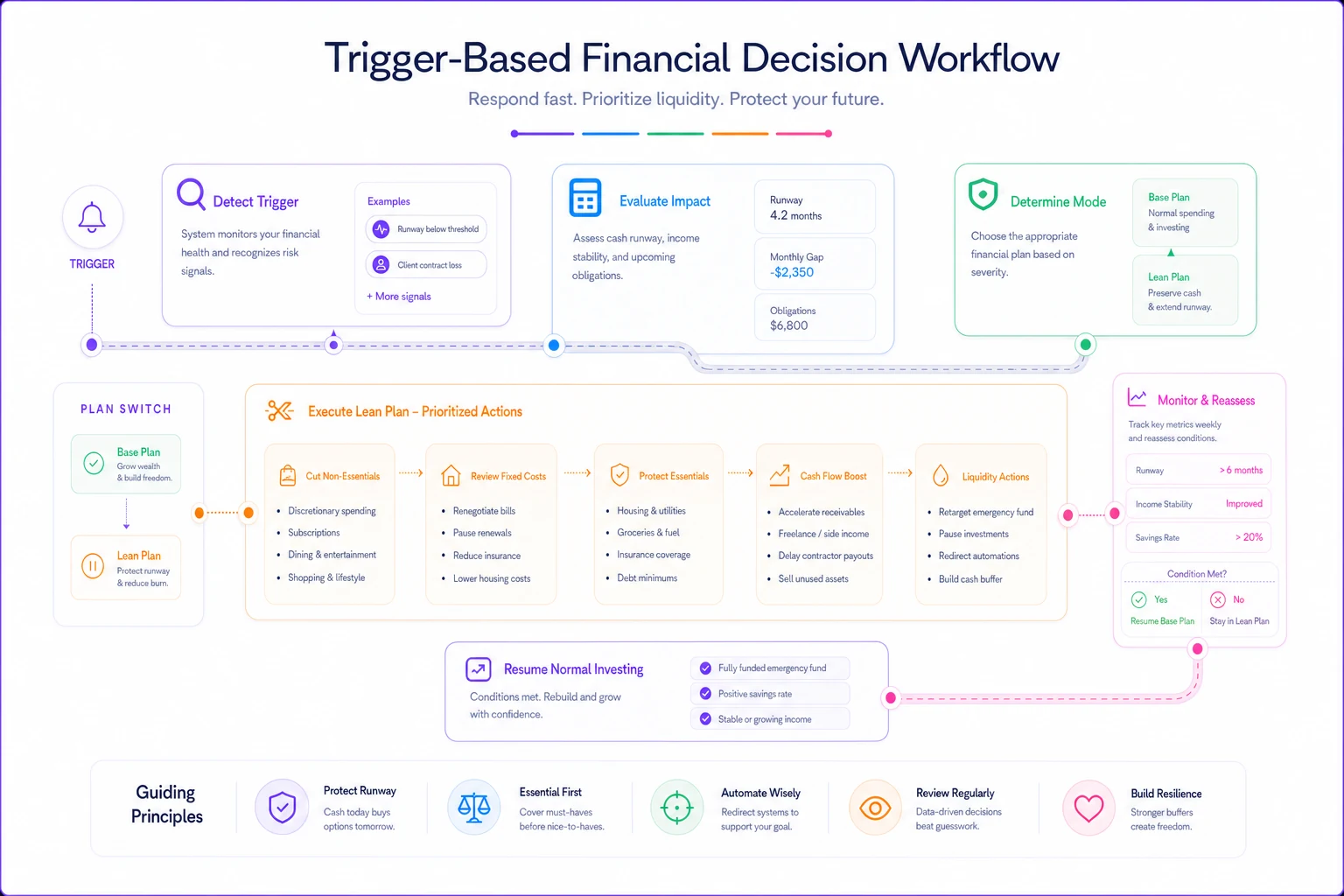
Place this flowchart near your written rules so it's easy to follow when you're under pressure.
A quick real scenario
A quick real scenario
A freelance marketing consultant—somewhere around $7k–$9k in monthly billings across four clients—had been treating all of it as stable income. When the hiring slowdown rippled into her clients' budgets, two of them cut scope within the same month, dropping her to about $4k.
Because she'd never separated essential from discretionary spending, the first few weeks were pure panic. After the fact, she ran the runway math: her liquid cash covered only about 2.5 months at her full lifestyle. She retargeted her emergency fund to a 9-month freelancer buffer, redirected her excess brokerage automation to cash for a stretch, and wrote a lean plan that cut roughly $1,900/month in discretionary spend tied to a specific trigger.
Three months later she'd replaced one client and added a smaller retainer—back to around $6k—and her buffer had grown enough that the next client loss wouldn't trigger panic. Nothing dramatic. She just stopped being surprised by her own finances.
When tightening up is overkill
Not everyone needs to go into defensive mode, and overcorrecting has real costs—mainly lost long-term growth from pulling back on investing unnecessarily.
You probably don't need aggressive changes if you already hold 9+ months of liquid runway, your income is genuinely recession-resistant, and you have no major cash outlays planned in the next year. A light subscription sweep and a quick runway check is enough.
You should move now if your floor and comfortable runway numbers are close together, your income is specialized or commission-based, you're carrying BNPL plans you'd half-forgotten about, or a big purchase is coming in the next few months. Acting during a quiet cooling period means you get to make these moves calmly, on your terms, instead of reactively.
The real takeaway
A dip in job openings isn't a reason to panic—layoffs staying low is genuinely reassuring. But it's a signal to shift from "how fast am I growing wealth" to "how long could I hold steady if income paused." Those are different questions, and they call for different settings on your money.
Run the runway math. Retarget the emergency fund to the slower-hiring reality. Re-sequence automations toward liquidity, surface the obligations hiding in your spending, and write your lean-mode rules before you need them. Do those five things this week, and a cooling labor market becomes something you've already planned around—not something that catches you off guard.
A dip in job openings isn't a reason to panic—layoffs staying low is genuinely reassuring. But it's a signal to shift from "how fast am I growing wealth" to "how long could I hold steady if income paused." Those are different questions, and they call for different settings on your money.
Run the runway math. Retarget the emergency fund to the slower-hiring reality. Re-sequence automations toward liquidity, surface the obligations hiding in your spending, and write your lean-mode rules before you need them. Do those five things this week, and a cooling labor market becomes something you've already planned around—not something that catches you off guard.
Ready to master your money?
Join thousands of users leveraging Savioly to build smarter budgets, save more efficiently, and plan for a secure financial future.