



Most people run their tax life on two dates: April 15th and whenever their W-2 shows up. Everything in between just… happens. Withholding runs on autopilot from a form you filled out during onboarding at some job you've probably left. Roth conversions get discussed in December, usually too late to do them well. Tax-loss harvesting is something you vaguely remember reading about after a bad market week.
The problem isn't that any single one of these is hard. It's that they're all connected — they all key off the same number, your taxable income for the year — and they all have deadlines that don't line up with when you actually have the information to act on them. A household tax calendar fixes the coordination problem. It puts every income-sensitive decision on the same timeline, ties each one to a threshold, and tells you what to check and when.
What follows is the actual month-by-month structure, plus the decision checkpoints and income-band triggers that make it work instead of just being a wall calendar with tax words on it.
Why the disconnected version quietly costs you
The core issue is timing mismatch. Your withholding is set in January based on a guess. Your Roth-conversion opportunity is best measured in November, when you can actually see your full-year income. Your capital gains and losses accumulate all year but only matter for netting purposes by December 31. And your estimated payments — if you owe them — are due on a schedule the IRS invented that has nothing to do with your actual cash flow.
When these run independently, three predictable things break:
-
You over-convert or under-convert. People do a Roth conversion in a year they didn't realize a bonus or capital gain pushed them into the next bracket. The conversion that looked like a 22% move becomes a 24% or 32% move.
-
You harvest losses you didn't need and skip gains you should've realized. Loss harvesting without knowing your bracket is just moving money around. In a low-income year, realizing gains at 0% long-term rate is often the better play — and almost nobody does it because they're not looking.
-
Your withholding drifts out of sync with reality. A raise, a side gig, a spouse's job change — any of these throws off the January guess, and you find out in April.
The households that handle this well aren't smarter about tax law. They just look at the same numbers on a regular cadence, so nothing surprises them. If you've already built a runnable reserve formula and monthly withholding check, this calendar is the layer that sits on top of it and adds the seasonal decisions.
The one number everything keys off
Before the calendar makes sense, you need one running figure: projected taxable income for the year, updated as you go. Not last year's number. This year's, forecast forward.
Take charge of your finances with clarity and confidence.
Savioly gives you real-time visibility and actionable steps to improve your money management.
- Automated expense tracking
- Goal-based saving plans
- Personalized financial insights
No credit card required
-
Year-to-date wages, minus pre-tax contributions
-
Expected remaining paychecks
-
Known bonuses, RSU vesting, or lumpy income (if you have equity comp, mapping RSU and option income into your cashflow matters a lot here — vesting events are the single biggest thing that quietly bumps your bracket)
-
Realized capital gains so far
-
Interest and dividends
You compare that projection against the bracket edges and a few key thresholds. Those thresholds are what turn "should I convert?" from a gut call into a rule.
Thresholds worth marking on the calendar
| Threshold (approximate, single/MFJ) | Why it matters | What it triggers |
|---|---|---|
| 0% LTCG ceiling (~$47k / ~$94k taxable) | Long-term gains taxed at 0% below this | Realize gains, not losses, if you're under it |
| Top of 12% / 22% bracket | Cheap conversion space | Fill remaining room with Roth conversions |
| IRMAA cliffs (Medicare, ~$103k / ~$206k MAGI) | Extra Medicare premiums for 2 years | Hard stop for conversions if you're near retirement age |
| NIIT threshold (~$200k / ~$250k MAGI) | Extra 3.8% on investment income | Watch before realizing big gains |
| Estimated-tax safe harbor (110% of last year's tax) | Avoids underpayment penalty | Sets your minimum payment floor |
Numbers shift yearly and the exact figures aren't the point — the structure is. You mark the edges, then the calendar tells you when to look.
The month-by-month calendar
Here's the actual cadence. Some months are heavy, most are light. That's intentional — the whole system falls apart if every month demands a full review, because you'll stop doing it by March.
January — Reset withholding, set the year's baseline
-
Pull your final W-2s / 1099s from the prior year and note your effective rate.
-
If you owed more than roughly $1,000 or got a refund over $3,000, adjust your W-4. A big refund means you gave the government an interest-free loan.
-
Set your safe-harbor floor
110% of last year's total tax, divided across the year. That's your penalty-proof minimum.
-
Schedule 401(k)/HSA contribution increases if limits went up.
April — Q1 estimated payment + prior-year true-up
-
Pay Q1 estimate based on your safe-harbor floor.
-
Make prior-year IRA/HSA contributions before the deadline if you haven't.
June — Q2 estimate + first income reality check
-
Pay Q2 estimate.
-
Run your first real income projection. Are you tracking above or below plan? A big spring bonus or a slow business quarter changes everything downstream.
September — Q3 estimate + preliminary conversion math
-
Pay Q3 estimate.
-
Estimate your remaining bracket room. If you'll land well under the top of your bracket, you're a Roth-conversion candidate — start sizing it now instead of scrambling in December.
-
Flag any positions sitting on losses for potential harvesting.
November — The decision month
-
Roth conversion Convert enough to fill the bracket but stop before the next bracket edge or an IRMAA/NIIT cliff. This is where the calendar actually earns its keep — you're converting with your full-year picture visible, not blind.
-
Tax-loss harvesting Net your realized gains against losses. Harvest what you need to offset gains, plus up to $3,000 against ordinary income. Watch the wash-sale rule — don't rebuy the same or substantially identical security within 30 days.
-
Gain harvesting (the overlooked one) If you're under the 0% LTCG ceiling this year, realize gains and reset your basis at zero tax cost.
-
Charitable timing Bunch donations or use a donor-advised fund if you're itemizing this year.
December — Execute and confirm
-
Finalize conversions and harvests before the 31st. Trades must settle in the calendar year.
-
Confirm required minimum distributions if applicable.
-
Check that Q4 withholding plus estimates cover your safe harbor.
January (Q4 estimate) — Final estimate due mid-month
The prior year's Q4 estimated payment is due. Then the cycle restarts.
A real scenario: the year the bonus wrecked the conversion
A dual-income household, both salaried, combined income around $180k. In prior years they'd done a $30k Roth conversion each December on their advisor's suggestion — a decent habit in theory.
One year, one spouse got a retention bonus of about $40k in October that they hadn't fully registered as taxable "on top" of everything else. They did the usual December conversion without recalculating. The result: roughly $18k of that conversion got taxed at 24% instead of the 22% they'd assumed, and it nudged their MAGI close enough to the NIIT threshold that their investment income picked up the extra 3.8%. The avoidable cost landed somewhere around $900–$1,100 — not catastrophic, but entirely a coordination failure.
The fix wasn't complicated. The next year they moved the conversion decision to November and ran a full-year projection first. When they saw a smaller bonus had already used up most of their bracket room, they converted about $12k instead of $30k. Same discipline, but the calendar caught what the calendar-less version missed. Over a few years, those caught mistakes add up to real money and, honestly, a lot less April anxiety.
Where automation actually helps (and where it doesn't)
The temptation is to automate the decisions. Don't. Roth conversions and gain realization are judgment calls that depend on your full-year picture and your read on future tax rates. What you can and should automate is the tracking and the triggers — the boring, error-prone data work that makes the decisions possible.
A workflow that runs quietly in the background looks like this: your accounts feed a running total of income, realized gains, and contributions. The system compares that total against the thresholds you've set. When you cross a checkpoint — say, your projected income clears the top of the 22% bracket, or your realized losses exceed your realized gains by more than $3k — it flags it. You still make the call. It just makes sure you're never flying blind in December.
Here's a simple visualization of that workflow.
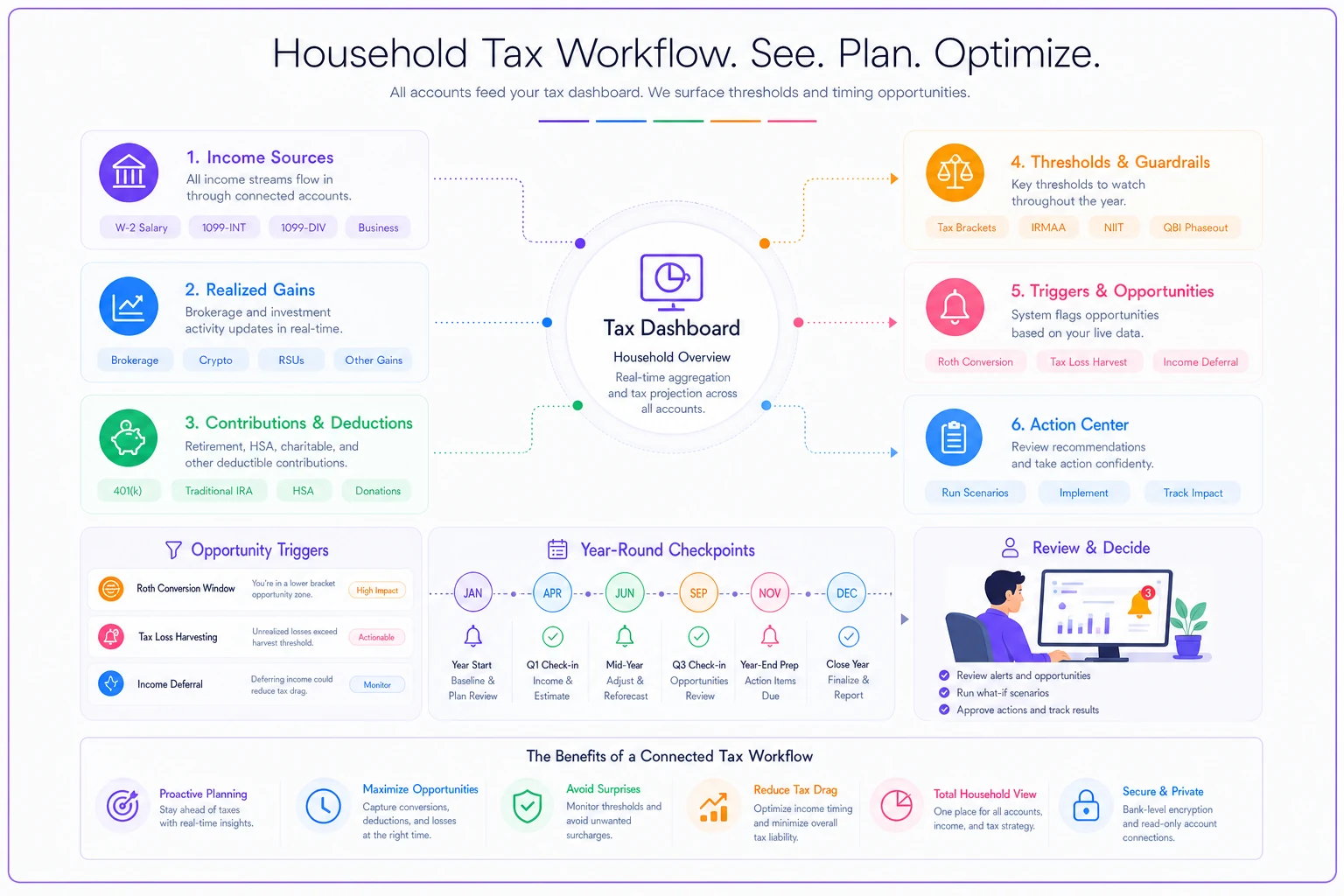
The image shows how feeds, thresholds, and calendar checkpoints interact.
Sync account feeds daily so projections reflect real-time income swings.
This is where AI-assisted household financial platforms genuinely earn their spot: they watch the thresholds continuously instead of you remembering to check a spreadsheet quarterly, and they surface prompts like "you're approaching a conversion window" or "harvest opportunity available" at the right time. The decision stays yours; the monitoring stops being your job.
A simple trigger checklist to build
-
[ ] Projected income within $10k of a bracket edge → review conversion room
-
[ ] YTD realized gains exist and you're under the 0% LTCG ceiling → consider gain harvesting
-
[ ] Any position down >10% held short-term → flag for loss-harvest review (mind wash-sale)
-
[ ] MAGI approaching an IRMAA or NIIT threshold → hard-stop check before any conversion
-
[ ] Actual income drifting >15% from January plan → re-run withholding
-
[ ] Estimated payment date within 2 weeks → confirm safe-harbor coverage
The decision stays yours; the monitoring stops being your job.
When this full system makes sense — and when it's overkill
Worth the effort if: you have variable income, RSUs or lumpy comp, meaningful taxable investments, you're pre-Medicare and doing conversions, or you're in a low-income year — early retirement, sabbatical, business ramp-up — where gain-harvesting and conversions are genuinely valuable.
Probably overkill if: your income is a steady W-2, you don't hold much in a taxable brokerage, and you're not near any bracket or cliff. In that case, right-sized withholding and maxed retirement accounts do most of the work. You don't need the November decision month at all.
Skip the conversion piece entirely if you're within two years of Medicare and near an IRMAA cliff, or if you genuinely can't cover the conversion tax from outside the retirement account. Paying the tax from the converted funds usually defeats the purpose.
The households that keep more of their money aren't running exotic strategies. They're just looking at the same handful of numbers on a schedule, so that by the time a decision deadline arrives, they already know the answer. The withholding is tuned to reality. The conversion is sized to actual bracket room. The harvest offsets real gains instead of being a random December ritual. Put the checkpoints on a calendar, tie each one to a threshold, and let something automate the watching. Then the only thing left for you to do is make the call — with the full picture in front of you, in November, instead of guessing in the dark in December.
Ready to master your money?
Join thousands of users leveraging Savioly to build smarter budgets, save more efficiently, and plan for a secure financial future.