



Equity comp breaks people in a pretty predictable way: they treat vested RSUs, unexercised options, and post-IPO shares as one big pile called "my stock," then make decisions on the whole thing at once. That's the mistake. Each grant type has a different taxable moment, a different liquidity profile, and a different risk of going to zero. Treating them the same is how someone ends up with a $180k tax bill and no cash to cover it — or a concentrated position that quietly becomes 70% of their net worth while they were busy working.
This is a working map. What to do in the first 30 days after each type of grant or event, how to size de-risk sales, and how to build a multi-year plan that actually respects your lockups and cashflow instead of pretending all the money is available today.
Start by separating the pile into three different problems
The reason people freeze up is that "equity compensation" is really three separate financial situations wearing the same jacket.
RSUs are compensation that already happened. When they vest, they're taxed as ordinary income whether you sell or not — the share sale afterward is a separate decision. Options are an opportunity with a clock on them; you decide when to trigger the taxable event, and that timing is most of the game. IPO proceeds (or a tender/secondary) are the moment paper turns into cash, gated by a lockup you don't control.
-
When does the tax hit, and where does the cash to pay it come from?
-
How much of this should I even be holding?
-
When can I actually access the money?
Most planning content jams these together. In real life they have different deadlines and different failure modes, so we'll handle them separately and reconnect at the end into one allocation schedule.
The 30-day checklist, by grant type
Different events, different first moves. Here's what the first month should look like depending on what just happened.
Take charge of your finances with clarity and confidence.
Savioly gives you real-time visibility and actionable steps to improve your money management.
- Automated expense tracking
- Goal-based saving plans
- Personalized financial insights
No credit card required
When RSUs vest:
-
Confirm the exact number of shares withheld for taxes and the withholding rate used (default federal supplemental is often 22% — a problem we'll get to).
-
Calculate your marginal rate. If your income puts you above the 22% bracket, you are under-withheld the day you vest.
-
Decide your sell-to-cover default now. The cleanest rule
sell 100% of newly vested RSUs on vest day unless you have a specific reason to hold. Vested RSUs are just cash the company handed you in stock form — holding them is an active decision to buy your employer's stock.
-
Move any gap between withholding and your real tax owed into a reserve account before you touch anything.
When you receive an options grant (ISOs or NSOs):
-
Record grant date, strike price, vesting schedule, and — critically — the expiration window if you leave (often 90 days post-departure).
-
For ISOs
exercising can trigger AMT even without a sale. This is the trap that catches people.
-
Do nothing financially yet. A new grant needs no action beyond documentation. The action comes at exercise.
When you're inside an IPO / lockup window:
-
Write down the lockup expiration date and any staggered release provisions.
-
Model your tax on the assumption you'll sell a chunk at unlock, not that the price holds.
-
Do not restructure your whole financial life around a stock price you cannot sell yet. Paper value during lockup is a number, not a plan.
The pattern: RSUs demand immediate action, options demand documentation and patience, IPO shares demand a countdown clock and restraint.
The taxable-event problem nobody warns you about: the 22% withholding gap
This is the single most common blowup. RSU vesting withholds federal tax at the flat supplemental rate — commonly 22%. If your actual marginal rate is 32% or 35%, you are silently under-withheld by 10–13% on every single vest.
A typical example: someone vests roughly $140k in RSUs during the year. The company withholds around 22% — call it $30.8k. But their marginal rate is 35%, so the real tax is closer to $49k. The gap is about $18k, and it doesn't show up until April. If they sold those RSUs and spent the proceeds, that $18k has to come out of savings — or a scramble.
The fix is building a reserve the moment shares vest, not at tax time. The mechanics of running a dedicated tax reserve — the formula, the monthly check, and the withholding tweaks — are covered in the tax provisioning reserve approach, and equity comp is exactly the situation that framework was built for. Short version: estimate your true rate, subtract what was withheld, and park the difference before you allocate a dollar.
For ISOs the math is nastier because the "event" can be invisible. You exercise, don't sell, and the spread between strike and fair market value becomes an AMT preference item. People find this out the following spring when they owe tax on gains they never received in cash.
A percent-based de-risk ladder instead of an all-or-nothing decision
The hardest question isn't tax — it's how much of your net worth should sit in one company's stock. People answer this emotionally: hold everything hoping for more, or panic-sell after a drop.
A ladder replaces the emotion with a rule tied to concentration.
| Employer stock as % of liquid net worth | Action |
|---|---|
| Under 10% | Hold — this is normal, no forced selling |
| 10–20% | Trim on vest: sell all new RSUs, hold existing |
| 20–35% | Active reduction: sell new RSUs + ~25% of the existing position per year |
| 35–50% | Aggressive de-risk: sell new RSUs + ~40% of existing annually |
| Over 50% | Emergency: sell to get under 35% as fast as tax and lockups allow |
A percent-based ladder self-adjusts. If the stock rips, your concentration climbs and the ladder tells you to sell more. If it falls, concentration drops and the ladder eases off. You're not predicting the price — you're managing exposure.
Recalculate your employer-stock percentage after any material price move before acting, so your ladder tier reflects current concentration.
One mistake that comes up constantly: anchoring to cost basis. "I'll sell when it gets back to $80." The market does not care what you paid. Concentration risk is about how much you'd lose if the stock halved, not about your entry point.
When holding actually makes sense
Holding a concentrated position isn't always wrong. It makes sense when the position is under roughly 10% of your net worth, when you have genuine conviction and the rest of your financial base is solid, or when selling would trigger a tax event large enough to materially shift your bracket and you can spread it across years instead.
When holding is a bad idea
If those shares are supposed to fund near-term goals — a house down payment in 18 months, tuition, a planned career break — concentration is reckless. And if you can't answer "how much would I lose if this dropped 50%?" without flinching, you're already overexposed.
Who should not run an aggressive hold
Anyone whose salary and net worth both depend on the same company. If your paycheck and your portfolio go to zero in the same event, you don't have a diversified life — no amount of upside justifies that correlation.
Tying it to cashflow: a multi-year allocation plan
Selling shares is only half the job. The other half is deciding where the proceeds go, and that depends on your cashflow needs and lockup timing, not a generic percentage.
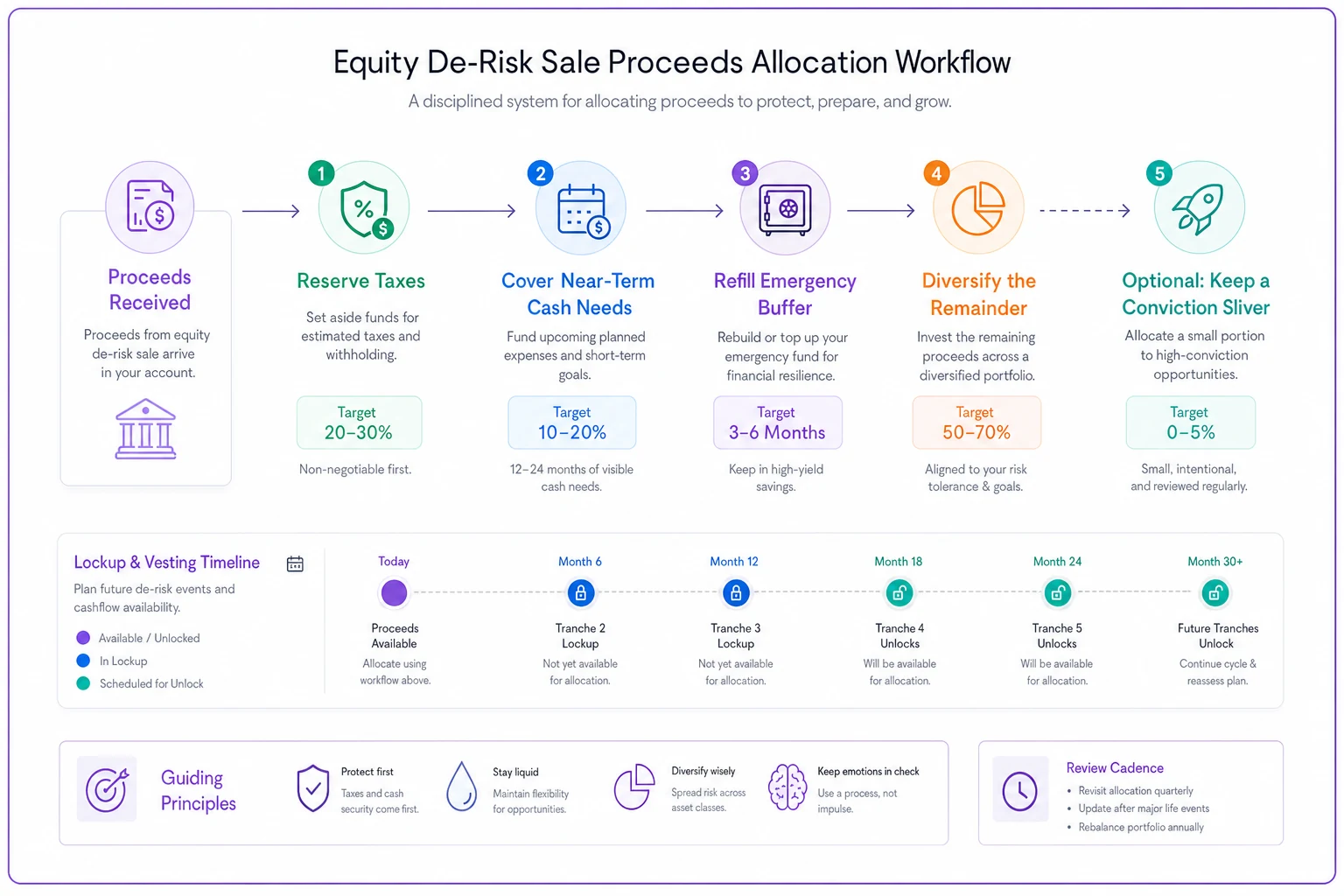
A workable process for turning a de-risk sale into an allocation:
-
Reserve taxes first. Pull out your true tax owed before allocating a dollar. Non-negotiable, comes off the top.
-
Cover near-term cash needs. Any goal inside roughly 24 months — down payment, tuition, a planned income gap — gets funded next, into cash or short-term instruments, not back into the market.
-
Refill or extend your emergency buffer if the windfall lets you do it cleanly.
-
Diversify the remainder into your normal long-term allocation — broad index exposure, not more single-stock risk.
-
Leave a "conviction sliver" if you genuinely want upside — a capped amount, maybe 5–10% of proceeds, that you're fully willing to lose.
For how the remainder splits across those buckets, the percentage-allocation logic in the windfall decision template maps cleanly onto IPO and large-vest proceeds — an equity liquidity event is functionally a windfall with a tax bill attached.
The lockup is what makes equity comp different from a normal bonus: you're planning around money you can see but can't sell yet. If your lockup expires in six months and you know you'll de-risk 40% at unlock, you can start pre-committing that future cash to specific goals now — as long as you size for a lower price, not the current quote.
Below is a simple workflow diagram for allocating proceeds after a de-risk sale.
The lockup is what makes equity comp different from a normal bonus: you're planning around money you can see but can't sell yet. If your lockup expires in six months and you know you'll de-risk 40% at unlock, you can start pre-committing that future cash to specific goals now — as long as you size for a lower price, not the current quote.
A real scenario: the pre-IPO engineer with a cashflow trap
A senior engineer at a company heading toward IPO. On paper the equity was worth somewhere around $600k at the last valuation. The plan, in their head: "sell some at the IPO and buy a house."
Three problems surfaced when it got mapped out:
-
About 65% of their liquid net worth was tied to this one company — already past the emergency line on the ladder, before the IPO even happened.
-
A 180-day lockup meant zero access at the IPO itself. The house timeline assumed liquidity that didn't exist yet.
-
RSU withholding had been running at 22% while their marginal rate was 35%, leaving an accumulated under-withholding gap of roughly $20k they hadn't reserved for.
The fix wasn't dramatic, just sequenced. Set the de-risk ladder to sell all new RSUs going forward, unload about 40% of the existing position across the first two post-lockup windows, build the tax reserve immediately to close the withholding gap, and push the house timeline back to align with the lockup instead of forcing it. A year later the concentration was down to the low-30s, the tax surprise was gone, and the down payment sat in cash — not riding on an earnings report.
Nothing here required a hot take on the stock. It required treating each grant type as its own problem and putting the pieces on a calendar.
The recurring checklist to keep it from drifting
Equity comp goes sideways slowly, between decisions, when nobody's watching the concentration creep back up. A short recurring review keeps it honest:
-
Recalculate employer stock as a % of liquid net worth — every quarter, and after any big move in the price.
-
Confirm every RSU vest was sold-to-cover or intentionally held (never accidentally held).
-
Check your tax reserve against your true marginal rate, not the 22% default.
-
Track each option grant's expiration — especially the post-departure exercise window.
-
Log lockup dates and any staggered release schedule so nothing surprises you.
-
Re-run the de-risk ladder and act on whatever tier you've landed in.
Whether you keep this in a spreadsheet or a planning tool, the value is the same: concentration stays visible, the tax gap can't hide, and each grant stays sorted into its own bucket instead of melting into one undifferentiated "my stock" pile that you eventually make one big emotional decision about.
Bringing it together
The whole game is separation. RSUs are already-taxed compensation you should default to selling. Options are timed opportunities where the taxable event is yours to control — and where ISOs can bite you with AMT on gains you never pocketed. IPO proceeds are cash on a lockup delay, so plan around the calendar and around a lower price than the screen shows.
Layer a percent-based de-risk ladder on top so concentration decisions stop being emotional, reserve your true tax the moment anything vests or sells, and route proceeds through a cashflow-first allocation that funds your near-term goals before it funds more market risk. Do that, and the paper wealth actually becomes a plan — instead of a stressful number you're afraid to look at.
Ready to master your money?
Join thousands of users leveraging Savioly to build smarter budgets, save more efficiently, and plan for a secure financial future.