

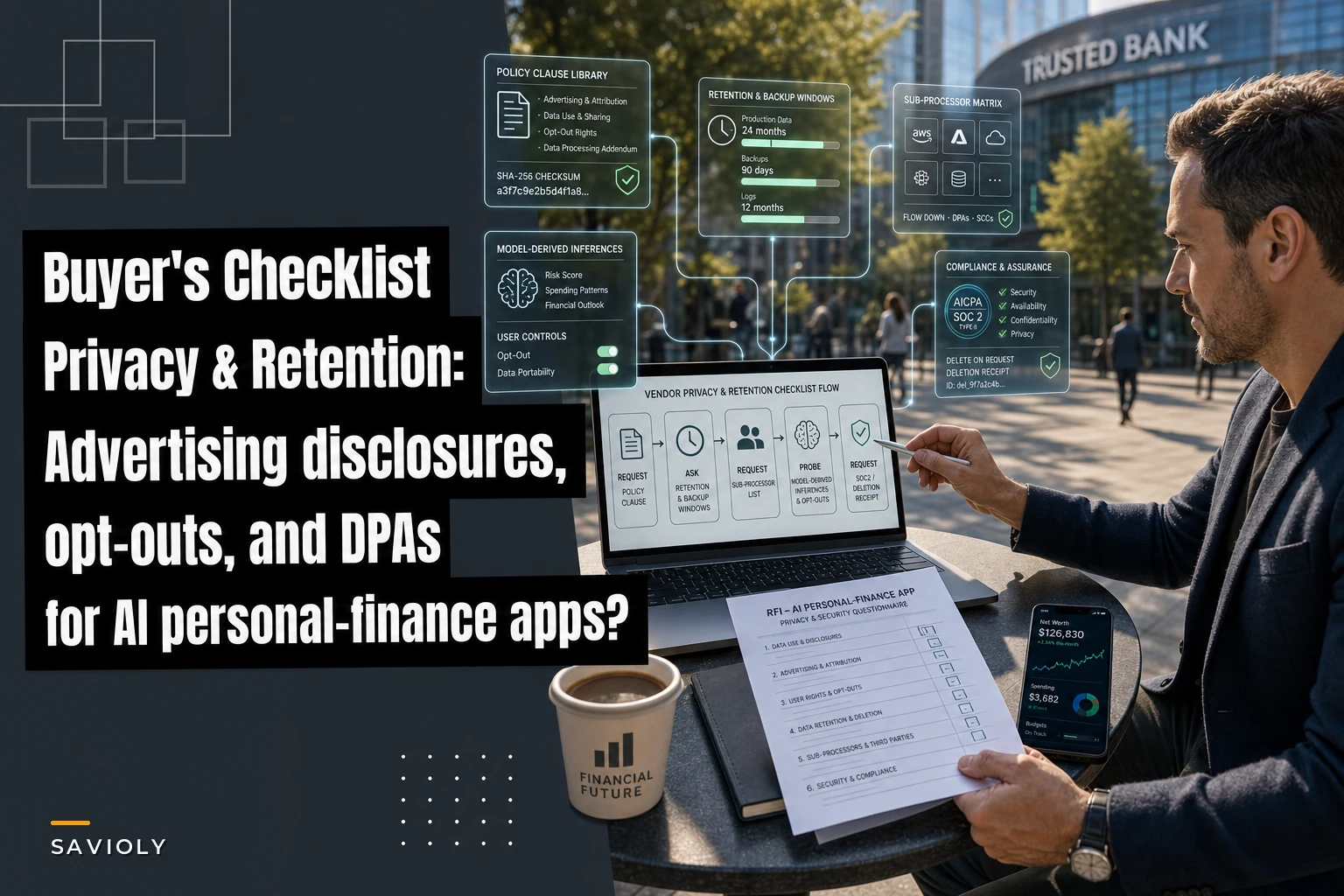

The moment you connect an AI personal-finance app to your checking account, you've handed over something far more revealing than a credit score. Transaction data shows where you eat, who you pay rent to, what medications you fill, whether you're gambling, and roughly how much you earn. Most people skim the onboarding screen, tap "Agree," and move on without ever reading how that data gets used after it leaves their phone.
This guide exists for that gap. Whether you're a consumer picking an app, a product manager vetting a vendor, or part of a small procurement team signing a contract, use the AI personal finance app privacy checklist below to interrogate what actually happens to your financial life once it's inside someone else's model.
Why this matters more with AI apps than old-school budgeting tools
A spreadsheet doesn't learn from you. An AI-driven app does — and that's exactly where the privacy question gets complicated.
Three specific risks separate AI finance tools from the Mint-era apps:
Model-training repurposing. Your transaction data might not just sit in a database. It could become training fuel for models that power features you never asked for, or get folded into systems sold to other businesses entirely. Once de-identified data goes into a model, pulling it back out is basically impossible.
Inference leakage. The unsettling part isn't the raw data — it's what gets derived from it. A model can infer pregnancy, a health condition, a divorce, or financial distress from spending patterns. Those inferences can then feed ad targeting or risk scoring, even if the "raw data" was never technically shared with anyone.
Regulatory exposure. If you're a business evaluating these tools for employees or clients, you inherit real liability. GLBA, GDPR, and CCPA all have teeth, and "the vendor handled it" is not a defense that holds up when a DPA was never signed.
The uncomfortable pattern: most vendors write privacy policies that are technically accurate and practically useless. They'll say data is "used to improve our services" — a phrase vague enough to cover almost anything.
The one-page checklist
Here's the core of it. Print this, or paste it into your vendor questionnaire. Each line is something you should get a specific answer to — not a marketing paragraph.
Take charge of your finances with clarity and confidence.
Savioly gives you real-time visibility and actionable steps to improve your money management.
- Automated expense tracking
- Goal-based saving plans
- Personalized financial insights
No credit card required
Model training use
-
- [ ] Written policy on whether PII/transaction data trains internal or third-party models
-
- [ ] A working opt-out mechanism (not buried in email support)
-
- [ ] Named examples of allowed uses (personalization) vs. disallowed uses (training public models)
Data minimization & purpose limitation
-
- [ ] Clear list of what's collected and the specific reason for each field
-
- [ ] Retention schedules tied to those purposes
-
- [ ] Automatic minimization where the data is no longer needed
Third-party sharing
-
- [ ] Inventory of third-party categories (analytics, processors, advertisers)
-
- [ ] Stated purpose for each sharing relationship
-
- [ ] Contract safeguards (DPAs) confirmed in writing
-
- [ ] Explicit statement on whether data is sold
Deletion & retention
-
- [ ] Retention periods for raw, derived, and aggregated data
-
- [ ] Deletion request workflow with a stated time-to-deletion
-
- [ ] What remains in backups and for how long
-
- [ ] Proof/confirmation of deletion
User controls & consent UX
-
- [ ] Granular toggles (model-training opt-out, targeted-ads opt-in)
-
- [ ] Machine-readable account export (JSON/CSV)
-
- [ ] Documented data-access endpoints or self-serve export
Advertising disclosures
-
- [ ] Whether targeted ads are served at all
-
- [ ] Whether ads use transaction data or model inferences
-
- [ ] Exactly what ad partners receive
Security & access controls
-
- [ ] Encryption in transit (TLS) and at rest (AES-256)
-
- [ ] Tenant separation in multi-tenant model setups
-
- [ ] Role-based access controls
-
- [ ] SOC 2 / ISO attestations available on request
Auditability & transparency
-
- [ ] Access and data-lineage logs
-
- [ ] Periodic transparency reports on model use and sharing
Compliance & certifications
-
- [ ] GDPR/CCPA mapping
-
- [ ] GLBA handling (if the app touches financial-account data)
-
- [ ] Recent third-party audit results
A downloadable one-page PDF version of this checklist plus an RFI snippet is linked at the end.
What good answers actually sound like — and the red flags hiding behind them
The difference between a solid vendor and a risky one usually isn't the headline answer. It's the specificity. Vague answers aren't neutral; they're almost always covering something.
Here's a translation table for the answers you'll hear:
| Topic | Answer you'll hear | Rating | What to do |
|---|---|---|---|
| Model training | "We don't use customer-identifying data to train general ML models. De-identified aggregates only; identifiable data in training requires explicit opt-in and contract terms." | Good | Ask how de-identification is validated |
| Third-party sharing | "Card and ACH data go only to processors under contract. We don't sell PII. Analytics events go to vendor X under a DPA." | Acceptable | Request the actual DPAs and vendor list |
| Deletion | "Primary systems purged within 30 days; encrypted backup snapshots retained up to 90 days; you get a confirmation receipt." | Common | Nail down backup specifics in writing |
| Advertising | "No targeted ads based on raw transaction data. Non-personalized ads or anonymized segments only; advertisers never get PII." | Verify | Ask to see it in logs or contract |
None of the "good" answers above are vague. They name timeframes, name conditions, name the mechanism. That's what you're looking for.
The red flags worth walking away over:
-
- "We use data to improve our models" with zero detail on de-identification. This is the single most common evasion you'll encounter.
-
- Refusal to describe backup retention or inability to produce proof of deletion. If they can't tell you where deleted data goes, assume it doesn't go anywhere.
-
- "Shared with partners" with no categories and no contract references. "Partners" is where data gets sold without actually saying sold.
-
- No opt-out for model training or ad personalization. If consent isn't granular, it isn't really consent.
One thing worth flagging separately: some vendors answer the model-training question cleanly but go quiet on inference use. They'll promise not to train on your data while quietly using model-derived inferences — "likely new parent," "probable income band" — for targeting. Ask about inferences explicitly. The training answer doesn't cover them.
When a vague answer is a dealbreaker vs. when it isn't
Not every gap is fatal. Context matters a lot here.
When to walk away: The app serves ads and won't describe what ad partners receive and has no training opt-out. That combination means your financial inferences are very likely being monetized with no real way to stop it.
When it's workable: A smaller vendor without a formal transparency report, but with a clear DPA, named sub-processors, and a documented deletion workflow. Younger companies often lack the paperwork polish of larger ones but run reasonably clean practices — the specificity of their answers tells you more than a glossy compliance page.
Who should be strictest: Anyone procuring on behalf of others — employees, clients, people on a shared household plan. You're accepting liability for people who never read the policy themselves. The same diligence you'd apply to re-tuning household savings automations after a rate change applies here: the defaults matter, and they're almost always set in the vendor's favor.
How to frame the questions so you get real answers
Vendors give vague answers partly because questions are vague. More specific questions force more specific replies. A short process worth following when interviewing providers:
-
1. Ask for the policy section, not a summary. "Point me to the exact clause covering model training" beats "Do you use my data?" every time.
-
2. Ask for timeframes and numbers. Deletion in how many days? Backups retained how long? Silence on specifics is itself a tell.
-
3. Ask for the sub-processor list. A real one exists as a document. If they have to "get back to you," note how long it actually takes.
-
4. Ask the inference question separately. "Do you use model-derived inferences for advertising or sharing?" — it's a different question from training and should be treated that way.
-
5. Request one recent artifact. The latest SOC 2 summary or a sample deletion receipt. Whether they'll share it is itself a signal.
Here's a short RFI snippet you can paste directly into a vendor questionnaire:
-
1. Do you use customer PII or transaction data to train internal or third-party models? Describe any de-identification applied and whether opt-out is available.
-
2. Do you use model-derived inferences for advertising, sharing, or resale? Describe.
-
3. List categories of third parties receiving user data and confirm a signed DPA for each. Is any data sold?
-
4. State retention periods for raw, derived, and aggregated data, time-to-deletion for requests, and backup retention. Do you provide deletion confirmation?
-
5. Confirm encryption (transit/at rest), multi-tenant separation, RBAC, and attach your most recent SOC 2 / ISO attestation.
-
6. Provide links to GDPR/CCPA mapping and, if applicable, GLBA handling documentation.
Short, specific, and hard to dodge with marketing copy.
Quick visual of the vendor interview workflow:
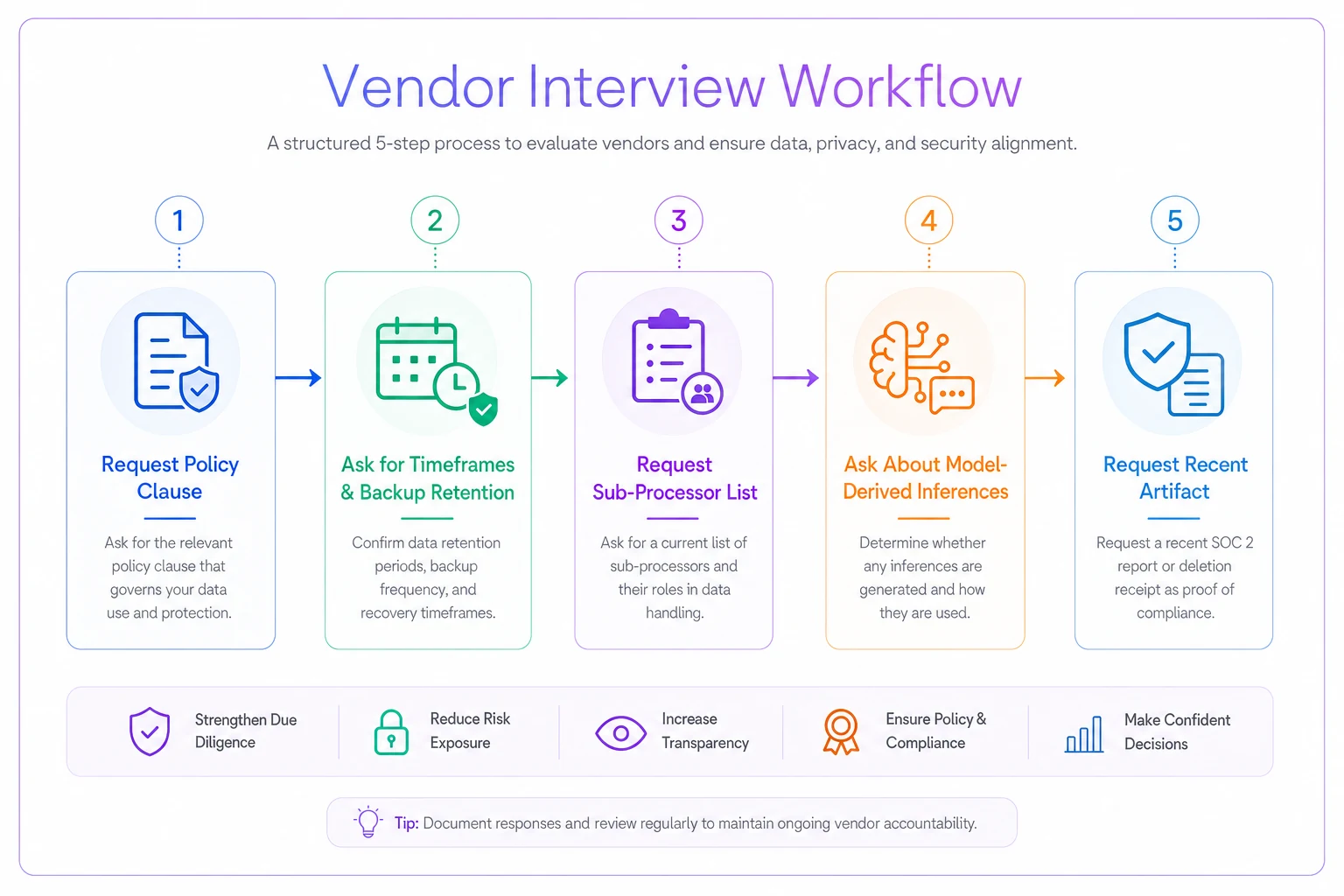
Ask for one recent artifact — whether they'll share it is a quick transparency test.
Short, specific, and hard to dodge with marketing copy.
The quick real-world version
A three-person consulting firm was comparing two AI budgeting tools to roll out to its contractors. Both had clean-looking privacy pages.
The first answered all six RFI questions in writing within a week — including a named sub-processor list and a sample deletion receipt. The second took eleven days, couldn't produce a DPA for its analytics vendor, and described ad practices as "we may work with marketing partners." Same price point, roughly $6–8 per user monthly. They went with the first. Not because its features were better, but because the second vendor's answers kept dissolving into "may" and "partners." That ambiguity was the finding.
Bottom of the stack: what to remember
The checklist above isn't about paranoia. It's about matching the sensitivity of the data to the diligence you apply before handing it over. Transaction history is one of the most revealing datasets about a person that exists outside a doctor's office, and AI apps are specifically built to learn from it.
Read the answers closely. Specificity signals good practice; vagueness signals the opposite. Ask about inferences, not just training. Get deletion timeframes in writing. And if a vendor can't tell you where your deleted data lives, treat that as the answer to every other question you were about to ask.
Download the one-page checklist PDF and the copy-paste RFI snippet to drop straight into your vendor evaluation.
Ready to master your money?
Join thousands of users leveraging Savioly to build smarter budgets, save more efficiently, and plan for a secure financial future.