



Most people don't have a money problem. They have a governance problem.
They know how much they earn. They roughly know where it goes. They've got a budget app, maybe a spreadsheet, a couple of automated transfers. And yet every few months something wobbles—a surprise tax bill, a savings goal that quietly stalled, a rebalance that never happened because nobody was actually watching the account. The pieces exist. What's missing is the machinery that makes them work together on a schedule.
That's the difference between a pile of financial tools and a personal financial operating system. The system isn't a fancier budget. It's the recurring reviews, defined metrics, and pre-made decision rules that keep everything coordinated as your life gets more complicated.
The real failure: no close, no cadence, no rules
Here's the pattern that shows up once you look at how people actually manage money over a full year rather than a single month.
Everything works when income and expenses are simple. One paycheck, predictable bills, a savings transfer on the 1st. The trouble starts when the moving parts cross some invisible threshold—usually when a second income shows up, or equity comp enters the picture, or you're suddenly juggling three savings goals, two debts, a side income, and quarterly taxes simultaneously.
At that point people don't fail because they're irresponsible. They fail because they're managing a growing operation with no operating rhythm. No monthly close to confirm the numbers are real. No quarterly review to ask whether the plan still fits. And no decision rules written down in advance, so every financial choice becomes a fresh negotiation with themselves—usually late at night, usually emotionally charged.
Businesses solved this problem a long time ago. Even small ones run a monthly close and a quarterly review because without them, the founder is flying on gut feel. Individuals almost never borrow the concept, even though the underlying problem is identical: information scattered across accounts, decisions made reactively, and no checkpoint where someone confirms reality matches the plan.
Three layers that hold a money system together
A functional personal financial operating system has three layers. Miss any one and the whole thing degrades quietly.
Take charge of your finances with clarity and confidence.
Savioly gives you real-time visibility and actionable steps to improve your money management.
- Automated expense tracking
- Goal-based saving plans
- Personalized financial insights
No credit card required
Governance is the rhythm—the monthly close and the quarterly review. It's when you look and what you confirm.
KPIs are the small set of numbers that tell you whether things are actually healthy, not just whether you felt frugal this month.
Decision rules are the pre-committed responses—"if X happens, I do Y"—that remove willpower from the equation.
Most people have zero of the three, or maybe a weak version of one. They "check their accounts sometimes" (no real governance), they track spending but not financial health (weak KPIs), and they decide everything in the moment (no rules). The value isn't in any single layer. It's in how they reinforce each other. The close feeds the KPIs. The KPIs trigger the rules. The rules get reviewed and adjusted quarterly. Round and round.
The monthly close: 45 minutes that prevents most disasters
A personal monthly close is not budgeting. Budgeting is forward-looking guessing. The close is backward-looking confirmation. You're answering one question: did last month actually happen the way I think it did?
A close that takes under an hour and catches the stuff that silently compounds:
-
Reconcile every account. Pull balances for checking, savings, credit cards, brokerage, and any loans. Confirm the transfers you think fired actually fired. This is where people discover the "automatic" savings transfer that quietly bounced two months ago.
-
Categorize anything uncategorized. You're not judging yet—just making sure the data is clean enough to trust.
-
Record your KPIs. Log four or five numbers (below) into a simple sheet. One row per month. This single habit turns money into a trend instead of a snapshot, and that's where most of the value lives.
-
Flag anomalies. Anything more than roughly 20–25% off its normal range gets a note. Not action yet—just a flag.
-
Confirm next month's obligations. Big bills, quarterly tax dates, annual renewals landing soon. A 30-second look forward.
Here's a simple workflow to visualize what you should do each month during the close.
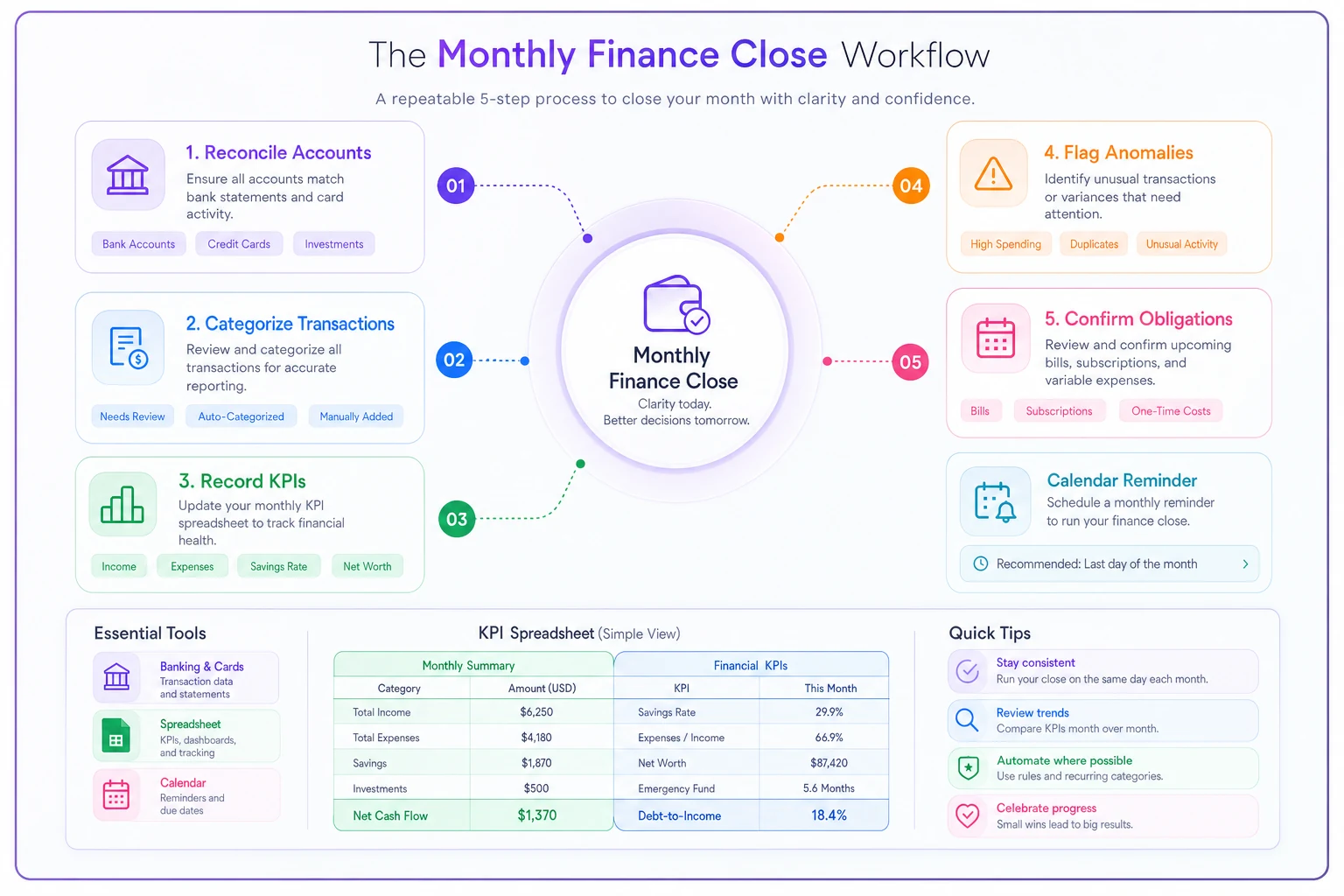
The value of the close isn't in any single month. It's in month seven, when you glance at your KPI sheet and realize your savings rate has been sliding for four consecutive months and you never noticed because each individual month felt fine. Reality drifts slowly. The close is how you catch it before it becomes a crisis.
A common mistake is over-engineering the whole thing. People build a monster spreadsheet with 40 categories, use it twice, and abandon it. The close only survives if it's boring and fast. If it takes more than an hour, you'll skip it the month you're busy—which is exactly the month you needed it most.
KPIs that actually mean something
Spending totals feel like a metric but they're mostly noise. What you want is a handful of numbers that describe the health of your financial operation. Here's a working set with rough targets—adjust for your situation, and don't treat these as gospel.
| KPI | What it measures | Rough healthy range | Why it matters |
|---|---|---|---|
| Savings rate | % of net income saved/invested | 15%+, higher if you can | The single best predictor of long-term outcomes |
| Runway (months) | Liquid cash ÷ core monthly expenses | 3–6 months (more if income is variable) | How long you survive with zero income |
| Fixed-cost ratio | Fixed obligations ÷ take-home pay | Under ~55% | High values mean you can't flex when income drops |
| Debt-service ratio | Monthly debt payments ÷ take-home | Under ~20% (ex-mortgage lower) | Early warning for overleverage |
| Net worth trend | Direction over trailing 3 months | Rising, or explainably flat | The honesty check on everything else |
The insight most people miss: KPIs are only useful as trends against yourself, not comparisons to strangers on the internet. Your fixed-cost ratio creeping from 48% to 56% over a year tells you something real—you've quietly taken on obligations that reduce your ability to absorb a shock. Whether 56% is "good" in the abstract is almost irrelevant. The direction is the signal.
Keep the list short. Track five things well and you'll actually respond to them. Track fifteen and you'll respond to none, because a dashboard with fifteen numbers becomes a wall of anxiety you learn to scroll past.
Decision rules: deciding once instead of every time
This is the layer that separates a system from a habit. A decision rule is a pre-committed response you write down while you're calm, so your stressed-out future self doesn't have to improvise.
The structure is always the same: a trigger, a threshold, and an action.
-
If runway drops below 3 months → pause discretionary investing, redirect surplus to cash until back above 4.
-
If a windfall over ~$2k arrives → it sits in a holding account for 30 days before any allocation decision.
-
If credit card balance isn't fully paid in a given month → next month's "wants" budget is cut by half until it's cleared.
-
If net worth trend is flat or down for two consecutive closes → the next quarterly review gets a mandatory deep-dive, not a skim.
Rules work for behavioral reasons, not mathematical ones. Financial mistakes are rarely calculation errors—they're emotional decisions made under pressure. The rule moves the decision to a moment when you were thinking clearly. When the trigger fires later, you're not deciding anything; you're executing a decision you already made. That's a completely different cognitive load.
The trap is writing rules too vague to actually fire. "Spend less when money's tight" is not a rule—it's a wish. A rule needs a specific number and a specific action that a slightly-panicked version of you could follow without thinking. If you can't execute it on autopilot, tighten it.
The quarterly review: where the plan gets to change
The monthly close confirms reality. The quarterly review decides whether the plan still fits reality. These are different jobs, and blending them is a common mistake—people try to make big strategic decisions during a rushed monthly check and end up doing neither well.
Every quarter, sit down for maybe an hour and work through four questions:
-
Did the KPIs move the way I expected? If not, why?
-
Did any decision rules fire, and did they work? A rule that never fires might be badly calibrated. One that fired and felt wrong needs rewriting.
-
Have my goals or circumstances changed? New job, raise, kid, move, market shift.
-
What one thing do I adjust for next quarter? Just one. Systems degrade when you change everything at once and lose track of what caused what.
The quarterly rhythm is also where you catch the slow structural stuff the monthly close is too zoomed-in to see: lifestyle inflation eating a raise, a savings goal that's technically funded but at a pace that won't hit the deadline, an allocation that drifted with the market. Monthly is for drift. Quarterly is for structure. Annual is for direction.
A real scenario
Consider a dual-income couple, combined somewhere in the $140k–$150k range, with one variable freelance income. On paper they were doing everything right—maxing one retirement account, auto-saving, no consumer debt beyond a car loan. But every spring they got blindsided by a tax bill in the low thousands, and their "emergency fund" had quietly been raided three times over eighteen months without anyone consciously deciding to touch it.
The problem wasn't income or discipline. It was the absence of any governance at all. Nobody was closing the books, so the emergency fund erosion was invisible until it was nearly gone. Nobody had a rule for the variable income, so tax money got spent as though it were discretionary.
They set up a bare-bones monthly close—roughly 40 minutes, one shared spreadsheet with five KPI columns—plus two decision rules: 25% of every freelance payment moves to a tax-and-holding account immediately, and any emergency fund withdrawal requires a written note in the sheet stating the reason and the replenishment plan.
Nine months later, the results were unremarkable in the best way. The spring tax bill was fully pre-funded. The emergency fund stopped leaking because "just this once" now required writing down a justification, which killed most of the impulse withdrawals. Their savings rate ticked up a few points—not because they earned more, but because money stopped falling through cracks nobody was watching. No new app. No new expense. Just a rhythm and two rules.
When this makes sense—and when it's overkill
It makes sense when you've got multiple income sources, several competing goals, variable income, equity comp, or a partner whose financial decisions interact with yours. Basically, whenever the moving parts have outgrown your ability to hold them all in your head at once.
It's overkill when your finances are genuinely simple—one steady paycheck, no debt, one savings goal. At that stage a single automated transfer beats a governance ritual. Don't build a control tower for a bicycle.
Who should skip this entirely: anyone who'd use "building the system" as a way to avoid the harder work of actually spending less or earning more. The operating system organizes and coordinates. It doesn't manufacture money. If the underlying numbers don't work, a polished monthly close just gives you a very organized view of a sinking ship.
Keeping it running without new software
You can run the entire thing in a spreadsheet and a recurring calendar block. The minimum viable setup:
-
One spreadsheet with a KPI tab (one row per month) and a rules tab (your trigger-threshold-action list).
-
A recurring monthly calendar event, ideally the first weekend after your last paycheck of the month clears.
-
A recurring quarterly event, 60–90 minutes, scheduled a full year out so it doesn't feel optional.
-
A holding account for windfalls and variable income so decisions have a place to wait.
-
A short written charter—half a page—stating what the close covers and what the review covers, so you're not reinventing the process each time.
If you already use budgeting or account-aggregation tools, they can feed the reconciliation step and pull balances automatically, which shaves the tedious part of the close down considerably. The tooling is optional, though. The rhythm and the rules do the heavy lifting; software just reduces the friction of gathering numbers. Plenty of people run this well with nothing but a spreadsheet they've had open for years.
The point
A personal financial operating system isn't about tracking more or restricting harder. It's about installing the three things that keep any operation coordinated as it grows: a rhythm that confirms reality, a small set of numbers that reveal health, and decisions made once instead of a hundred times under pressure.
Most personal finance setups don't break because of a missing feature or the wrong app. They break because they were never built to be operated—just set up once and hoped for. Set-and-forget works until life adds a variable, and then the whole thing needs governance it never had. Build the rhythm first. The rest follows.
Ready to master your money?
Join thousands of users leveraging Savioly to build smarter budgets, save more efficiently, and plan for a secure financial future.