

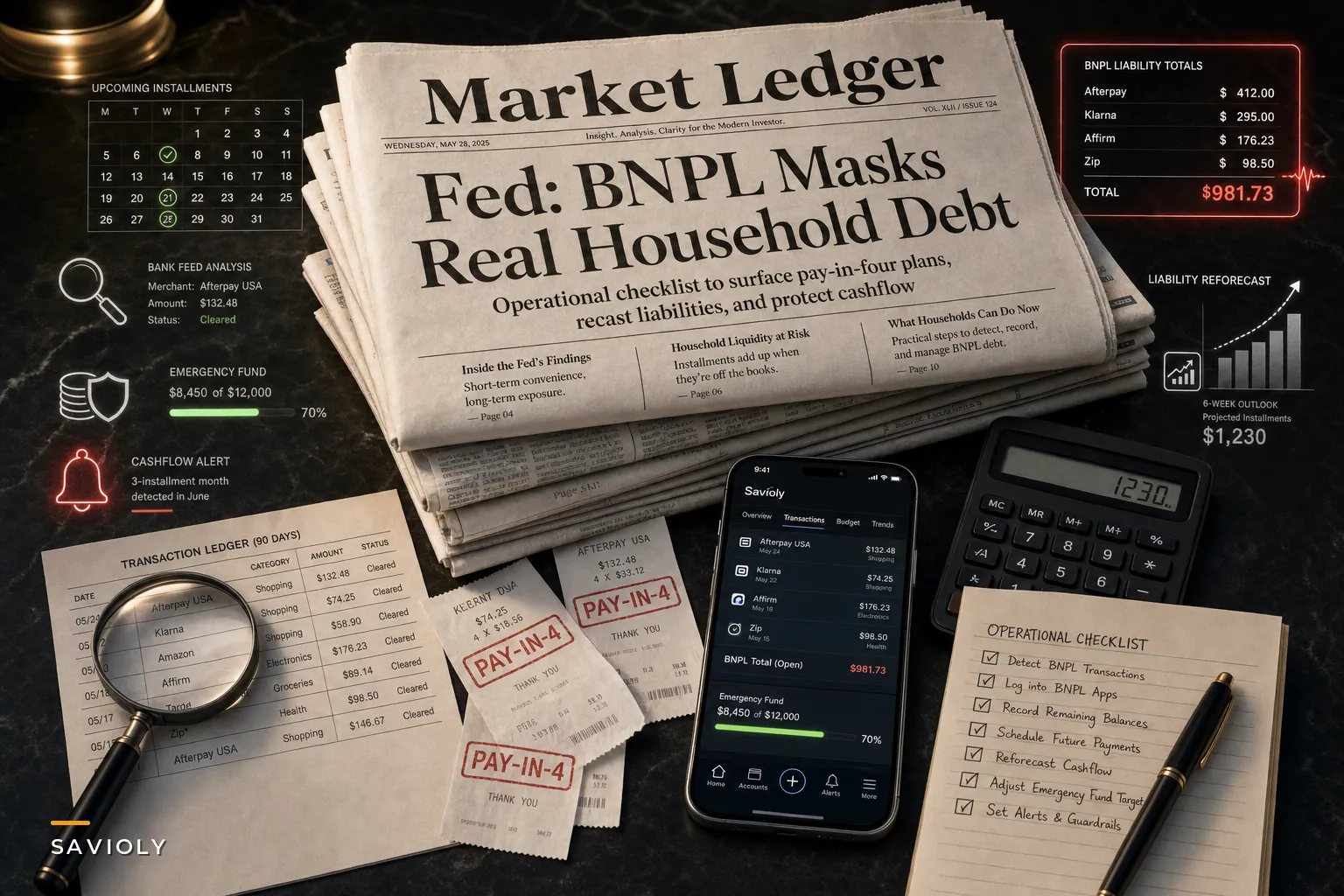

Most budgets track what shows up on statements. That's exactly the problem with pay-in-four. When you split a $240 pair of sneakers into four $60 payments, nothing about that transaction behaves like the debt it actually is. It doesn't hit your credit card as one lump. It doesn't appear on your credit report. It doesn't generate a monthly statement you scan. It just quietly pulls $60 from your checking account every two weeks, four times, then disappears—right around the time you've stacked three or four more of these plans on top of it.
The Federal Reserve's August 2026 Consumer & Community Context report put numbers behind what a lot of people already sensed: BNPL use is climbing fast, it's concentrated among younger and lower-liquidity households, and the vast majority of pay-in-four loans never touch the credit bureaus. So you have a growing category of real obligation that's invisible to the two systems most people rely on to understand their debt—their credit report and their monthly budget.
That's not a moral panic about spending. It's a visibility problem. And visibility problems are fixable.
The real issue isn't BNPL—it's that it hides from every tool you use
A credit card at least forces a reckoning once a month. You get a statement, a minimum payment, a balance staring at you. BNPL skips all of that. The obligation lives in four separate app accounts—Klarna here, Afterpay there, a Shop Pay installment buried inside a Shopify checkout—and each one only tells you about its slice.
So when you sit down to budget, you're looking at a checking account full of small biweekly withdrawals that look like noise. $47.50 here. $62 there. $38 twice a month. None of them individually looks like debt. Collectively they might be $400–$500 a month in scheduled outflow that your budget has never named, categorized, or forecasted.
The pattern worth flagging: BNPL doesn't show up as debt in your head because it never showed up as debt in your tools. People who'd never carry a $1,200 credit card balance without noticing will happily carry $1,200 across five pay-in-four plans and describe themselves as "basically debt-free." Both are real liabilities. Only one is visible.
A quick way to see the damage: the biweekly drain math
Because pay-in-four runs on a two-week cadence rather than monthly, it interacts with your cashflow in a way that catches people off guard. Two-week cycles don't line up with monthly rent, monthly salary, or a monthly budget. Roughly twice a year you hit a "three-payment month" where a biweekly obligation pulls three times instead of two.
Take charge of your finances with clarity and confidence.
Savioly gives you real-time visibility and actionable steps to improve your money management.
- Automated expense tracking
- Goal-based saving plans
- Personalized financial insights
No credit card required
| Plan | Purchase | Per-payment | Biweekly? | Monthly drain (avg) |
|---|---|---|---|---|
| Electronics (headphones) | $220 | $55 | Yes | ~$110 |
| Grocery split | $180 | $45 | Yes | ~$90 |
| Clothing | $160 | $40 | Yes | ~$80 |
| Home item | $320 | $80 | Yes | ~$160 |
| Concert tickets | $240 | $60 | Yes | ~$120 |
That's roughly $560/month in obligations that likely never entered the budget as a line item—and in a three-payment month, it spikes closer to $700–$840. If your emergency reserve was sized against a budget that ignored all of this, your actual runway is shorter than you think.
The checklist: surface every pay-in-four plan
Do this once, thoroughly, then keep it maintained. The first pass takes maybe 30–40 minutes.
-
Pull the last 90 days of checking and debit transactions. Ninety days catches most active plans since pay-in-four typically runs six weeks.
-
Search for the merchants. Filter for Klarna, Afterpay, Affirm, Zip, Sezzle, PayPal Pay in 4, Shop Pay Installments, and any recurring same-amount biweekly withdrawals you don't recognize.
-
Log into each BNPL app directly. The transaction feed only shows past payments. The app shows remaining payments—the part your budget actually needs.
-
Write down every open plan with
merchant, total remaining balance, per-payment amount, payment frequency, and next payment date.
-
Total the remaining balances. This is your off-report BNPL liability. Add it to your household debt picture immediately.
-
Flag anything due in the next 14 days so you don't get caught by a payment your budget never planned for.
-
Note which plans (if any) report to credit bureaus. Most won't, but some longer installment products—especially Affirm's longer-term loans—sometimes do. This matters for credit planning, not just cashflow.
Label identified BNPL merchants consistently in your transaction export so future audits are faster.
The output of this checklist is a single number and a short list. That's it. But that number belongs on your balance sheet, not dissolved into a fog of tiny debits.
Turn plans into scheduled liabilities (not vibes)
Surfacing the balance is step one. The more useful move is converting each open plan into a scheduled liability—a set of dated, known future payments—so your cashflow forecast actually reflects reality.
-
Create a dedicated budget category called "BNPL / Installments." Don't scatter these across "shopping" and "groceries." You want the total drain visible in one place.
-
Enter each open plan's remaining payments as future dated transactions. If you have a $60 payment due every two weeks for three more payments, that's three entries, not one vague estimate.
-
Recalculate your true monthly obligation, and specifically identify any three-payment months coming up in the next six months.
-
Re-run your emergency-fund math against the new, higher fixed-obligation number. If your reserve was "three months of expenses," those expenses just went up.
-
Set a rule
no new pay-in-four plan opens until an existing one closes.
A hard cap on concurrent plans is the single most effective guardrail. Two open plans at a time is a reasonable default for a tight-liquidity household.
This is exactly the kind of hidden obligation that a proper balance-sheet habit is designed to catch. If you haven't set one up, the approach in governing your household balance sheet to surface hidden liabilities is the natural home for BNPL totals—it treats these plans as the liabilities they are instead of letting them hide inside transaction noise.
Once you have everything mapped out, it helps to visualize how these steps connect—especially for anyone managing multiple plans at once:
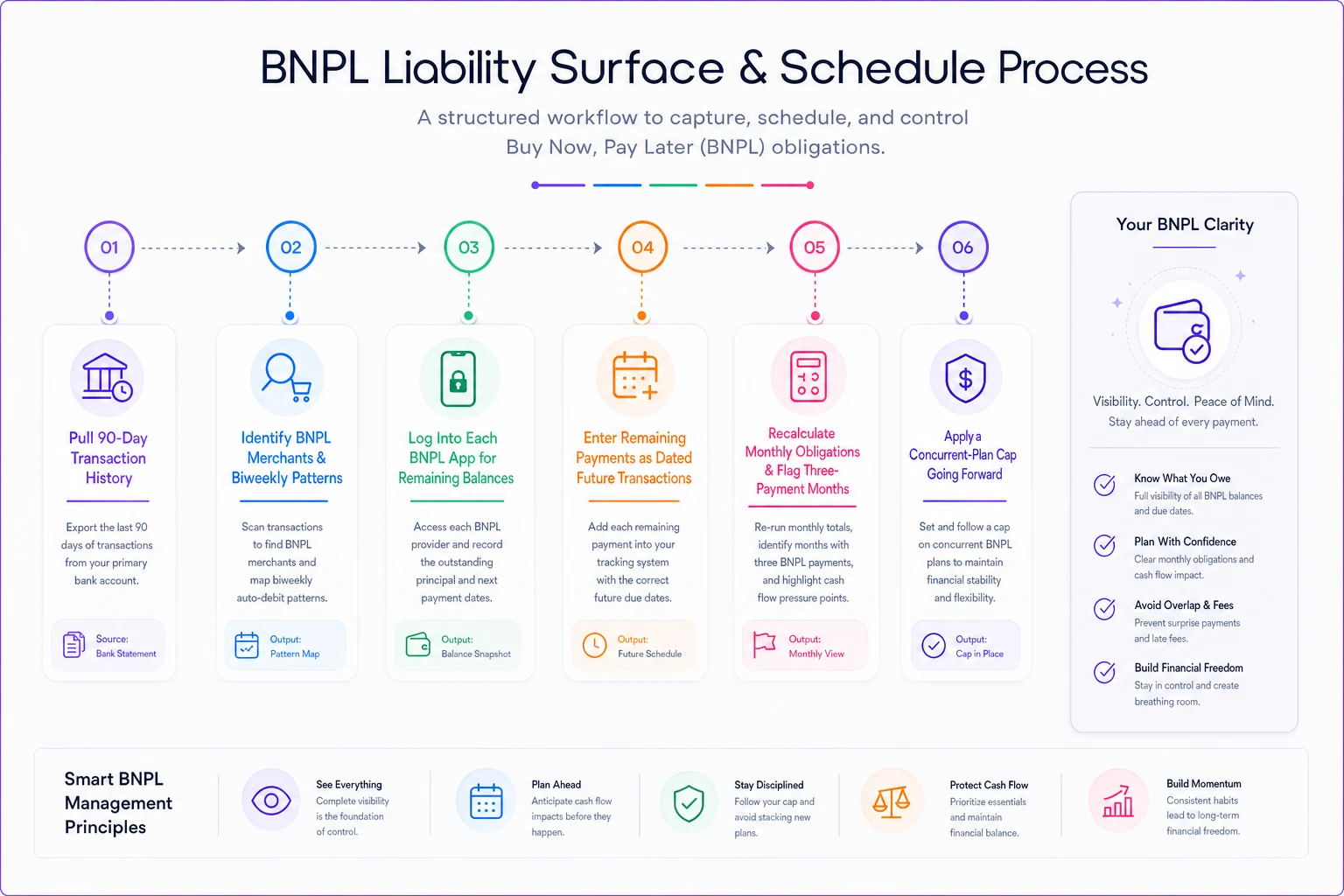
Seeing it laid out linearly makes it easier to hand off to a partner or revisit six months later without starting from scratch.
Where a good money app quietly helps (and where it doesn't)
Manual tracking works, but it decays. You do the 40-minute audit once, feel good about it, and three months later there are four new plans nobody logged. Maintenance is the hard part.
AI-assisted budgeting tools genuinely earn their place here—not through anything flashy, just pattern detection. A tool watching your transaction feed can auto-detect BNPL merchants and biweekly same-amount debits, tag them, and prompt you to add the remaining plan balance manually (since it can't see inside Klarna's account). It can adjust your cashflow forecast for the biweekly cadence automatically and flag three-payment months before they surprise you. It can also throw an alert when your BNPL obligations climb past a threshold you set—say, more than 8–10% of monthly income—which is often the early warning that liquidity is tightening.
What software can't do is see obligations that only exist inside a third-party app you haven't connected. So the honest version: automation catches the pattern, you supply the balance. Together that's a maintained system instead of a one-time cleanup.
When pay-in-four is genuinely fine—and when it's a warning sign
Not all BNPL use is a problem. A quick decision frame:
It's reasonable when: you'd have bought the item anyway, you can cover all four payments from current income without touching savings, it's a one-off, and you have zero or one other plan open. In that case it's just a short-term, interest-free cashflow convenience.
It's a warning sign when: you're using it for groceries or other consumables, you have three or more plans running simultaneously, you're opening new plans to smooth over the drain from old ones, or you genuinely can't state your total outstanding balance without logging into every app. That last one—not knowing the number—is the clearest signal that BNPL has outrun your visibility.
Who should probably avoid it entirely: anyone whose emergency reserve is under one month of expenses. When liquidity is that thin, a three-payment month or a single unexpected bill can turn convenient installments into missed payments and fees fast.
Real scenario: a two-income household that "had no debt"
A couple with combined income somewhere around $6,200/month after tax described themselves as carrying no debt beyond their car. No credit card balances, good on paper. But their checking account felt tighter every month and they couldn't explain why.
The 90-day audit turned up six open pay-in-four plans across three providers—an air fryer, two clothing orders, a phone accessory bundle, holiday gifts, and a set of tires split into four. Total remaining balance: roughly $1,150. Combined monthly drain: about $480, spiking to nearly $700 in the month where two of the biweekly cycles tripled up.
Nothing dramatic happened after they surfaced it. They didn't cancel anything—the plans were interest-free and already in motion. But they logged all six as scheduled liabilities, set a two-plan cap going forward, and rebuilt their emergency-fund target against the true fixed-obligation number, which had been understated by close to $500/month. Within a couple of months the checking account stopped feeling mysteriously tight. Mostly because they finally knew what was leaving and when.
The takeaway
BNPL isn't dangerous because it's expensive—most pay-in-four is interest-free. It's dangerous because it's invisible to the exact tools you use to understand your money.
The Fed's report is a useful nudge, but the fix has nothing to do with policy and everything to do with process: find every open plan, write down the remaining balances, convert them into dated future payments, and re-size your reserves against the real number. Do that, and pay-in-four goes back to being a convenience instead of a blind spot.
BNPL isn't dangerous because it's expensive—most pay-in-four is interest-free. It's dangerous because it's invisible to the exact tools you use to understand your money.
The Fed's report is a useful nudge, but the fix has nothing to do with policy and everything to do with process: find every open plan, write down the remaining balances, convert them into dated future payments, and re-size your reserves against the real number. Do that, and pay-in-four goes back to being a convenience instead of a blind spot.
Ready to master your money?
Join thousands of users leveraging Savioly to build smarter budgets, save more efficiently, and plan for a secure financial future.