



There's a strange asymmetry in how households manage money. People will refresh their brokerage app four times a day to watch a stock tick up 1.2%, but they haven't looked at their actual liability picture — the whole picture — in years. Not the mortgage balance they vaguely remember. The whole thing: the cosigned car loan for a sibling, the HELOC they opened "just in case" and forgot has a variable rate, the vested RSUs they mentally count as cash but are one bad earnings call away from being worth half.
The asset side of a household balance sheet is easy to admire. The liability side is where financial plans quietly break. And it's not laziness — liabilities are structurally harder to see. They hide inside contracts, contingent obligations, and future events that haven't triggered yet.
A liabilities-first governance system flips the usual approach. Instead of building your plan around what you hope your assets will do, you build it around what you're actually exposed to, then let the asset decisions follow. This post walks through how to run that system: monthly valuation rules, a hidden-liability audit, quarterly stress tests, and decision ladders you can actually use when something moves.
Why liabilities go dark in the first place
The core problem is that a lot of what you owe never shows up on a statement you check regularly.
Your mortgage sends a monthly bill, so it stays visible. But contingent and structural liabilities behave differently. A cosigned loan doesn't bill you — it bills the primary borrower — so it's invisible until they miss a payment and it shows up on your credit report. A lease reads as "rent" mentally, but a 39-month car or equipment lease is a fixed multi-year obligation that behaves exactly like debt. Equity compensation feels like an asset, but the tax liability attached to it — plus the concentration risk — is a liability wearing an asset's clothing.
A consistent pattern shows up across household reviews: people underestimate their total obligations by somewhere between 20 and 40 percent because they only count the debts that actively bill them each month. Everything contingent or embedded gets rounded to zero. That rounding error is fine until a job change, a rate reset, or a family member's financial trouble makes it real all at once.
The second reason liabilities go dark is that they reprice silently. A fixed-rate mortgage is stable. A HELOC, an ARM, a variable private student loan, or a margin balance changes cost without anyone sending you an alert. You find out at the payment level, months after the exposure changed.
The monthly valuation rules
Governance starts with a rule for how you value things, not just whether you list them. Without valuation rules, you'll unconsciously inflate assets and deflate liabilities every single month — it's just how optimism works.
Take charge of your finances with clarity and confidence.
Savioly gives you real-time visibility and actionable steps to improve your money management.
- Automated expense tracking
- Goal-based saving plans
- Personalized financial insights
No credit card required
-
Liquid assets (cash, money market)
face value.
-
Marketable securities
last closing price, no averaging, no "it'll come back."
-
Vested equity comp
current price, then apply a haircut for tax and concentration (more below).
-
Unvested equity comp
value at zero on the balance sheet. It's a hope, not a holding.
-
Real estate
update only quarterly, and use a conservative estimate — the low end of your comp range, not the Zillow number you like.
-
Retirement accounts
current value, but tagged as illiquid so you never mentally spend them.
-
All debts at current balance, including anything that repriced this month.
-
Variable-rate debt gets a note recording the current rate so you can see drift over time.
-
Cosigned or guaranteed debt listed at the full outstanding balance, even if you're not the one paying. You're on the hook for 100%, not your "share."
-
Lease obligations listed as the remaining total of payments, not the monthly figure.
-
Embedded tax liabilities (equity comp gains, deferred capital gains, an underfunded estimated-tax position) estimated and carried as a real line.
The discipline here isn't the math — it's refusing to let each side of the sheet be valued with a different level of optimism. Assets conservative, liabilities complete.
The hidden-liability audit
This is the part almost nobody does, and it's the highest-value hour you'll spend on your finances all year. Once a year — twice if your situation is complex — you go looking specifically for obligations that don't bill you monthly.
-
Cosigned and guaranteed debt. Anything you signed for that someone else uses — a car for a kid, a lease for a parent, a business line for a co-founder. Pull your credit report to catch ones you forgot. These are full liabilities to you regardless of who pays.
-
Leases. Car, equipment, sometimes a solar agreement. Add up the remaining payments and treat that number as debt.
-
HELOCs and unused credit lines. An open HELOC isn't a liability until drawn — but it's a latent one, and if it's variable, its terms are drifting. Note the draw period end date; when it flips to repayment, the payment can jump substantially.
-
Equity-comp exposure. Concentration risk plus embedded tax. If a big chunk of your net worth sits in one employer's stock, that's both a liability of correlation (your job and your portfolio can crater together) and a tax obligation waiting to trigger. Our practical equity-comp map goes deeper on how to handle the cashflow and de-risk side of this.
-
Deferred tax positions. Big unrealized gains in taxable accounts, a Roth conversion you're planning, under-withholding. These are real future cash outflows.
-
Recurring contractual commitments. Not subscriptions — the bigger stuff. Alimony, tuition contracts, a multi-year gym or club membership with an early-termination penalty, a support obligation to family.
Pull your credit report annually to catch forgotten cosigns.
A typical example of what this surfaces: a household thinks they carry "about $310k in debt" — mortgage plus one car loan. The audit turns up a cosigned $22k auto loan for an adult child, roughly $9k left on a leased second vehicle, and an $80k HELOC that's fully drawn at a variable rate nobody had checked in 18 months. Real total exposure is closer to $420k, and a meaningful slice of it is variable. Nothing changed in their life — they just finally counted it.
Quarterly stress tests
A balance sheet is a snapshot. Stress tests tell you whether that snapshot survives contact with a bad quarter. You don't need a spreadsheet full of Monte Carlo simulations — three or four concrete scenarios run every quarter is enough.
| Stress scenario | What you're testing | The number that must survive |
|---|---|---|
| Job loss for the higher earner (6 months) | Liquidity + fixed obligations | Months of runway covering all fixed debt + leases + minimums |
| Rate shock: +2% on all variable debt | Cashflow under repricing | New monthly payment vs. current budget headroom |
| Equity-comp drawdown of 40% | Net-worth concentration | Net worth excluding employer stock |
| Cosigned loan goes to you | Contingent liability triggers | Ability to absorb the full payment |
| Home value −15% + forced sale | Underwater / equity check | Sale proceeds vs. mortgage + HELOC combined |
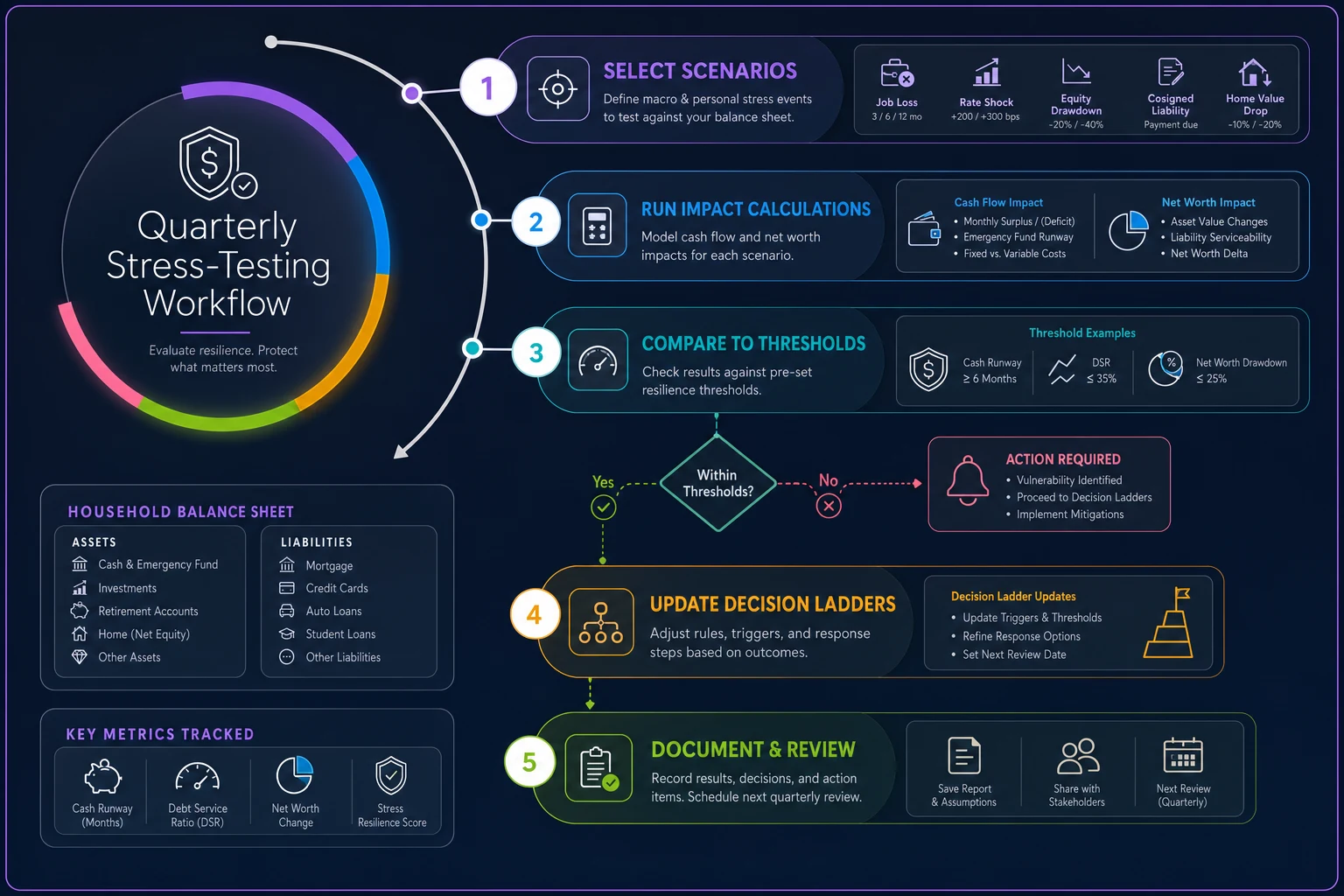
The one people flinch at most is the rate shock. A household with an $80k HELOC and a $60k variable balance elsewhere is carrying $140k that reprices. A 2% jump is roughly $2,800 more per year — not catastrophic in isolation, but it usually arrives alongside inflation and other pressure, and it compounds with the ARM reset they also forgot about.
The point of stress testing isn't to scare yourself. It's to find the scenario where two ordinary events overlap — a job change and a rate reset, an equity drawdown and a big tax bill — because that overlap is where households actually get hurt. Single shocks are usually survivable. The correlated pair is what breaks plans.
Decision ladders: what you actually do when something moves
Stress tests are useless without pre-committed responses. If you decide in the moment how to react to a rate spike or a stock drop, you'll react emotionally. A decision ladder sets the response before the trigger fires, so future-you just executes.
A ladder is a set of "if X, then Y" thresholds. Here's a deleveraging ladder as an example:
Trigger-based deleveraging ladder
-
If variable-rate debt exceeds 15% of total debt → freeze new discretionary spending, redirect the surplus to the highest-rate variable balance.
-
If any variable rate crosses a pre-set ceiling (say, 9%) → evaluate refinancing or a fixed-rate consolidation, and stop treating the HELOC as available liquidity.
-
If total debt-to-liquid-assets exceeds a set line (e.g., 3
1) → pause investing beyond employer match, route cash to debt until the ratio recovers.
-
If stress test shows runway under 3 months → rebuild liquidity first, before any deleveraging or reallocation, even if it feels inefficient.
-
If equity-comp concentration exceeds roughly 20% of net worth → begin scheduled selling regardless of price sentiment.
And a reallocation ladder for the other direction — when things are healthy and you're deciding where surplus goes:
-
Emergency runway below target → cash first.
-
Runway fine, high-rate variable debt present → debt paydown wins over most investing.
-
Runway fine, only low-rate fixed debt → invest per your asset-location plan, prepay only for peace-of-mind reasons.
The mortgage prepay-vs-invest question deserves its own numeric treatment; if that's where your surplus decision keeps landing, the breakdown on refinancing or prepaying a mortgage lays out the thresholds and break-even checks worth running first.
The value of a ladder is that it removes the argument. When the trigger fires, you don't debate — you already decided.
A real scenario
A dual-income household, mid-40s, felt "basically fine." Combined income around $240k, a house they liked, retirement accounts growing. On paper, net worth looked comfortably north of $600k.
The liabilities-first review changed the story. Their vested employer stock — which they'd been counting at full value — made up roughly 35% of net worth, and the embedded tax on it hadn't been provisioned. They had an open HELOC drawn to about $55k at a variable rate that had drifted up nearly 3 points since they opened it. One spouse had cosigned a $28k loan for a family member that never once entered the household's mental math.
Once everything was on the sheet honestly, their real leverage and concentration looked far worse than the net-worth number suggested. The stress test that broke them was obvious in hindsight: a tech-sector downturn would hit the employer stock and the higher earner's job at the same time — perfectly correlated.
The response wasn't dramatic. Over the next three quarters they trimmed the concentrated stock position on a schedule, ignoring price, used a chunk of proceeds to pay the HELOC down to about $18k, and set aside the embedded tax so it stopped being a surprise. Net worth barely moved. But the fragility dropped considerably — the correlated-shock scenario went from "we'd be in trouble" to "we'd be uncomfortable but fine." That's the whole game.
When a liabilities-first system makes sense — and when it doesn't
This approach earns its keep when your balance sheet has moving parts: variable-rate debt, equity comp, cosigned obligations, leases, meaningful embedded tax. The more contingent and repricing exposure you carry, the more this pays off.
It's overkill if your entire liability picture is one fixed-rate mortgage and a car loan you'll clear in a year. A simple monthly check is plenty in that case.
Running this as a source of ongoing anxiety is also a mistake. The goal is to surface exposure and pre-commit responses so you can then stop worrying. If the audit turns into monthly panic, you've missed the point — the whole reason to build the ladder is so you don't re-litigate every decision when the market moves.
Who should not skip it: anyone with concentrated equity comp, anyone who's cosigned meaningful debt, and anyone whose "assets" include a lot of things that can reprice downward at the same time their income does.
Making the system actually run
The failure mode of every governance system is that it's a heroic one-time effort that never repeats. You do a thorough audit in January and never touch it again. By the following January the HELOC has drifted, a new lease appeared, and the equity comp doubled its share of net worth.
The fix is cadence, not effort. Monthly, you do a quick valuation refresh — balances, variable rates, any new obligation. Quarterly, you re-run the stress tests and check whether any ladder trigger fired. Annually, you do the full hidden-liability hunt and reconcile everything. This nests cleanly into a broader annual financial close — the balance-sheet governance is the risk-side counterpart to the goals-and-allocation work that close already covers.
Whether you run this in a spreadsheet with a few tabs or in a tool that pulls balances and flags rate changes automatically, the structure is what matters: consistent valuation rules, a deliberate hunt for hidden obligations, scenario tests that assume things go wrong in pairs, and pre-committed decision ladders so you're not improvising under stress.
Households don't usually get wrecked by the debts they can see. They get wrecked by the ones they forgot to count, the rates they stopped checking, and the correlated shock nobody stress-tested. Governing the liability side first is how you make those invisible obligations visible — early enough to actually do something about them.
Households don't usually get wrecked by the debts they can see. They get wrecked by the ones they forgot to count, the rates they stopped checking, and the correlated shock nobody stress-tested. Governing the liability side first is how you make those invisible obligations visible — early enough to actually do something about them.
Ready to master your money?
Join thousands of users leveraging Savioly to build smarter budgets, save more efficiently, and plan for a secure financial future.