

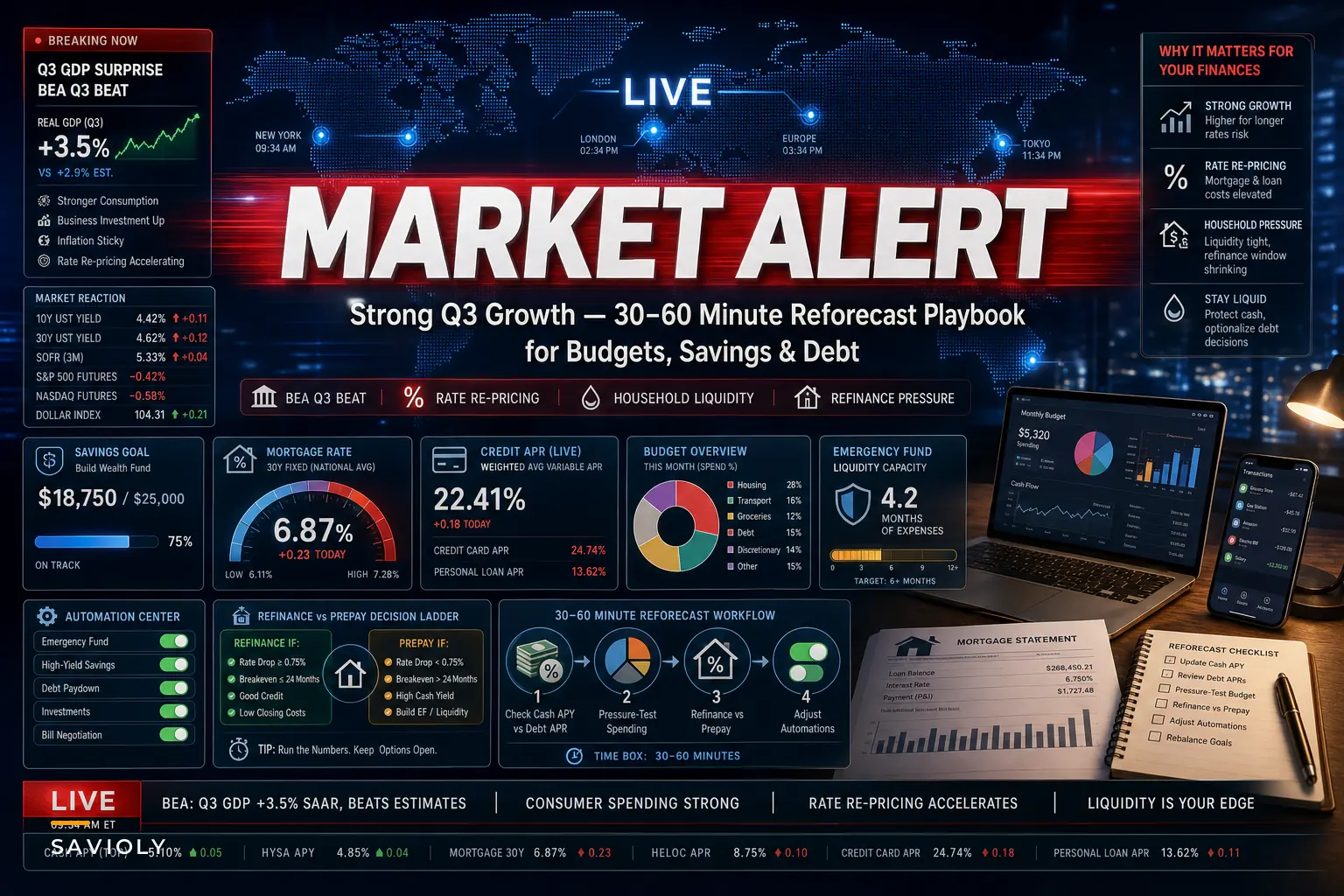

The BEA's advance estimate landed on October 29 showing U.S. real GDP grew 3.4% annualized in the third quarter of 2026 — a stronger-than-expected read that Reuters flagged as an acceleration from the prior quarter. On its own, that number is interesting. For a household running a real budget, the print itself isn't the point. The implications are.
Strong growth with a Fed sitting on its hands shifts the near-term math on three things you actually care about: what you earn on cash, what you pay on variable debt, and how long your discretionary buffer holds if prices stay sticky. None of that requires a finance background. It requires about an hour and a willingness to look at numbers you've been putting off.
This is a reforecast playbook, not a lecture. The goal is to get through it in one sitting — 30 to 60 minutes — and come out with specific changes queued up, not a vague sense that you "should probably look at things."
Why a GDP surprise even touches your budget
Most people treat macro data as noise, and honestly, most of the time they're right. But a growth surprise matters for households because of what it does to expectations, not what it changes today.
When growth comes in hot and the Fed is paused, the market starts pricing a longer stretch of elevated rates. That filters down quickly. Your high-yield savings stays attractive for longer. Your variable debt — HELOC, credit cards, anything tied to the prime rate — stays expensive for longer. And if strong consumer demand keeps certain prices firm, the slack in your discretionary budget gets quietly squeezed even if your paycheck didn't move.
The mistake that keeps showing up: people react to the headline instead of the transmission path. A 3.4% print doesn't mean "the economy is good, go spend." For your household it usually means the cost of carrying debt isn't dropping soon, and cash is still paying you something — plan around both.
There's a deeper problem a reading like this exposes. Most household budgets are built around a single assumed interest and inflation environment and never get re-run when that environment shifts. The budget turns into a fossil. You set it in January, rates and prices moved, and you're still allocating like it's nine months ago.
The 30–60 minute reforecast, start to finish
You don't need to rebuild your budget. You need to run a targeted pass on the four areas a growth surprise actually touches. Work through them in order.
Take charge of your finances with clarity and confidence.
Savioly gives you real-time visibility and actionable steps to improve your money management.
- Automated expense tracking
- Goal-based saving plans
- Personalized financial insights
No credit card required
Keep a running list of your variable-rate accounts and their APRs so step 1 takes less than five minutes.
-
Re-check your cash yield vs. your debt cost (10 min). Pull the current APY on your savings and the current APR on any variable-rate debt. If your card is at 23% and your savings pays 4%, that's a 19-point spread — extra dollars go to debt, full stop. A paused-rate, strong-growth environment keeps that spread roughly where it is for months, so the decision isn't a close call.
-
Pressure-test your discretionary buffer against sticky prices (15 min). Pull the last two months of actual spending in the categories most exposed to firm demand — groceries, dining, travel, home services. If those crept up 5–8% over your budgeted line, your "flexible" money is smaller than your plan thinks. Adjust the budgeted number to reality instead of treating the overage as a one-off.
-
Revisit refinance-vs-prepay logic (10 min). If you were waiting on falling rates to refinance a mortgage or consolidate debt, a strong growth print pushes that window further out. Don't hold liquidity hostage to a rate cut the data just made less urgent. Decide based on today's break-even, not a hoped-for one.
-
Confirm your automations still match the environment (10 min). If your automated savings transfer was sized when your buffer was fatter, and step two just revealed the buffer shrank, the automation might be over-pulling and forcing you into a card you're carrying at 23%. That's the worst loop. Throttle the transfer down to what the new numbers actually support.
Four moves, one sitting.
Here's a quick visual of the four-step pass.
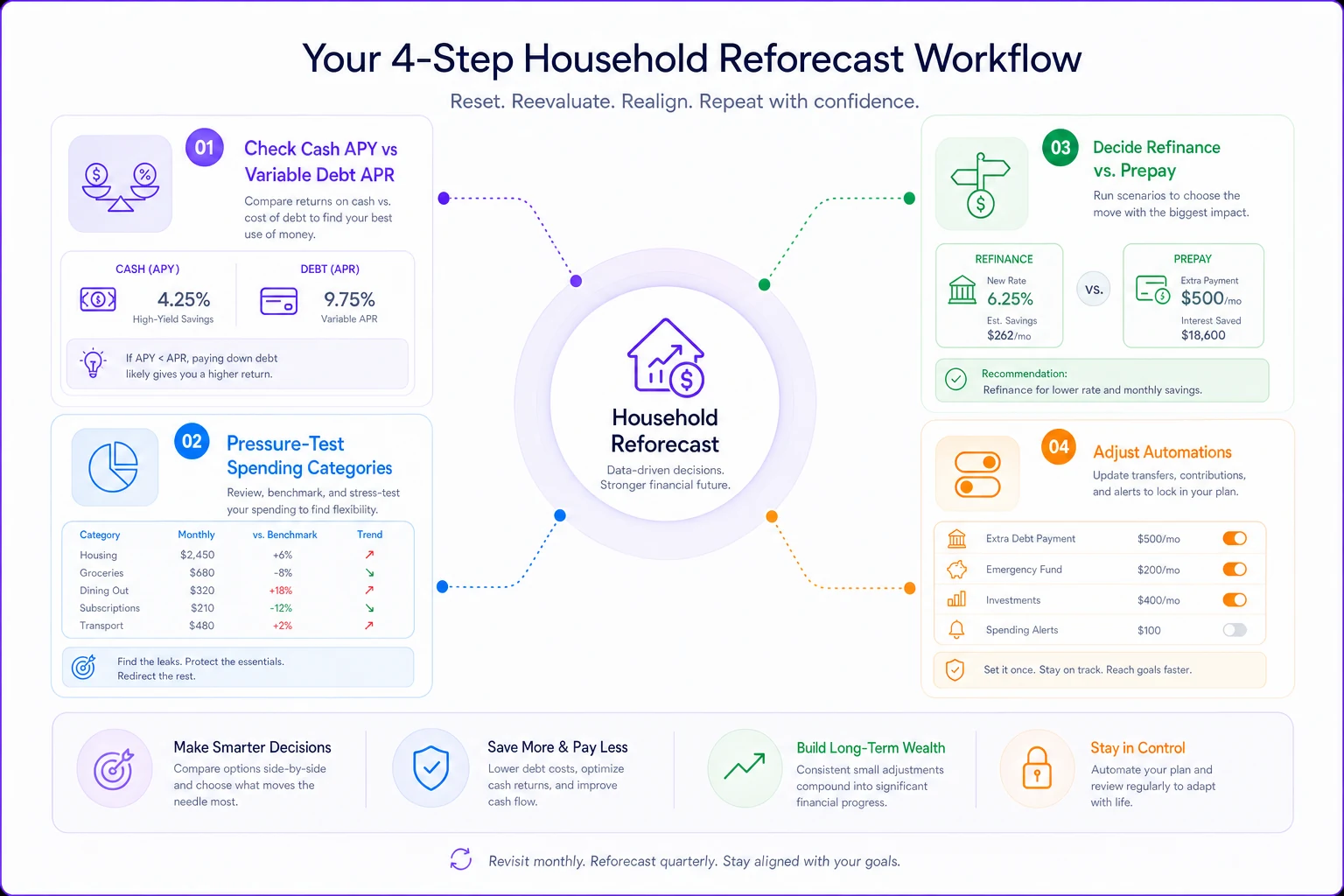
Use it to run the pass in one sitting.
A quick decision table for where the marginal dollar goes
The whole reforecast usually collapses into one question: given the current spread between what you earn and what you pay, where does your next flexible dollar belong?
| Your situation | Cash yield vs. debt cost | Where the marginal dollar goes |
|---|---|---|
| Carrying variable debt above ~15% APR | Debt cost far exceeds cash yield | Debt paydown, almost always |
| Only fixed low-rate debt (sub-5% mortgage) | Cash yield competitive or higher | Savings / investing per your plan |
| Thin emergency fund, any debt mix | Liquidity risk outweighs yield math | Rebuild cash buffer first |
| Strong buffer, no high-cost debt | Yield is attractive, no fires | Rebalance toward long-term goals |
Worth noticing: a strong-growth, paused-rate backdrop doesn't flip any of these rules. It extends how long they stay true. That's the real value of reforecasting after a print like this — you're confirming the current regime has staying power, so you can commit to a direction instead of second-guessing it every week.
A real scenario: the dual-income household fighting its own automation
A household bringing in roughly $9k–$10k a month combined had a savings automation set up 14 months earlier sweeping about $1,400 into a brokerage on the 1st. Good instinct when it was set up, but sized for a cheaper world.
When they ran the four-step pass, two things surfaced. Their grocery and dining actuals had drifted about 7% over the budgeted line — somewhere in the $180–$220 a month range of invisible overage. And they were carrying a rotating card balance that had grown to around $4,800 at roughly 22% APR, because the aggressive sweep kept leaving them short at month-end.
So the automation was "saving" $1,400 a month while quietly funding $4,800 of 22% debt. The sweep moved money into a brokerage returning an uncertain amount while the shortfall it created cost a certain 22%. Guaranteed negative spread.
The fix wasn't complicated. They cut the sweep to $600 for three months, redirected the difference at the card, and re-baselined the grocery and dining lines to the real number. The card was gone in about four and a half months. The sweep went back to $1,400 after that — now funded by actual surplus instead of borrowed money. No new income. Just a reforecast that caught a loop the January budget couldn't see.
When this reforecast matters — and when it's a waste of your hour
When it actually makes sense: You carry variable-rate debt, your budget is more than a few months old, or you have automations that were sized in a different rate environment. If any of those are true, the hour pays for itself.
When you shouldn't over-react: If all your debt is fixed and low, your buffer is healthy, and spending is tracking plan, a single GDP print isn't a reason to restructure anything. A strong number is information, not an instruction. Chasing every data release is how people churn their own finances into a mess.
Who should skip the panic entirely: Anyone whose plan is already built around scenario ranges rather than a single forecast. If you're running lean/base/stretch, you don't reforecast on headlines — you just check which scenario the data nudges you toward and keep moving.
The deeper fix: stop budgeting against a single frozen assumption
A GDP surprise is only disruptive to households that budget as if the economy stands still. The ones that barely blink are already running a light, repeatable close — reconciling actuals, re-checking yields and debt costs, resetting allocations on a cadence instead of in a panic.
That's the real lesson underneath the 3.4% headline. The BEA's full release is a quarterly reminder that the inputs to your plan drift whether or not you're watching. The households that handle it well aren't smarter — they just have a standing process that catches drift before it compounds. If you've never built that rhythm, the cleanest entry point is a compact financial close that reconciles accounts, updates goals, and resets allocations on a fixed schedule, so a surprise print becomes a 20-minute adjustment instead of a stressful scramble.
This is also where personal-finance tooling earns its keep. The tedious parts of this reforecast — pulling current APYs and APRs into one view, flagging when a spending category drifts past its budgeted line, surfacing an automation that's over-pulling and quietly funding a carried balance — are exactly the things software with light automation handles without you babysitting a spreadsheet. The value isn't the dashboard. It's that the drift gets caught early, so your numbers stay honest between manual passes.
Your one-sitting checklist
Run these before you close the laptop:
-
[ ] Pulled current APY on cash and current APR on every variable-rate balance
-
[ ] Calculated the spread and confirmed where the marginal dollar belongs
-
[ ] Compared last two months of actual spending vs. budget in demand-sensitive categories
-
[ ] Re-baselined any category that drifted more than ~5%
-
[ ] Checked whether any savings automation is over-pulling and forcing a carried balance
-
[ ] Throttled or held the automation to match the new numbers
-
[ ] Revisited any refinance-vs-prepay decision that was waiting on falling rates
-
[ ] Wrote down the three changes you're actually making this week
A strong growth print isn't a reason to feel richer or poorer. It's a prompt — a nudge to check whether the assumptions under your budget still match the world you're spending in. Spend the hour, make the changes, and move on. The households that stay calm when the data surprises are just the ones who built the habit of checking.
A strong growth print isn't a reason to feel richer or poorer. It's a prompt — a nudge to check whether the assumptions under your budget still match the world you're spending in. Spend the hour, make the changes, and move on. The households that stay calm when the data surprises are just the ones who built the habit of checking.
Ready to master your money?
Join thousands of users leveraging Savioly to build smarter budgets, save more efficiently, and plan for a secure financial future.