



Asset location is one of those things where doing it right versus winging it can cost you thousands in unnecessary taxes every year. Not asset allocation — that's the mix of stocks and bonds you choose. Asset location is about which account type holds each investment.
Most asset location frameworks are either too theoretical (academic papers with formulas nobody actually uses) or too simplistic ("just put bonds in your IRA!"). What you actually need is something practical that handles real portfolios, real tax situations, and the messy reality of rebalancing across multiple account types.
After building financial tracking systems for a lot of individuals and watching how tax efficiency plays out across different income levels, I keep seeing the same costly patterns. Solid portfolios losing somewhere between 0.5% and 1.5% annually just from putting the wrong investments in the wrong accounts. That compounds to serious money over decades.
Why traditional asset location advice breaks down
The standard advice usually goes: put tax-inefficient investments in tax-advantaged accounts, keep tax-efficient stuff in taxable accounts. That's directionally correct, but it falls apart when you're dealing with:
-
Multiple account types with different contribution limits
-
Income that pushes you between tax brackets year to year
-
Rebalancing needs that force sales across accounts
-
Target-date funds that don't fit cleanly into categories
-
International funds with foreign tax credits
Most frameworks also ignore how your asset location strategy needs to shift as your income changes. What works at $75k doesn't work at $175k, and definitely doesn't work if you're pulling $275k with significant capital gains on top.
The frameworks that do get sophisticated usually require spreadsheets with dozens of inputs or expensive software. Meanwhile, you're left trying to figure out whether that international small-cap value ETF belongs in your Roth or your taxable account while your spouse is asking why this needs to be so complicated.
The income-band framework that actually scales
An asset location framework based on income bands with clear placement rules and turnover thresholds works far better than trying to optimize for every possible scenario. You optimize for your current tax situation with rules that adapt as your income grows.
Take charge of your finances with clarity and confidence.
Savioly gives you real-time visibility and actionable steps to improve your money management.
- Automated expense tracking
- Goal-based saving plans
- Personalized financial insights
No credit card required
The framework breaks into four income bands (using 2024 numbers for married filing jointly):
Band 1: Under $94,375 You're in the 12% bracket or below. Long-term capital gains are taxed at 0%. This completely changes the game — you actually want appreciated assets in taxable accounts so you can harvest those gains tax-free.
Band 2: $94,375 - $206,700 Now you're in the 22% bracket with 15% capital gains. Traditional asset location advice starts making more sense here. Tax-inefficient investments hurt more, but you're not yet at the point where every basis point of tax drag matters.
Band 3: $206,700 - $394,600 Welcome to the 24% bracket. Municipal bonds start looking attractive in taxable accounts. Foreign tax credits become meaningful. You need to think about wash sales across account types when rebalancing.
Band 4: Above $394,600 You're dealing with 32%+ ordinary income rates and 20% capital gains (plus the 3.8% net investment income tax above $250k). Every placement decision matters. Asset location mistakes compound fast here.
The placement hierarchy by account type
Within each income band, here's the priority order for what goes where:
Tax-Deferred Accounts (Traditional IRA/401k)
-
High-turnover active funds (if you use them)
-
Taxable bonds and bond funds
-
REITs and REIT funds
-
High-dividend value funds
-
Commodities and alternatives
These accounts are built for sheltering ordinary income. Since everything comes out as ordinary income when you withdraw anyway, you might as well use them for investments that generate the most ordinary income along the way.
Roth Accounts
-
Highest expected return assets
-
Small-cap and emerging markets stocks
-
Growth stocks and growth funds
-
Assets you'll hold the longest
-
Anything with significant growth potential
The Roth is your growth engine. Everything comes out tax-free, so you want your biggest winners here. That tech stock that might 10x? Roth. That emerging markets fund compounding at 12% for decades? Roth.
Taxable Accounts
-
Tax-managed index funds
-
Broad market ETFs
-
Municipal bonds (if in Band 3+)
-
Foreign tax credit eligible international funds
-
Tax-loss harvesting pairs
Your taxable account is where tax efficiency matters most. Stick to funds with low turnover, qualified dividends, and minimal distributions. Build in tax-loss harvesting pairs from day one.
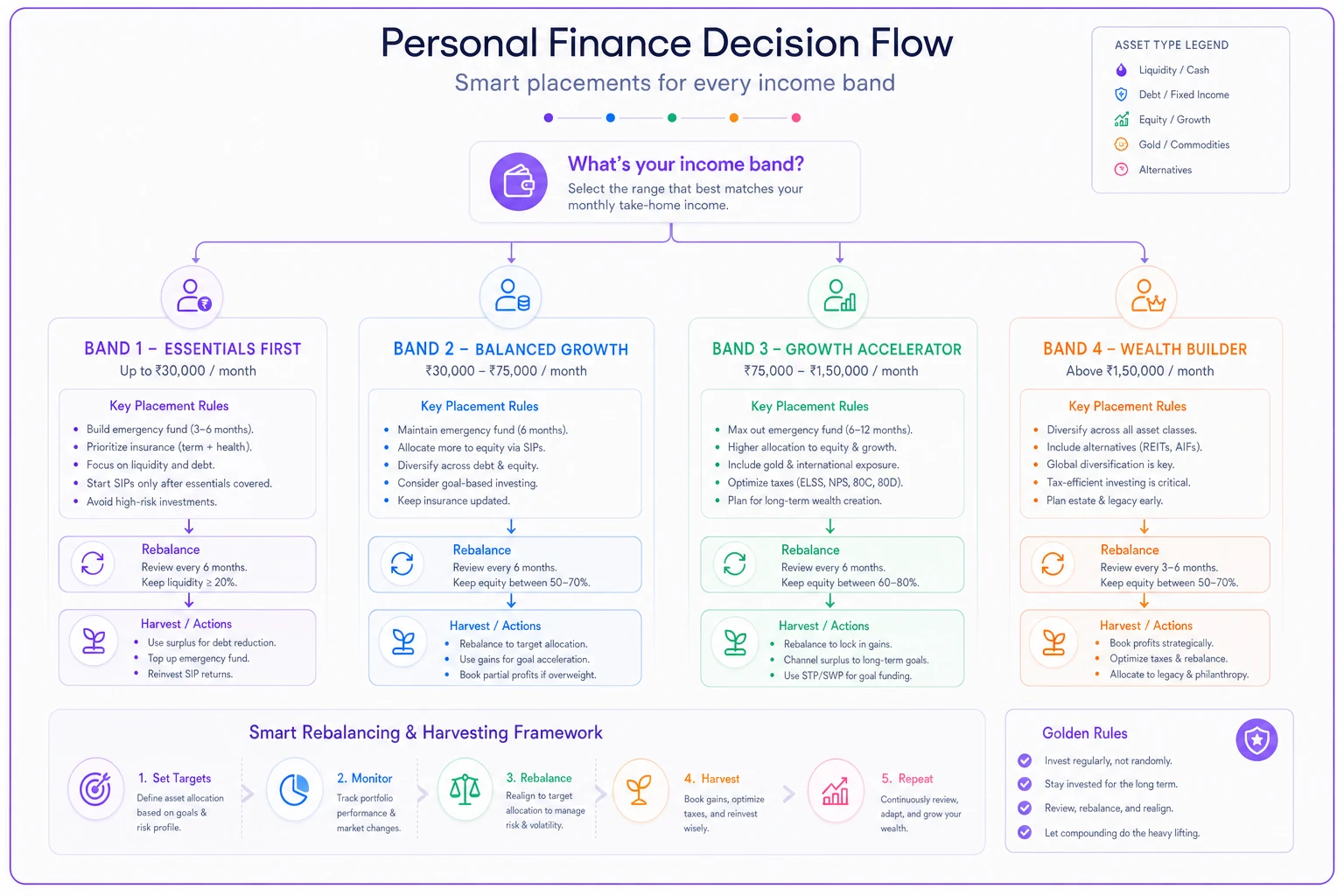
The one-page decision flowchart
Start → What's your income band?
A simple flowchart helps you step through placement rules quickly.
If Band 1:
-
Maximize appreciated assets in taxable
-
Bonds in tax-deferred
-
Growth in Roth
-
Harvest gains annually at 0%
If Band 2:
-
Follow standard placement hierarchy
-
Begin tax-loss harvesting in taxable
-
Keep REITs out of taxable
If Band 3:
-
Consider munis in taxable
-
Maximize foreign tax credits
-
Aggressive tax-loss harvesting
-
Never hold active funds in taxable
If Band 4:
-
Munis likely beat taxable bonds after-tax
-
Maximum Roth conversions during low-income years
-
Consider qualified opportunity zones
-
Daily tax-loss harvesting if possible
Start → What's your income band?
Common portfolio examples with exact placement
Here's how this works with portfolios people actually hold.
The Basic Three-Fund Portfolio
60% Total Stock Market, 30% International Stock, 10% Bonds
Band 1-2 Placement:
-
Taxable
30% International Stock (foreign tax credit)
-
Tax-Deferred
10% Bonds
-
Roth
60% Total Stock Market
Band 3-4 Placement:
-
Taxable
30% International Stock
-
Tax-Deferred
10% Bonds
-
Roth
Split remaining Total Stock Market
Target-Date Fund Plus Tilt
70% Target-Date 2045, 20% Small-Cap Value, 10% REITs
This gets tricky because target-date funds hold everything. Here's the approach:
-
Tax-Deferred
10% REITs, remainder of target-date fund
-
Roth
20% Small-Cap Value
-
Taxable
Only if tax-deferred and Roth are maxed
The target-date fund isn't tax-efficient, but sometimes convenience wins. Just keep it out of taxable if possible.
The Factor-Tilted Portfolio
40% US Total Market, 20% Small-Cap Value, 20% International, 20% Bonds
Optimal Placement:
-
Taxable
20% International, portion of US Total Market
-
Tax-Deferred
20% Bonds
-
Roth
20% Small-Cap Value, remainder of US Total Market
| Portfolio | Band 1-2 Placement | Band 3-4 Placement |
|---|---|---|
| Basic Three-Fund (60/30/10) | Taxable: 30% International Stock; Tax-Deferred: 10% Bonds; Roth: 60% Total Stock Market | Taxable: 30% International Stock; Tax-Deferred: 10% Bonds; Roth: Split remaining Total Stock Market |
| Target-Date + Tilt (70/20/10) | Tax-Deferred: 10% REITs, remainder of target-date fund; Roth: 20% Small-Cap Value; Taxable: Only if tax-deferred and Roth are maxed | Tax-Deferred: 10% REITs, remainder of target-date fund; Roth: 20% Small-Cap Value; Taxable: Only if tax-deferred and Roth are maxed |
| Factor-Tilted (40/20/20/20) | Taxable: 20% International, portion of US Total Market; Tax-Deferred: 20% Bonds; Roth: 20% Small-Cap Value, remainder of US Total Market | Taxable: 20% International, portion of US Total Market; Tax-Deferred: 20% Bonds; Roth: 20% Small-Cap Value, remainder of US Total Market |
Here's how this works with portfolios people actually hold.
Rebalancing across account boundaries
This is where things get genuinely messy. Your asset allocation might be 70/30 stocks to bonds, but if stocks are in your Roth and bonds are in your traditional IRA, rebalancing means... what exactly?
You rebalance by adjusting future contributions first, selling within tax-advantaged accounts second, and touching taxable accounts last.
-
Direct new 401k contributions to bonds
-
Use your IRA contribution to buy bonds
-
If still not balanced, sell stocks within your Roth to buy bonds
-
As a last resort, sell in taxable — but harvest losses where possible
The key is viewing all accounts as one portfolio while respecting the tax boundaries between them. You're optimizing location within your target allocation, not letting location drive your allocation.
Turnover rules and when to break them
Sometimes the "optimal" placement creates too much trading. Here are the turnover limits worth following:
-
Taxable accounts
No unnecessary turnover. Once something is there with gains, it generally stays.
-
Tax-deferred accounts
Rebalance quarterly if needed
-
Roth accounts
Rebalance as often as you want — no tax consequences
When to break these rules:
-
When you're in Band 1 and can harvest gains at 0%
-
During a market crash when you can tax-loss harvest across the board
-
When changing jobs and rolling a 401k to an IRA with better fund options
-
If tax law changes make your current placement seriously suboptimal
Don't let perfect be the enemy of good — a decent asset location strategy implemented beats endlessly optimizing while your money sits in cash.
The automation opportunity
This is exactly the kind of multi-variable problem that humans struggle with consistently. You're juggling tax brackets, account balances, contribution room, rebalancing needs, and trying to minimize taxes while maintaining your target allocation — all at once, across accounts you probably check at different times.
The real challenge isn't knowing the rules. It's implementing them consistently as your situation changes. Your income goes up, you switch jobs, you get married, you inherit money, tax laws shift. Each change potentially affects your optimal asset location, but most people set it once and never revisit it.
AI-powered financial management platforms can continuously monitor your income level, account balances, and tax situation, flagging placement adjustments as you cross income thresholds or when rebalancing opportunities come up. Instead of annual reviews where you realize you've been holding REITs in your taxable account all year, you get placement recommendations that adapt as your situation evolves — without you having to rebuild the analysis from scratch every time.
Special situations that change everything
Early retirement planning: If you're retiring at 45, you need taxable assets to bridge to 59.5. The framework shifts to ensuring enough liquidity outside retirement accounts, even if it means suboptimal placement for a few years.
High state taxes: In California or New York with combined rates over 50%? Municipal bonds become attractive earlier, and state-specific munis might beat treasuries even in tax-deferred accounts.
Concentrated stock positions: Huge embedded gains from company stock warp your entire framework. Sometimes taking the tax hit to diversify is the right call, even if it's painful.
Pension or deferred compensation: These create "phantom" bond allocations that affect your overall strategy. A stable pension is bond-like, so you can reasonably hold more stocks elsewhere.
If you're dealing with withdrawal sequencing in retirement, asset location becomes even more critical since you're optimizing for tax-efficient distributions, not just accumulation.
The implementation checklist
Your action sequence:
-
Calculate your income band (include all income sources)
-
List all accounts with current balances and contribution room
-
Map current holdings to the placement hierarchy
-
Identify misplaced assets that are creating tax drag
-
Plan the transition prioritizing moves within tax-advantaged accounts
-
Set up rebalancing rules based on the turnover thresholds above
-
Schedule quarterly reviews as income or tax laws change
Start with the biggest mistakes first. Actively managed funds churning in your taxable account while index funds sit in your IRA? Fix that immediately. REITs throwing off ordinary income in your taxable account? Move them as soon as you can do so without massive capital gains.
A good asset location strategy implemented today beats a perfect one that never gets off the ground. The tax savings start compounding immediately.
Common mistakes that cost thousands
Holding tax-managed funds in IRAs: You're paying for tax management you don't need inside a tax-deferred account. These funds often carry higher expenses or tracking error specifically to minimize taxes — pointless in an IRA.
Keeping international funds in tax-deferred accounts: You lose the foreign tax credit, which can be worth 0.2% to 0.5% annually. Always check if your international fund qualifies for the credit before defaulting to tax-deferred.
Overweighting munis when you don't need them: Below Band 3, municipal bonds rarely make sense. Run the actual math on after-tax yield rather than assuming munis are automatically better.
Ignoring wash sale rules across accounts: Selling a fund in taxable for a loss then buying it in your IRA within 30 days eliminates the tax loss. The IRS treats all your accounts as connected for wash sale purposes.
Placing based on last year's tax bracket: If your income varies significantly, you need to adjust placement proactively, not after the fact. Going from Band 2 to Band 3 changes optimal placement immediately.
For those dealing with quarterly tax provisioning, getting asset location right also reduces the complexity of estimating quarterly payments since you're minimizing unexpected investment income throughout the year.
Why this framework beats the alternatives
The academic optimal asset location models require inputs most people don't have: expected returns for every asset class, probability distributions of outcomes, correlation matrices, future tax rate assumptions. They produce "optimal" solutions that are impossible to implement in practice.
The simple heuristics ("bonds in IRA!") leave money on the table because they ignore your specific situation. Better than nothing, but not by much.
This framework hits the practical middle ground: sophisticated enough to capture most of the value, simple enough to actually follow. The income bands give you clear transition points. The placement hierarchy tells you exactly what goes where. The turnover rules prevent unnecessary trading.
It also scales with your wealth. The same framework applies whether you have $50k or $5 million, just with different income band rules in play. You don't need to learn a completely new system as your assets grow.
Most investors obsess over asset allocation while ignoring asset location entirely. They'll spend hours debating 70/30 versus 60/40, then blindly dump everything into whatever account has contribution room. That's like carefully selecting premium fuel then putting it in a car with a massive oil leak.
The framework outlined here isn't theoretically perfect, but it's practically effective. Follow the income bands, use the placement hierarchy, respect the turnover limits, and you'll capture most of the benefit with a fraction of the complexity.
The tax savings compound just like returns do. Starting this at 35 versus 45 could mean a meaningful difference in wealth by retirement. Even starting at 55 beats never starting.
Take an hour this weekend to map out where everything currently sits. Figure out which income band you're in. Identify the two or three biggest placement mistakes in your current setup and fix those first. Every basis point of tax drag you eliminate is a basis point of additional compound growth — and over decades, those basis points add up to real money that should be in your pocket, not lost to placement mistakes that were entirely preventable.
Ready to master your money?
Join thousands of users leveraging Savioly to build smarter budgets, save more efficiently, and plan for a secure financial future.