



Most people think of estate planning as a one-time event: draft a will, maybe a trust, sign some paperwork, file it away. Done. But that's not how estates actually transfer. The paperwork in your drawer is often overruled by a set of small forms you filled out years ago and completely forgot about — the beneficiary designations attached to your 401(k), IRA, life insurance, and sometimes your bank and brokerage accounts.
Those designations move first. They don't care what your will says. A retirement account with an ex-spouse listed as primary beneficiary will pay the ex-spouse, even if your will leaves everything to your current partner and kids. Courts have upheld this over and over. The form wins.
So the real work isn't drafting documents once. It's keeping the whole set of designations, titling structures, and access records aligned as your life changes. That's governance work — recurring, boring, and genuinely high-stakes. What follows is a beneficiary audit checklist built around three time horizons: what to do in the next 24 hours, what to clean up in 30 days, and what to review every year.
Why this breaks in normal households (not just complicated ones)
The failure usually isn't negligence. It's that beneficiary designations get created at scattered moments — when you open an account, start a job, buy a policy — and never revisited as a set.
Here's the pattern that comes up constantly:
-
You set a 401(k) beneficiary during onboarding at a job you left six years ago. That account rolled into an IRA, and the designation may or may not have carried over.
-
You opened a Roth IRA before you got married and never touched it since.
-
Your life insurance through work names your estate (the default) instead of an actual person, which forces the payout through probate.
-
You added a payable-on-death (POD) beneficiary to one bank account but not the other three.
-
Your brokerage account is titled individually, so it doesn't automatically transfer to your spouse at all.
Each of those decisions made sense in isolation. The problem is nobody ever looks at them together. There's no single view. And because nothing breaks while you're alive, the misalignment stays invisible until the exact moment it can't be fixed.
What makes this worse: the accounts that transfer outside your will are usually your biggest ones — retirement accounts and insurance. The assets most likely to be misdirected are also the largest ones.
The 24-hour tasks: stop the active bleeding
Some things are urgent because a stale designation right now could send money to the wrong person tomorrow. If you've had any major life event recently — divorce, remarriage, a death in the family, a new child — start here.
Take charge of your finances with clarity and confidence.
Savioly gives you real-time visibility and actionable steps to improve your money management.
- Automated expense tracking
- Goal-based saving plans
- Personalized financial insights
No credit card required
-
Pull up your two largest retirement accounts and read the beneficiary line. Don't assume. Log in and look. Primary and contingent. Write down exactly what it says.
-
Check your life insurance beneficiary — both employer-provided and any private policy. Employer group life very often defaults to "estate," which is almost never what you want.
-
Confirm your spouse or partner can actually access at least one liquid account if something happens to you tomorrow. Not the login-sharing gray area — a legitimate joint account or POD arrangement.
-
Flag anything with an obviously wrong name — ex-spouse, deceased relative, "my estate" as a placeholder. You may not fix it in 24 hours, but you need it on the list.
The point of the 24-hour pass isn't to complete everything. It's triage. You're looking for the "money goes to the wrong human" errors — the ones that create irreversible damage.
Worth noting: the ex-spouse-still-listed problem and the estate-as-life-insurance-beneficiary problem show up together more often than you'd expect. People who forget one usually forgot the other, because both happened during the same distracted life transition.
The 30-day project: build the beneficiary-audit spreadsheet
This is the core of the whole system. A single sheet that lists every account that can name a beneficiary or transfer at death. Once it exists, maintaining it is easy. Building it the first time takes an afternoon or two.
Here's the column structure that actually works:
| Column | What goes in it |
|---|---|
| Account / Policy | "Fidelity Rollover IRA," "MetLife term policy," etc. |
| Institution | Where it lives |
| Account type | 401(k), IRA, Roth, brokerage, checking, life insurance, HSA |
| Titling | Individual, joint (JTWROS), trust, custodial |
| Primary beneficiary | Exact name(s) + % split |
| Contingent beneficiary | Exact name(s) + % split |
| Transfer mechanism | Beneficiary form, POD/TOD, joint title, will/probate |
| Last verified | Date you actually logged in and confirmed |
| Issue flag | Blank, or a short note: "ex still listed," "no contingent" |
A few things this spreadsheet surfaces immediately:
-
Accounts with no contingent beneficiary. If your primary predeceases you and there's no backup, the account falls to probate — the exact outcome you were trying to avoid.
-
Percentage splits that don't total 100% or that don't match your actual intent.
-
Accounts that transfer through probate by default because they're individually titled with no POD/TOD — usually plain brokerage and checking accounts.
The "last verified" column is the underrated one. It turns a static document into a maintenance log. You want a date on every row, and you want that date to be recent. An account you haven't verified in four years is functionally unknown.
Once the sheet is built, the 30-day work is closing the flagged issues:
-
Update stale beneficiaries (submit new forms, save confirmation).
-
Add contingent beneficiaries everywhere they're missing.
-
Add POD/TOD designations to bank and brokerage accounts that should skip probate.
-
Reconcile every split so it reflects what you actually want.
One realistic note on timing: beneficiary form changes often take a couple of weeks to process, and some institutions still require paper or a signature guarantee for certain accounts. Submit early in your 30-day window so you're not chasing confirmations at day 29.
Here's a quick visual of the workflow.
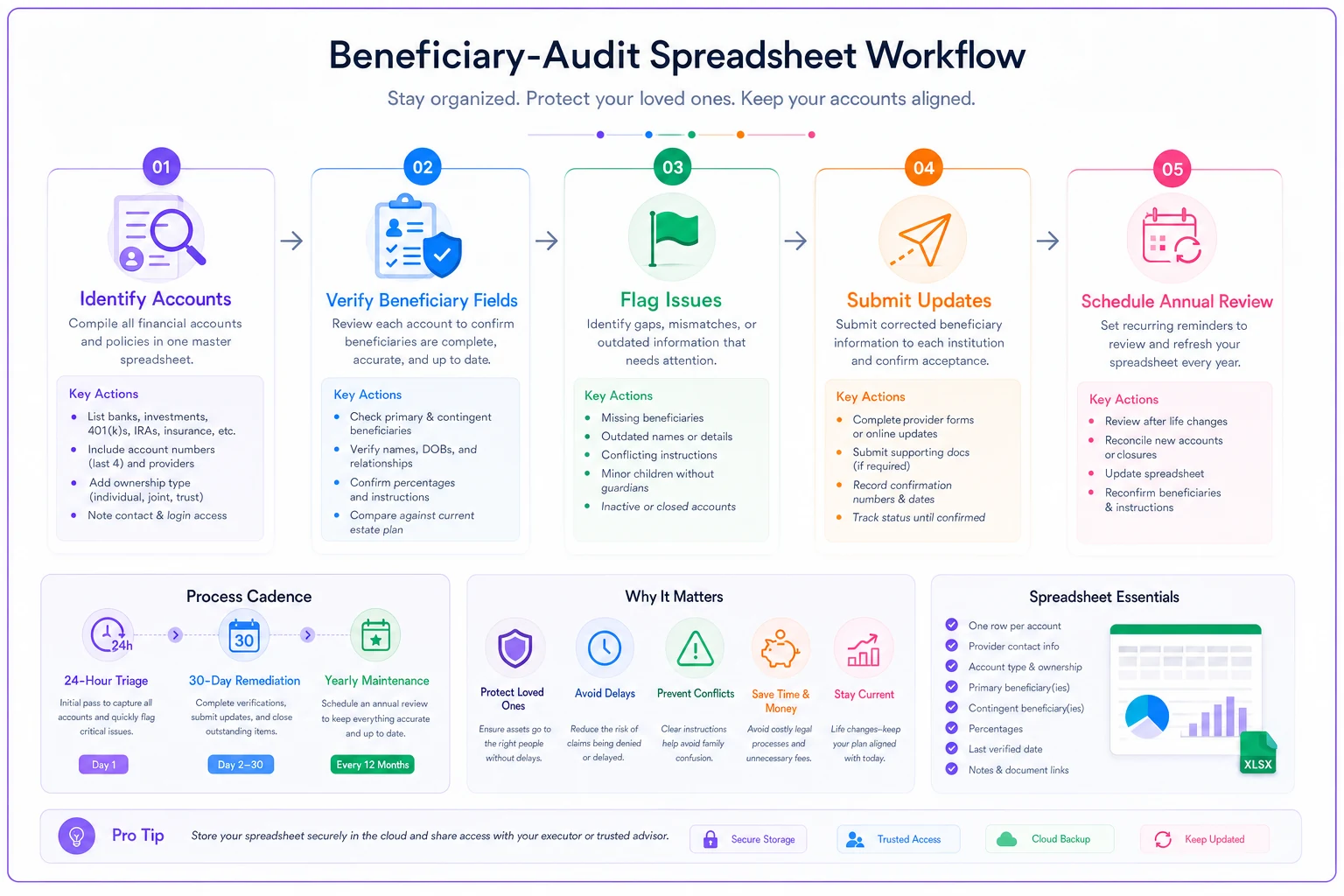
This captures the triage, build, and annual review steps.
Titling heuristics for common account mixes
Beneficiary forms handle retirement and insurance. Titling handles everything else — and it's where most households are quietly exposed, because plain individual accounts don't transfer automatically to anyone.
These are working heuristics for the account combinations most households actually have. Starting points, not legal advice — titling interacts with state law, so anything complex deserves a real attorney conversation.
-
Everyday checking/savings, couple Joint with rights of survivorship (JTWROS) for at least one operating account, so the surviving partner has immediate liquidity without waiting on probate.
-
Secondary savings or a solo account Add a POD beneficiary. Costs nothing, skips probate, keeps the account in your sole control while you're alive.
-
Taxable brokerage, individual Add a TOD (transfer on death) registration. This is the single most-missed one. People assume brokerage assets follow the will — they follow the TOD if one exists, and go to probate if it doesn't.
-
Retirement accounts (401k/IRA/Roth) Always the beneficiary form, never the will. Name a person, add a contingent, and if minor children are involved, coordinate with your attorney rather than naming the kids directly.
-
HSA This one surprises people — naming a spouse vs. a non-spouse produces very different tax outcomes for the beneficiary. A spouse inherits it as an HSA; a non-spouse generally receives it as taxable income in one lump. Worth naming deliberately.
-
Accounts held in a living trust Retitle the account into the trust's name so the trust actually controls it. An unfunded trust — one you set up but never moved assets into — is one of the most common expensive mistakes in personal estate planning.
Save confirmation emails or screenshots after submitting beneficiary changes so you have proof of the update if record-keeping gets messy.
The heuristic underneath all of these: every meaningful account should have an explicit transfer path that isn't "the will." The will is your backstop, not your primary mechanism. Anytime an account's transfer path is blank, that's a probate exposure you probably didn't intend.
The annual review: keeping the system aligned
Once the spreadsheet exists and the flags are closed, the annual pass is short — maybe an hour. Fold it into whatever end-of-year money routine you already run.
-
Re-verify the two or three largest accounts by logging in and confirming beneficiaries against your sheet. Update the "last verified" dates.
-
Cross-check against life changes in the past year marriage, divorce, birth, death, a new large account, a rollover. Any of these should have triggered an update — confirm it did.
-
Confirm no rollovers dropped their beneficiaries. When a 401(k) rolls into an IRA, the new account frequently starts blank. This is a silent, extremely common gap.
-
Recheck percentage splits for anything that changed — new child, changed intent.
-
Verify your document access. Does your executor or partner know the spreadsheet exists and how to find it? A perfect designation set nobody can locate is still a failure.
That last point matters more than it sounds. The whole system only works if someone can find it under stress. A sealed, secret plan isn't governance — it's a puzzle you're leaving behind.
A real scenario
A dual-income couple in their late 30s — household income somewhere around $150k–$170k — ran this exact process after their second kid was born.
Going in, they assumed everything was handled because they'd had wills drafted two years earlier. The 30-day audit found four things: the husband's rollover IRA (roughly $90k) still listed his mother as primary beneficiary from before he got married; the wife's employer life insurance defaulted to her estate; their taxable brokerage account (around $40k) was individually titled with no TOD; and neither retirement account had a contingent beneficiary.
None of that would have surfaced during their lives. If either of them had died, a large chunk of money would have either gone to the wrong person or been dragged through probate — discovered by the surviving spouse at the worst possible time.
Fixing it took maybe three hours of actual work spread across three weeks, mostly waiting on form confirmations. Nothing dramatic. But they went from "we think it's fine" to a documented, verified transfer path for every account. The alternative was potentially months of legal cleanup and money landing nowhere near where they intended.
When this is worth doing thoroughly — and when it isn't
When the full spreadsheet-and-annual system makes sense: blended families, multiple retirement accounts, real estate, a business interest, or minor children. The more accounts and life transitions you've had, the higher the odds something is misaligned right now.
When a lighter touch is fine: if you're single, early-career, and have one checking account, one IRA, and no dependents, you don't need a nine-column spreadsheet. Name a beneficiary and a contingent on the IRA, add a POD to your checking, and revisit it when life changes. Ten minutes.
Who should slow down and get a professional involved: anyone with a trust, significant assets, a special-needs beneficiary, or non-U.S. accounts. Beneficiary designations and titling interact with tax and state law in ways that get expensive to guess at. The spreadsheet is still useful — it just becomes the input you bring to the attorney rather than the final answer.
Fitting this into a personal financial OS
The reason beneficiary hygiene fails isn't that people don't care. It's that it lives outside any recurring process, so it never gets touched. The fix is to stop treating it as a separate one-time chore and attach it to the operating system you already run for your money.
If you've built any kind of structured routine around your finances — the sort of thing described in the idea that most personal finance systems are broken and need an actual operating system with monthly closes and decision rules — the beneficiary audit becomes just another recurring line item. The spreadsheet lives next to your account list. The annual verification rides on your year-end close. Life-event triggers (marriage, birth, rollover) automatically kick off a review.
For couples, this fits well into a shared governance cadence. The same structure people use for regular money meetings — the kind of setup in this household financial governance playbook with meeting agendas and decision ladders — is exactly where a once-a-year beneficiary check belongs. Put it on the agenda for one meeting a year. Both partners look at the sheet together. Done.
The whole point is to make this invisible-until-catastrophic problem into something routine and low-effort. Estate hygiene isn't a document you finish. It's a set of designations and titles that drift out of alignment over time, and the only real defense is a light, repeating review that catches the drift before it matters. Build the sheet once, verify a few rows a year, and the largest transfers of your life stay pointed exactly where you intended.
Ready to master your money?
Join thousands of users leveraging Savioly to build smarter budgets, save more efficiently, and plan for a secure financial future.