



Most blended families think their financial tension comes from spending habits or "his money vs. her money." It rarely does. The real friction shows up in the seams — the accounts nobody agreed to combine, the beneficiary form that still names an ex-spouse, the house titled in a way that quietly disinherits the stepkids, the custody handoffs where one parent paid for the braces and the other forgot they agreed to split it.
These aren't isolated mistakes. They're governance gaps. A first marriage usually runs on informal defaults — "we'll figure it out." A blended household can't survive on defaults, because there are more parties, more prior obligations, and more scenarios where "figuring it out later" turns into a legal or emotional mess. Titling errors and beneficiary drift are the two most expensive versions of "we never got around to it."
What follows is a staged governance approach — not a lecture on estate law, but a workable operating system for how decisions get made, how assets get titled, and how you keep the whole thing from silently breaking as kids age, homes get bought, and custody arrangements shift.
Why blended households break in predictable places
The failure points are almost boringly consistent. The same three seams keep splitting.
Seam one: prior obligations don't disappear. Child support, alimony, a 529 started by grandparents on one side, a life insurance policy court-ordered to name the kids from a first marriage. These pre-exist the new household and often override whatever the couple later "agrees" to. A couple can decide to pool everything, but if a divorce decree requires a policy to name specific children, pooling doesn't erase that.
Seam two: titling and beneficiaries operate independently of the will. People assume their will controls everything. It doesn't. Retirement accounts, life insurance, transfer-on-death deeds, and jointly titled property pass by their own designation — completely outside the will. So you can have a beautifully drafted estate plan and still have your 401(k) go to an ex because the form was never updated. In blended families, this single gap causes more damage than anything else.
Seam three: there's no agreed decision process. In a first marriage, two people argue and eventually align. In a blended household, there are stepchildren, sometimes ex-spouses, sometimes grandparents funding things, and each "yes" affects people who aren't in the room. Without a defined way to make decisions, every disagreement becomes a fresh negotiation from zero.
A typical scenario looks like this: a couple remarries, each with two kids. They buy a home together, put it in joint tenancy with right of survivorship, and feel good about having "handled it." Except joint tenancy means when the first spouse dies, the entire house goes to the survivor — and the deceased's biological children get nothing from the largest asset in the household. Nobody intended to disinherit anyone. The titling just did it automatically.
Titling heuristics: get this part right before anything else
Titling is where good intentions become permanent outcomes. You don't need to be a lawyer to understand the heuristics — you need to know which structure sends assets where, and match that to who you actually want to protect.
Take charge of your finances with clarity and confidence.
Savioly gives you real-time visibility and actionable steps to improve your money management.
- Automated expense tracking
- Goal-based saving plans
- Personalized financial insights
No credit card required
A simplified breakdown of common structures and what they quietly do in a blended household:
| Titling structure | What happens at death | Blended-family risk |
|---|---|---|
| Joint tenancy w/ right of survivorship | Passes 100% to surviving co-owner, bypasses will | Deceased's kids can be fully cut out of that asset |
| Tenancy in common | Each owner's share passes via their will/trust | Better for keeping each side's share separate |
| Transfer-on-death (TOD/POD) | Passes to named beneficiary directly | Great if kept updated; disaster if stale |
| Revocable living trust | Distributes per trust terms | Most control for complex blended intent |
| Individual account, no beneficiary | Passes through probate/will | Slow, public, and often not what you meant |
The heuristic most blended couples miss: "survivorship" and "fairness to both sides' children" usually point in opposite directions. If you want the surviving spouse to have use of an asset and eventually pass it to a specific set of kids, a trust — often a QTIP-style arrangement — does what joint titling can't. Joint titling gives everything to the survivor, who is then free to leave it to their own kids and no one else.
A practical rule of thumb that tends to work: separate what's genuinely shared from what carries a prior obligation. The shared home, the joint checking, the vacation fund — those can be titled jointly if you actually want survivorship. But the retirement account you brought into the marriage, the life insurance meant for your first-marriage kids, the inheritance you received — those usually belong in structures that protect your intended line, not the household default.
Staged agendas: govern by life stage, not all at once
Trying to solve every blended-family financial question in one weekend sitting is how couples end up avoiding it entirely. Stage the work. Different life stages surface different issues, and cramming them together creates decision fatigue.
If you already run structured money meetings, this builds directly on the couple-level cadence in the household financial governance playbook — you're just adding the blended-family layers on top.
Stage 1 — New marriage with children (first 90 days)
-
List every account, policy, and property with its current title and beneficiary — actual, not remembered.
-
Flag every asset carrying a prior obligation (support, decree-mandated insurance, existing 529s).
-
Decide, per asset, whether it's shared, separate, or separate-for-now.
-
Update the beneficiaries that are clearly wrong today (the ex still named on the 401(k) is the urgent one).
-
Agree on a spending threshold above which both partners must approve — this single rule prevents most early conflict.
Stage 2 — Custody overlaps and shared child costs
-
Define which child expenses are split, which are per-household, and which follow the court order.
-
Create one shared record of agreed reimbursements so "you owe me for the cleats" doesn't become a monthly argument.
-
Set a settle-up cadence — monthly is usually enough — so balances don't accumulate resentment.
The shared record part sounds almost too simple. In practice it's the thing that kills the most arguments, because most of those fights aren't really about money — they're about one person feeling like they're keeping score alone.
Stage 3 — Multi-home budgets and larger asset decisions
Once you're buying property together or blending significant assets, the titling heuristics above become the main event. This is the stage where trusts, updated deeds, and formal beneficiary alignment need professional review — not because it's fancy, but because the dollar amounts and the number of affected people are now large enough that mistakes are expensive.
Here's a simple visual of the staged workflow to keep on your fridge.
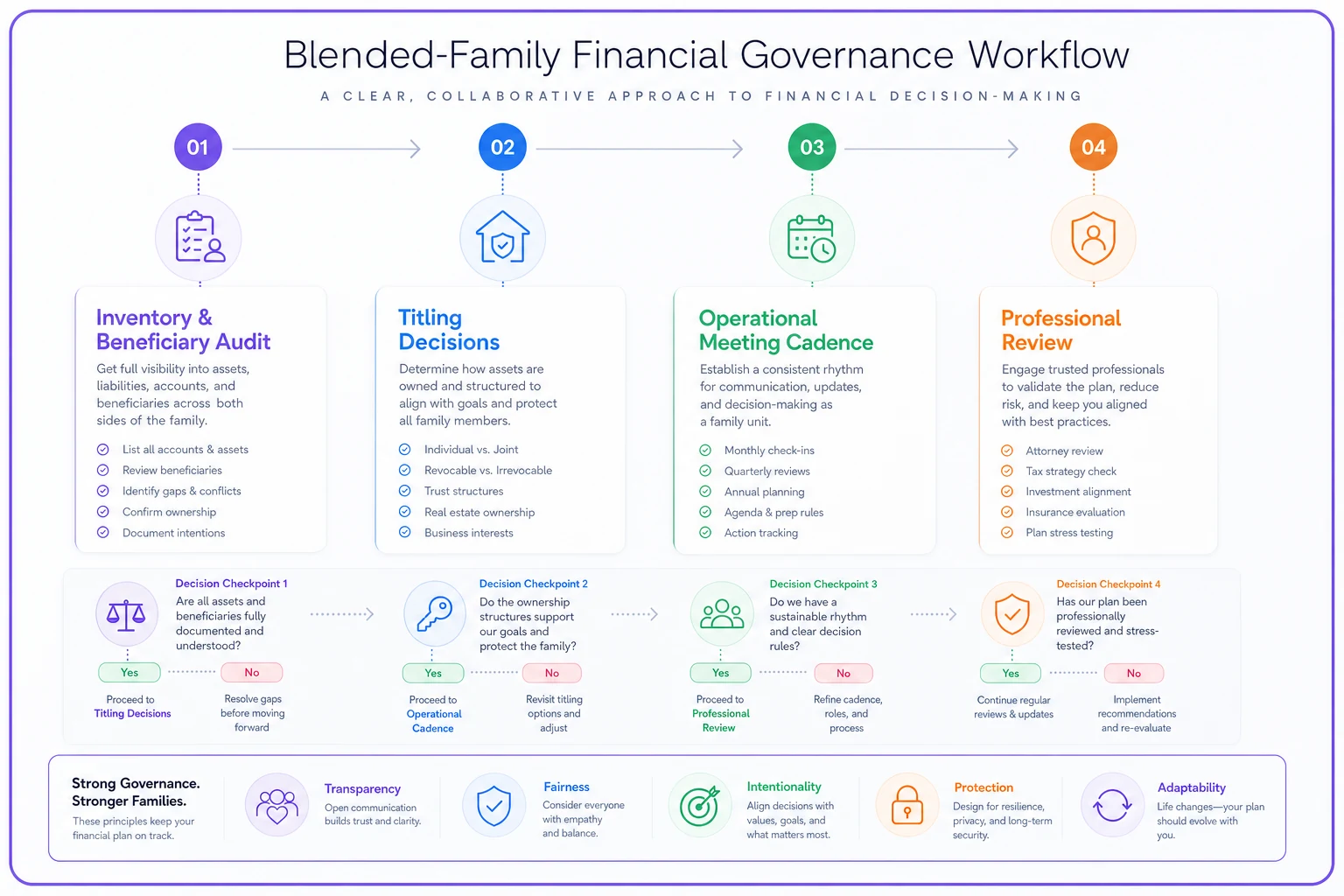
Use the stages to avoid decision fatigue: inventory first, then titling and beneficiaries, then operational rules and periodic reviews.
Conflict-minimizing meeting agendas
The structure of the meeting matters more than people expect. Blended-family money meetings go sideways when they mix logistics with emotionally loaded decisions. Separate them on purpose.
-
Open with numbers, not judgments. Review what happened last month — spending, reimbursements owed, any threshold-crossing purchases. Facts first.
-
Handle the operational items. Shared child costs, upcoming known expenses, settle-up. These are usually quick if tracked well.
-
Reserve one "big topic" per meeting. Titling, beneficiary changes, a major purchase, funding a stepchild's college. One per session. Trying to resolve three heavy topics in one sitting is where couples blow up.
-
Assign owners and a date, then stop. Nothing kills momentum like re-deciding things already decided. Write down who does what by when.
Conflict drops sharply when there's a standing agenda and a spending threshold. Most fights aren't about the $80 purchase — they're about not knowing whether the $80 purchase was supposed to be discussed. A pre-agreed threshold removes the ambiguity.
For the decision-heavy items, a simple ladder helps: below the threshold, either partner decides alone; above it, both must agree; anything touching prior-marriage obligations or titling gets professional input before it's final.
Beneficiary hygiene: the part that silently fails
Beneficiary drift is the quiet killer. Forms get set once — often years before the remarriage — and then never touched. The account that names an ex-spouse, the policy that lists "my children" without saying which ones, the retirement account with no contingent beneficiary at all. These don't announce themselves. They surface at the worst possible moment.
Blended households need beneficiary review as a recurring ritual, not a one-time cleanup. The mechanics of running that on a 24-hour, 30-day, and annual cadence are covered in the beneficiary-audit playbook — the key adaptation for blended families is adding a trigger review after any custody change, new child, home purchase, or divorce finalization involving an ex.
-
[ ] Every retirement account has a current primary and contingent beneficiary
-
[ ] No policy or account still names a former spouse (unless intentionally required by decree)
-
[ ] Vague designations ("my children") are replaced with named individuals where intent matters
-
[ ] TOD/POD designations match your current titling plan
-
[ ] Court-mandated life insurance still names the correct kids at the correct amounts
-
[ ] Trust-owned assets are actually retitled into the trust (a funded trust, not just a signed one)
PRO-TIP-SENTENCE: Trigger a beneficiary review immediately after any custody change, new child, home purchase, or divorce finalization.
That last point trips up more families than any other: they pay for a trust, then never move the assets into it. An unfunded trust governs nothing. The paperwork feels like the finish line, but it's really just the starting point.
A real scenario
A remarried couple in their late 40s — two kids each, combined household income somewhere around $180k–$200k — came into their second marriage having "handled" the paperwork. In practice, that meant a jointly titled home, his old 401(k) still naming his first wife, and a life insurance policy that vaguely said "my children" without specifying which four.
Nothing was on fire. That's exactly why it stayed broken for close to three years.
When they finally staged it out — inventory first, then titling, then beneficiaries — the fixes weren't dramatic individually. Updating the 401(k) beneficiary took ten minutes. But the combined exposure they'd been carrying was significant: had he died during those three years, roughly $140k in retirement assets would have gone to his ex-wife, and the ambiguous insurance language could have forced his kids into a probate fight. Retitling the home into a trust structure preserved the survivor's right to live there while ensuring each side's children eventually inherited their parent's share.
The outcome wasn't a bigger net worth. It was the elimination of four or five landmines that none of them knew they were standing on. And the settle-up arguments over shared kid expenses mostly stopped once they had one running ledger and a monthly review.
When this level of structure makes sense — and when it's overkill
When it makes sense: any remarriage where either partner brings children, meaningful pre-marriage assets, a business, or court-ordered obligations. Also any household about to buy property together or blend retirement accounts. The more parties affected by a "yes," the more you need the governance.
When it's lighter: a remarriage later in life with adult, financially independent children and clearly separate finances may only need clean beneficiary hygiene and correct titling — not the full staged agenda. The operational reimbursement tracking mostly matters when there are minor kids and active custody costs.
Who should not DIY this: if there's a contested divorce decree, a special-needs child, a business with partners, or significant assets crossing state lines, the titling and trust decisions need a real estate-planning attorney. The heuristics here help you walk in prepared and ask better questions — they don't replace professional drafting when the stakes are high.
Bringing it together
Blended-family households that stay financially calm aren't the ones with the most money or the least conflict. They're the ones with a system — an agreed way to decide, a titling structure that matches their actual intent, and a beneficiary ritual that doesn't rely on anyone remembering to do it.
Titling errors and beneficiary drift don't happen because people are careless. They happen because a first-marriage mindset — informal, default-driven, "we'll sort it later" — gets carried into a second-marriage structure that has too many moving parts for defaults to work. Staged governance replaces the guessing with a process.
It won't make every conversation easy. But it makes sure the paperwork points where you actually intend it to, and that the people you want protected don't get quietly written out by a form nobody updated.
Blended-family households that stay financially calm aren't the ones with the most money or the least conflict. They're the ones with a system — an agreed way to decide, a titling structure that matches their actual intent, and a beneficiary ritual that doesn't rely on anyone remembering to do it.
It won't make every conversation easy. But it makes sure the paperwork points where you actually intend it to, and that the people you want protected don't get quietly written out by a form nobody updated.
Ready to master your money?
Join thousands of users leveraging Savioly to build smarter budgets, save more efficiently, and plan for a secure financial future.