



Most college-savings advice collapses into one line: "just open a 529." That's fine until you realize a 529 behaves very differently for a household earning $55k with a newborn than it does for one earning $220k with a kid entering junior year. The account isn't the decision. The timeline and income band are the decision, and the account is what falls out of that.
Below you'll find worked examples for three timelines — infant, elementary, and high-school — plus how gifting changes the math and where financial aid quietly punishes the wrong account choice.
Why "529 vs custodial" is the wrong opening question
The college savings 529 vs custodial debate usually gets framed as tax efficiency. But what actually moves outcomes is flexibility risk vs financial-aid treatment vs control, and those weights shift depending on how many years you have.
-
A 529 gives you tax-free growth for qualified education expenses, parental control, and light financial-aid treatment. The cost is flexibility — non-qualified withdrawals hit earnings with tax plus a 10% penalty.
-
A custodial account (UTMA/UGMA) is legally the child's money the second you fund it. Great for gifting, bad for aid, and it becomes fully theirs at majority (18–21 depending on state). You lose control entirely.
-
A taxable brokerage in the parent's name has zero education restrictions, gets counted lightly for aid (parental asset), and gives you total flexibility. You just pay taxes on gains along the way.
The mistake people make is optimizing for the tax break when their real constraint is uncertainty. If there's any real chance the kid skips college, gets a scholarship, or the household needs that money back, over-funding a 529 early is how you end up paying penalties to access your own savings.
The financial-aid layer everyone underweights
Before getting into the timelines, understand how these accounts get treated in the aid formula — this is where custodial accounts quietly cause problems.
Take charge of your finances with clarity and confidence.
Savioly gives you real-time visibility and actionable steps to improve your money management.
- Automated expense tracking
- Goal-based saving plans
- Personalized financial insights
No credit card required
| Account type | Whose asset | Aid assessment rate | Control after 18 | Best-fit situation |
|---|---|---|---|---|
| 529 (parent-owned) | Parent | ~5.64% | Parent keeps it | Default for most families |
| Custodial (UTMA/UGMA) | Student | ~20% | Child controls it | Gifting when aid isn't a factor |
| Taxable brokerage (parent) | Parent | ~5.64% | Parent keeps it | High income, want flexibility |
| Custodial 529 | Parent (student beneficiary) | ~5.64% | Parent keeps it | Existing UTMA you want to shelter |
The number that jumps out: student assets get assessed at roughly 20%, versus about 5.64% for parental assets. A $30k custodial account can reduce aid eligibility by around $6k per year, while the same $30k in a parent 529 dings it by roughly $1,700. Over four years that's a five-figure swing for no reason other than which box you checked when the kid was born.
This is why aid-sensitive families almost never want money sitting in the student's name. If you already have a custodial account, one underused move is rolling it into a custodial 529 — the money stays legally the child's, but it now gets the friendlier parental-asset treatment.
Timeline 1: The infant (17–18 years out)
This is the easy case and the one people over-engineer.
With this much runway, growth dominates and flexibility risk is your biggest unknown. You genuinely don't know if this kid will get a merit scholarship, go to trade school, or decide college isn't for them. So the play is fund a 529, but don't over-fund it early.
A typical example: a household earning around $90k–$110k with a newborn. Instead of maxing contributions, they set a modest recurring amount — say $200–$300/month — into a low-cost age-based 529 portfolio. That's roughly $2,400–$3,600 a year. At a reasonable long-run return, that lands somewhere in the low-to-mid five figures by college, covering a real chunk of in-state costs without locking up money they might need for other things.
When to add a brokerage sleeve: if there's a decent chance of a scholarship, keep maybe 20–30% of the college savings in a plain taxable brokerage. If the kid gets a full ride, that sleeve comes out penalty-free and can fund a car, grad school, or a down payment. The 529 has a scholarship exception — you can withdraw up to the scholarship amount, paying tax but no penalty on earnings — but the brokerage gives you cleaner optionality.
If you're structuring these contributions as part of a broader automation cadence, the sizing logic pairs well with the approach in Build a savings ladder that works — same idea of matching contribution size to income band rather than guessing.
Timeline 2: The elementary kid (8–12 years out)
Now the tree branches hard on income.
Lower-to-middle income (roughly under $80k): You're likely to qualify for meaningful need-based aid, so keeping money out of the student's name matters more than the tax break. Parent-owned 529 is the default. Avoid custodial accounts entirely — the 20% assessment can erase more aid than the account ever earns in tax benefit.
Middle income ($80k–$180k): This is the sweet spot for a 529. Enough tax liability that tax-free growth is worth something, enough runway that growth compounds meaningfully, and usually partial-to-limited aid exposure. Fund the 529 as the core.
High income ($180k+): You're probably not getting need-based aid anyway, so the aid-treatment advantage of a 529 mostly disappears. What remains is the tax break — which is real — but it comes with flexibility cost. The honest answer here is often a split: a 529 for the tax-free growth on money you're confident you'll spend on college, plus a taxable brokerage for everything above that.
A worked example for the high-income case: household around $210k, kid in 4th grade. They're confident they'll spend at least ~$120k on college. They front-load a 529 with enough that it should grow into that range, then everything beyond goes into a taxable account. If costs run higher, the brokerage covers it. If the kid gets scholarships, the brokerage is theirs, penalty-free.
Timeline 3: The high-schooler (2–4 years out)
Short timeline changes everything. Growth barely matters anymore — two to four years isn't enough runway for the tax-free-growth pitch to hold up. What matters now is aid positioning and liquidity.
The thing families miss at this stage is the income vs asset distinction in aid formulas. Assets get assessed at those rates above (5.64% parent / 20% student). But income gets assessed far more aggressively — up to about 47% in the federal formula. This creates a real trap: Selling appreciated stock in a brokerage during the "base year" (the tax year the aid formula looks at) generates capital gains, and those gains count as income, assessed at up to ~47%. A family that liquidates $40k of gains to pay tuition could see aid drop far more than if that same money had sat in a 529, where qualified withdrawals don't count as income at all.
A quick decision path for the high-school timeline:
-
Estimate your aid eligibility honestly. If income is above ~$250k with significant assets, you're likely full-pay — optimize for flexibility, not aid.
-
If you do expect aid, avoid realizing large capital gains in the base year. Map out which years the formula looks at before selling anything.
-
If you're going to spend it on college anyway, moving cash into a 529 shortly before paying tuition can convert taxable-income exposure into aid-neutral qualified withdrawals — even with near-zero growth time. Some states also give a contribution deduction, so you get a small state tax break on money that's just passing through.
-
Keep an actual liquidity buffer outside all of this. The first tuition bill often lands before aid clarity does.
Here's a quick visual workflow.
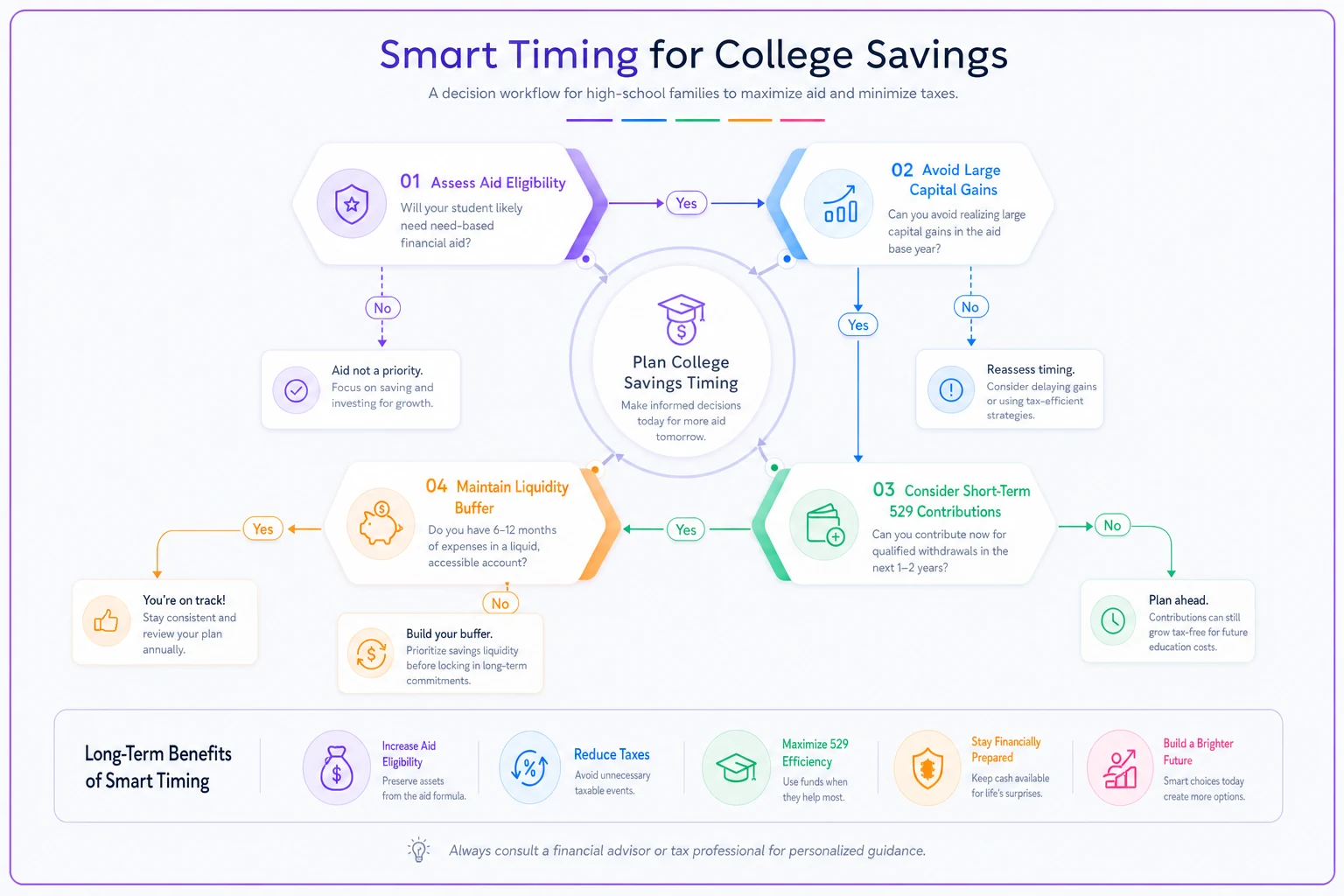
This is the single most expensive mistake at the high-school stage. A late 529 contribution — even one that grows essentially nothing — can be worth it purely for the withdrawal treatment. Having a clear decision path at this stage matters more than most families realize, and it's easy to sequence these steps incorrectly when you're managing multiple competing financial priorities at once.
Gifting tactics: where custodial accounts finally earn their keep
Custodial accounts have a bad reputation for aid, but they're genuinely useful for gifting, especially from grandparents.
-
Grandparent-owned 529s used to hurt aid badly because withdrawals counted as untaxed student income. Recent FAFSA changes removed that penalty on the current form — grandparent 529 withdrawals no longer count against the student. That makes grandparent 529s one of the cleaner gifting vehicles now.
-
Superfunding you can front-load five years of the annual gift exclusion into a 529 at once — roughly $90k per person, or about $180k for a couple, per beneficiary. For grandparents doing estate planning, this moves a chunk out of the taxable estate while it grows tax-free for the grandkid.
-
Custodial accounts still make sense when aid genuinely isn't a factor — high-income families, or gifts specifically meant to become the child's money at 18. Just go in eyes-open: at majority, it's legally theirs to spend on whatever they want.
For grandparent gifts, prefer a grandparent-owned 529 now that FAFSA no longer treats those withdrawals as student income.
The mistake here is grandparents opening custodial accounts by default because that's what they did decades ago, unaware that a grandparent-owned 529 now gives the same gift with dramatically better aid treatment.
A short coordination checklist before you fund anything
Run this before opening or funding an account — it catches the expensive errors:
-
[ ] Which timeline are you in — infant, elementary, or high-school? This sets growth vs flexibility weighting.
-
[ ] What income band, and do you realistically expect need-based aid? If yes, keep money out of the student's name.
-
[ ] Is any existing money sitting in a custodial (UTMA/UGMA) account? Consider rolling to a custodial 529 to fix the 20% assessment.
-
[ ] Are grandparents planning to help? Steer them toward a grandparent-owned 529, not a custodial account.
-
[ ] Do you have a scholarship scenario? Keep a taxable brokerage sleeve so a full ride doesn't trap money behind a penalty.
-
[ ] For high-schoolers
have you mapped the aid base years before selling any appreciated assets?
-
[ ] Does your state offer a 529 deduction? If so, even short-term contributions may carry a small tax perk.
Running through this before funding anything takes maybe thirty minutes and can prevent the kind of structural errors that cost families real money years later.
A real scenario: the split that saved the flexibility
A dual-income household, roughly $195k combined, had one child in 3rd grade. They'd been putting everything — about $600/month — into a single 529, on track for close to $140k by college. On paper, fine. But their kid was showing early signs of being a strong athlete and student, meaning a real chance at merit money.
The problem: if a scholarship covered even half of college, they'd have a heavily over-funded 529 and would eat taxes plus penalties to repurpose it — or awkwardly shuffle it to a sibling who didn't exist yet.
The adjustment was straightforward. They kept the 529 funded to a "confident floor" of around $80k projected — the amount they were sure they'd spend regardless — and redirected the extra ~$250/month into a taxable brokerage. Same total savings rate, same monthly discipline. The difference was optionality: if the scholarship came through, that brokerage sleeve (projected in the low five figures) becomes penalty-free money for grad school or a first apartment. If it didn't, it pays tuition just fine.
Nothing exotic. They just stopped treating the 529 as the whole answer and started treating the timeline and scholarship odds as the actual inputs driving the decision.
When each account is actually the wrong choice
Skip the 529 when: the timeline is very short and you're clearly full-pay with no aid exposure and no state deduction — at that point you're accepting flexibility restrictions for almost no benefit. A brokerage does the same job with more freedom.
Skip the custodial account when: you expect any need-based aid, full stop. The 20% assessment is rarely worth it, and the loss of control at 18 is a real risk families consistently underestimate.
Skip the brokerage-only approach when: you're a middle-income family with a long runway and high confidence the money goes to college. You're leaving tax-free growth on the table for flexibility you probably won't use.
There's no universally correct account. There's a correct account for a specific timeline and income band with a specific aid exposure. Match those three inputs first, and the 529-vs-custodial-vs-brokerage question mostly answers itself.
If your college savings sits inside a larger picture of variable income or competing goals, it's worth sequencing these contributions against everything else rather than in isolation — the scenario-based logic in a multi-year living plan for uncertain incomes works well for deciding how aggressively to fund college versus keeping powder dry for the years the aid formula actually watches.
Ready to master your money?
Join thousands of users leveraging Savioly to build smarter budgets, save more efficiently, and plan for a secure financial future.