



Most people treat their credit score like weather — something that just happens to them. Then a mortgage pre-approval comes back with a rate that costs an extra $180 a month, and suddenly it matters. The problem is timing. By the time you're 30 days out from a big financing event, most of the levers that actually move a score are already locked.
This playbook works backward from that reality. Ninety days is roughly the window where you can make meaningful changes to utilization, reporting timing, and dispute resolution before a lender pulls your file. Less than that, and you're mostly stuck with whatever your report already says.
Going to skip the "what is a FICO score" lecture. You already know payment history and utilization dominate. What almost nobody gets right is the order of operations — which moves to make first, which to avoid entirely, and how to sequence them so the changes actually show up on your report before it counts.
The thing that trips up almost everyone: statement date ≠ due date
There's a mistake that quietly costs people 20–40 points, and it has nothing to do with missing payments.
Your card reports your balance to the bureaus on the statement closing date, not the due date. So you can pay your bill in full, on time, every single month — and still show 60% utilization on your credit report, because the balance that gets reported is whatever was sitting there when the statement closed.
A typical example: someone runs about $4,000 a month through a card with a $6,000 limit. They pay it off in full every cycle. Perfect payment history. But their report shows 66% utilization because the statement snapshots the balance before the payment lands. To a mortgage underwriter's automated model, that person looks nearly maxed out.
The fix is straightforward and almost nobody does it: pay the card down to your target balance a few days before the statement closing date, not before the due date. You can find the closing date on your statement or by calling the issuer. One small true-up payment right before it closes, then pay the rest normally.
This is usually the single highest-leverage move in the first 30 days, and it requires zero new accounts, zero disputes, zero waiting.
Utilization thresholds that actually matter
Utilization isn't linear. The scoring models react at certain threshold cliffs, and knowing where they are lets you stop optimizing past the point of diminishing returns.
Take charge of your finances with clarity and confidence.
Savioly gives you real-time visibility and actionable steps to improve your money management.
- Automated expense tracking
- Goal-based saving plans
- Personalized financial insights
No credit card required
| Utilization band | Score impact | What to do |
|---|---|---|
| 0% (all cards report $0) | Slightly worse than 1–9% oddly enough | Let one card report a small balance |
| 1–9% | Optimal zone | Target this before any major credit event |
| 10–29% | Mild drag | Fine for normal life, tighten before a mortgage |
| 30–49% | Noticeable damage | Prioritize paydown here first |
| 50–74% | Significant | Underwriters flag this range |
| 75%+ | Severe | Emergency territory |
Two things people consistently get wrong here.
First, per-card utilization matters, not just the overall number. You can be at 15% total but have one card sitting at 85%, and that single card drags the score. The models look at both aggregate and individual-card utilization. If you're spreading a paydown across multiple cards, kill the highest-percentage card first — not the highest-dollar balance.
Second, the 0% quirk is real but minor. Letting every card report zero can nudge your score down a few points versus showing one small balance. Not worth obsessing over, but if you're within 90 days of a mortgage application, let one card report somewhere around 2–4% and bring the rest to zero.
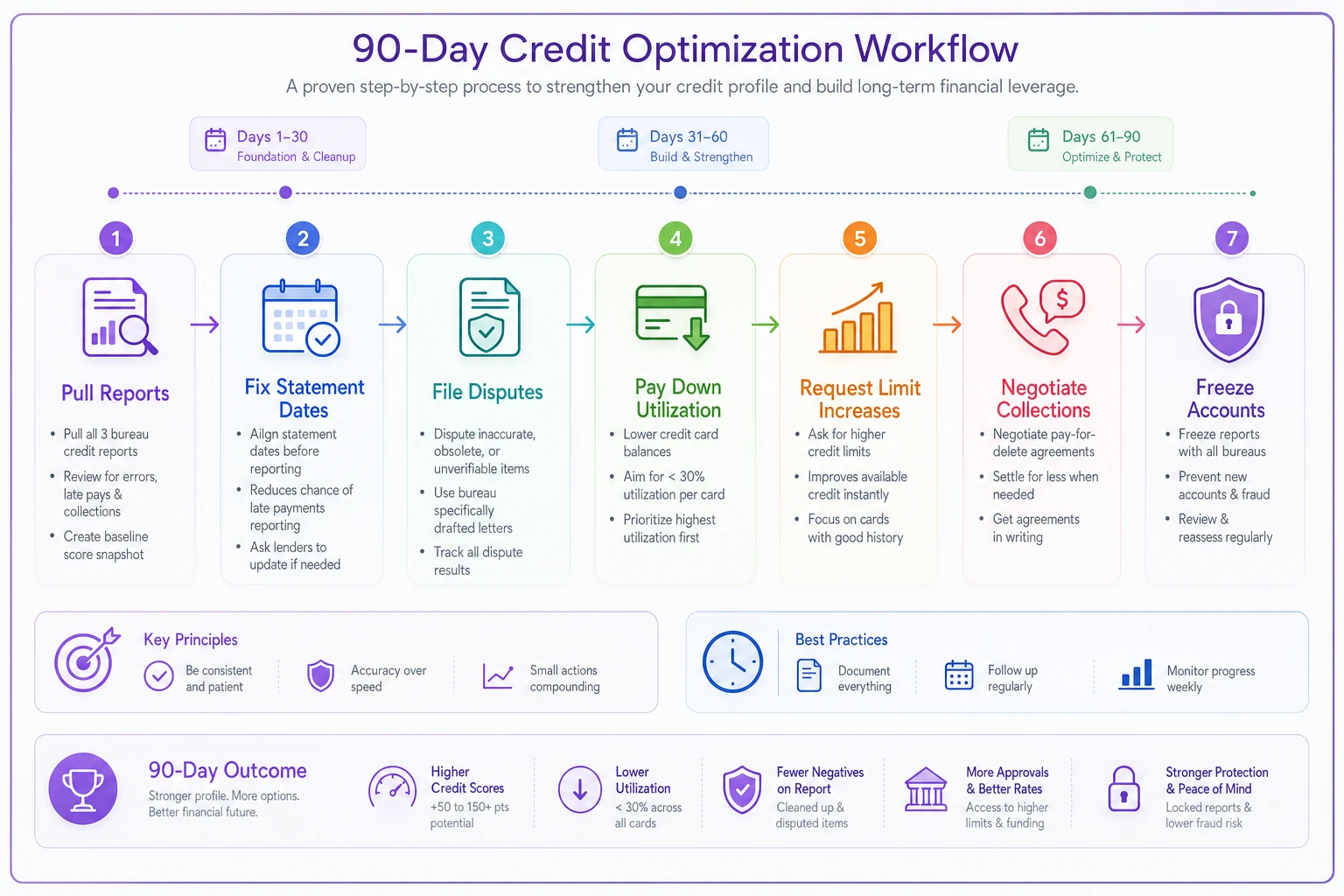
The 90-day sequence, in priority order
The whole point of a credit health playbook is sequencing. Doing the right things in the wrong order wastes whatever runway you have. Here's the order that works:
-
Days 1–7
Pull all three reports and map the terrain.
AnnualCreditReport.com gives you free reports. Write down every account, every balance, every limit, every negative mark, and the statement closing date for each card. You can't sequence what you haven't measured. -
Days 1–14
Fix statement-date timing.
Set up true-up payments before each card's closing date. Fastest structural fix available. -
Days 7–21
File disputes on anything genuinely wrong.
Late payments that weren't late, accounts that aren't yours, balances reported incorrectly, duplicate collections. Disputes take 30–45 days, so start early. Templates are below. -
Days 14–45
Attack utilization by threshold, highest-percentage card first.
Get individual cards under 30%, then work toward the 1–9% aggregate zone. -
Days 30–60
Request credit limit increases on established accounts
— but only via soft-pull issuers. A higher limit lowers utilization without paying down a dollar. -
Days 45–75
Handle any collections or charge-offs
through pay-for-delete negotiation where possible. -
Days 75–90
Freeze the account.
No new applications, no big purchases. Let the optimized balances report cleanly through a full cycle before the lender pulls.
Visual workflow for the 90-day sequence.
That last step matters more than people realize. Opening a new card 20 days before a mortgage application can knock your score and reset your average account age at exactly the wrong moment.
Account opening and closing: rules that prevent self-inflicted damage
This is where people accidentally sabotage themselves, usually with good intentions.
On opening:
-
Don't open anything within 90 days of a known large-credit event. The hard inquiry plus the new-account age drag isn't worth it.
-
If you're building thin credit and not about to apply for anything major, a new account can help — but the benefit shows up months later, not immediately.
-
Never open a store card at checkout for the 15% discount right before a mortgage. That $40 saved can cost you a rate tier.
On closing:
-
Closing a card raises your utilization because you lose that card's limit from the denominator. Close a $10k-limit card and your available credit drops — every other balance suddenly represents a larger percentage.
-
Closing old accounts eventually shrinks your average account age too.
-
The one exception
an annual-fee card you'll never use and can't downgrade. Even then, wait until after any pending credit event.
Quick heuristic: before closing any card, ask whether it changes your utilization or your average age. If yes, and a credit event is coming, don't.
The same discipline around keeping money and accounts cleanly separated applies on the business side too — if you run any kind of side income, the logic in this piece on keeping personal and business cash from commingling applies directly to how you structure the cards behind those flows.
Dispute letters that actually get results
Most dispute letters fail because they're either too vague or a copy-pasted internet template that the bureau's automated system flags and dismisses almost immediately. What works is specific, factual, and dated.
Three lean templates for the most common situations:
> To whom it may concern: > > I am disputing the following account listed on my credit report: [Creditor Name], Account #[XXXX]. This account does not belong to me and I have no record of opening it. I request that you investigate this item and remove it, as it appears to be reporting in error. Enclosed is a copy of my ID and current address verification. > > Please provide written confirmation of the results of your investigation.
> I am disputing a late payment reported by [Creditor Name] on account #[XXXX] for [Month/Year]. My records show this payment was made on time on [date], via [method/confirmation number]. I have enclosed [bank statement/payment confirmation] as evidence. Please correct this reporting to reflect the on-time payment.
> The account [Creditor Name] #[XXXX] is reporting a balance of $[X] and/or a credit limit of $[X], which is inaccurate. The correct figures as of [date] are a balance of $[X] and a limit of $[X], as shown on my enclosed statement. Please update this account to reflect accurate information.
A few things that make disputes stick:
-
Dispute with the bureau AND the furnisher (the actual creditor). Hitting only one leaves a gap.
-
Attach one piece of hard evidence. A payment confirmation or statement beats three paragraphs of argument.
-
One issue per letter. Bundled disputes get partially resolved and stall.
-
Send by mail with tracking for anything important. The paper trail matters if it escalates.
-
Don't dispute accurate negative items hoping they'll disappear. They usually come back verified, and you've burned a cycle.
Don't dispute accurate negative items hoping they'll disappear. They usually come back verified, and you've burned a cycle.
The decision ladder for a mortgage or other large-credit event
When something big is coming, you need a rung-by-rung framework, not a pile of tips. Here's the ladder, in order, for the 90 days before you apply:
Rung 1 — Is my score already in the right tier? Mortgage pricing moves in tiers, often at 20-point breakpoints — 740, 760, and so on. Find out which tier you're closest to. If you're at 738, getting to 740 is worth real money. If you're at 775, chasing more points is a waste of runway.
Rung 2 — Is utilization my limiting factor? If aggregate or any single-card utilization is above the low teens, that's almost always the fastest path up. Attack it before anything else.
Rung 3 — Are there errors dragging me down? If yes, disputes go in immediately because of the 30–45 day timeline. If no, move to the next rung.
Rung 4 — Would a limit increase help without a hard pull? If an issuer offers soft-pull increases, use it. Lower utilization instantly without spending anything.
Rung 5 — Should I pay off an installment loan early? Usually no. Keeping a small active installment loan can help your credit mix, and paying it off doesn't move the needle much in a short window. Don't drain liquidity you'll need for a down payment just to pick up a few points.
Rung 6 — Freeze and wait one full reporting cycle. Once everything's optimized, stop touching things and let it report cleanly.
That fifth rung connects to a bigger question a lot of people wrestle with before buying — whether to push spare cash toward debt or keep it liquid. If a mortgage is on the horizon, the breakdown on refinancing vs. prepaying with numeric thresholds and liquidity guardrails pairs naturally with rung 5's "don't sacrifice liquidity for points" logic.
A real scenario, start to finish
A couple planning to buy in about four months. Combined they had three cards: one at $8,900 on a $10k limit (89%), one at $1,200 on a $5k limit, and one nearly paid off. The primary borrower's middle score was sitting around 690 — enough to qualify, but at a rate tier that would have cost them noticeably more over the life of the loan.
-
Paid the $8,900 card down to around $900 (9%) over six weeks using savings that had been earmarked for closing costs — a calculated call, since the rate savings outweighed the smaller down payment.
-
Disputed the paid medical collection with a copy of the payment confirmation. It came off in roughly five weeks.
-
Requested a soft-pull limit increase on the second card, bumping it from $5k to $8k, which dropped that card's utilization without spending anything.
-
Froze everything and let it report for a full cycle.
By the time the lender pulled, the primary borrower's middle score had climbed into the mid-730s — enough to cross into a better pricing tier. The difference worked out to somewhere in the range of a couple hundred dollars a month over the life of the mortgage. Same income, same debt discipline. The score moved because the structure and timing moved.
Who should NOT run this aggressively
This plan assumes you have some runway and some flexibility. A few situations where easing off makes sense:
-
No upcoming credit event. There's no reason to drain savings to hit 9% utilization for one reporting cycle. Keep utilization reasonable and pay on time.
-
You're carrying balances you can't actually pay off. The utilization tactics here assume you can move money around. If the debt is real and stuck, the priority is a payoff plan — not score cosmetics.
-
Your score is already in the top tier. Above roughly 760–780, extra points buy you almost nothing on most loans. Don't optimize past the point of return.
-
You'd need a hard inquiry to "help." Opening new credit right before a big application usually hurts more than it helps in the short window.
This plan assumes you have some runway and some flexibility.
The one habit that keeps it from unraveling
The couple above didn't just fix their score once. The reason it held is that they kept the statement-date paydown habit going and set up a simple recurring check on balances before each closing date. That's the entire maintenance layer — a monthly glance at where each card sits relative to its closing date, and a true-up payment when needed.
Everything in this playbook comes down to two ideas most people never connect: your report is a snapshot taken on a specific day, and the score responds to structure and timing far more than to raw effort. You can pay every bill perfectly and still look risky to a lender because of when your balances happened to report. Once you see credit as a timing problem instead of a discipline problem, the ninety days in front of any big financing decision stop being a source of dread and start being a lever you actually control.
Everything in this playbook comes down to two ideas most people never connect: your report is a snapshot taken on a specific day, and the score responds to structure and timing far more than to raw effort. You can pay every bill perfectly and still look risky to a lender because of when your balances happened to report. Once you see credit as a timing problem instead of a discipline problem, the ninety days in front of any big financing decision stop being a source of dread and start being a lever you actually control.
Ready to master your money?
Join thousands of users leveraging Savioly to build smarter budgets, save more efficiently, and plan for a secure financial future.