



The hardest part of the early days isn't the math. It's that you're being asked to make irreversible financial moves while your sleep is wrecked, your attention is shredded, and half the decisions you make could show up later in a settlement conference. Most divorce "checklists" online treat this like a tidy admin task — close accounts, split assets, done. That framing gets people into trouble, because the moves that feel protective in the first week (draining the joint account, hiding a transfer, cancelling a card your spouse depends on) are often the exact moves that damage your negotiating position or trigger a temporary restraining order.
This runbook is organized around time pressure and emotional capacity — what you can realistically do in the first 48 hours, what you stabilize over 30 days, and what you rebuild over a year. It assumes you want to protect yourself without burning the bridge you still have to walk across during negotiation. If you're in danger, that changes everything and legal/safety advice overrides all of this.
A note on scope: this is operational guidance, not legal advice. Divorce law is state-specific, and "marital property" rules vary enormously. The goal here is to keep you from making avoidable financial mistakes between now and the day a lawyer is actually steering.
The core tension nobody tells you about
Every early decision sits on a spectrum between self-protection and negotiation preservation.
Drain the joint checking account to protect your cash, and you look like you're hiding money. Leave everything untouched to look cooperative, and your spouse clears it out next Tuesday. The skill isn't picking one side — it's finding moves that protect you and read as reasonable to a judge or mediator later.
-
Document every account balance before you touch anything.
-
Split joint funds down the middle rather than taking all of it.
-
Freeze new credit and recurring damage rather than canceling things your spouse relies on in a way that looks punitive.
Almost everything below flows from those three words.
The first 48 hours: stabilize, document, don't detonate
The goal in the first two days is narrow. You are not settling anything. You are preventing the two worst outcomes: getting locked out of your own money, and doing something that looks like financial misconduct.
Take charge of your finances with clarity and confidence.
Savioly gives you real-time visibility and actionable steps to improve your money management.
- Automated expense tracking
- Goal-based saving plans
- Personalized financial insights
No credit card required
-
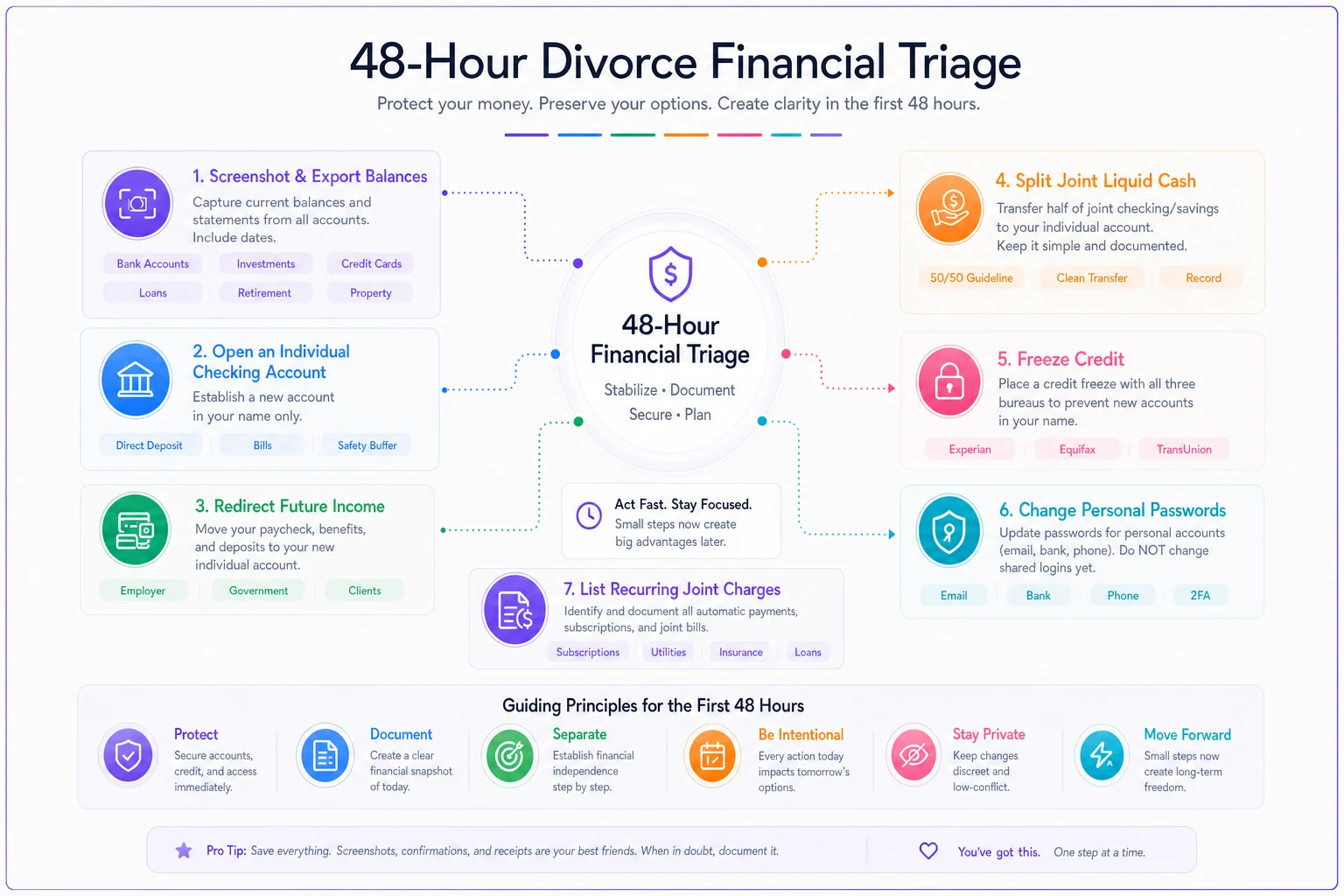
Screenshot and export balances for everything, today. Joint checking, joint savings, every credit card, the mortgage balance, brokerage, retirement accounts, the HELOC, car loans. You want a frozen snapshot of the financial picture as of this date. This single step is the most valuable thing you can do in 48 hours, and it's the thing people skip because it feels passive.
-
Open one new individual checking account at a bank where you have no joint relationship. Not to hide money — to have a landing spot for your own paycheck going forward. A different institution avoids the awkward "they can see my new account" problem and reduces accidental commingling.
-
Redirect only your own future income. Your next paycheck direct-deposits into the new account. You do not retroactively claw back past deposits. Future income going to a separate account is defensible; draining shared history is not.
-
Split, don't seize, joint liquid cash. If there's $18k in joint checking and you're genuinely worried it disappears, a common defensible move is transferring half to your individual account and leaving the other half, with a dated note explaining why. Taking all $18k is the move that gets cited against you.
-
Freeze your credit at all three bureaus. This stops new joint debt or accounts opened in your name during a messy period. It's reversible and invisible to your spouse.
-
Change passwords on your personal email, your phone account, and any password manager — but not on shared financial logins yet. Locking a spouse out of a joint bank portal can look like concealment. Locking them out of your personal email is just basic hygiene.
-
Make a quick list of recurring charges on the joint card so you know what breaks if that card changes. The mortgage autopay, the kid's therapy, the car insurance. You'll deal with these in the 30-day phase, not now.
What NOT to do in the first 48 hours
-
Don't cancel a credit card your spouse is an authorized user on if it leaves them stranded — pull your access or request a replacement card instead.
-
Don't move retirement or brokerage assets. Those are almost always marital property and touching them early is a classic unforced error.
-
Don't make large unusual purchases or "pay yourself back" for anything.
-
Don't vent the financial strategy over text to your spouse. Those texts get read out loud later.
A quick visual of the 48-hour workflow can make the steps easier to follow.
The pattern that goes wrong most often is someone treating the first 48 hours as the settlement instead of the stabilization. They make aggressive grabs in a panic, and three months later their lawyer is spending billable hours explaining the transfers.
The 30-day stabilization plan
This is the heart of the divorce financial checklist most people actually need. The first two days were about not detonating. The next month is about building a parallel financial life that runs on its own, while keeping shared obligations from blowing up.
Week 1–2: build the parallel system
-
Direct deposit confirmed into the individual account.
-
Open an individual credit card in your name only — do this before your income picture changes or your household debt load gets messy, because approval is easier right now.
-
List every autopay tied to the joint account and sort it into three buckets
mine to move, shared/keep running, theirs to take over.
-
Build a bare-bones separate budget. Not a beautiful one. A survival run-rate
housing, food, transport, kid costs, legal reserve.
Apply for an individual credit card while your income is still clean to improve approval odds.
If you've never run money in fully separated buckets before, the mechanics are the same discipline micro-business owners use to keep personal and business funds apart — the principles in this breakdown of ultra-lean separation rules and percent-splits translate almost directly to building a clean individual financial lane during separation.
Week 2–3: handle shared obligations without sabotage
-
The mortgage and shared housing costs keep getting paid. Missing a mortgage payment to "send a message" tanks both your credit scores and makes you look reckless. Keep it current; sort out reimbursement in the settlement.
-
Decide on a temporary joint-expense method. A common arrangement: both parties fund a shared account monthly for agreed joint costs — mortgage, kids — in proportion to income, and everything else runs separately.
-
Document every joint expense you cover. A dated log of "I paid the $2,400 mortgage in March, April, May" becomes real leverage in reimbursement discussions.
Week 3–4: lock down the leaks and the paperwork
-
Pull a full credit report for yourself and, if you legally can, review joint obligations.
-
Inventory every asset and debt with account numbers, balances, and whose name is on each.
-
Identify accounts where you're an authorized user vs. a joint owner — this distinction matters enormously for who's actually liable.
-
Set aside a legal reserve as its own line item. Contested divorces routinely run into five figures; even a cooperative one has real costs.
The 30-day checklist
-
[ ] Individual checking open and receiving income
-
[ ] Individual credit card approved
-
[ ] Credit frozen at all three bureaus
-
[ ] Autopays sorted into mine / shared / theirs
-
[ ] Survival budget written
-
[ ] Temporary joint-expense arrangement agreed or proposed in writing
-
[ ] Dated log started for all shared payments
-
[ ] Full asset + debt inventory completed
-
[ ] Authorized-user vs. joint-owner status identified for each account
-
[ ] Legal reserve funded or earmarked
The first two days were about not detonating. The next month is about building a parallel financial life that runs on its own, while keeping shared obligations from blowing up.
Custody and titling templates: the documents that prevent future fights
Titling errors are where otherwise amicable separations turn expensive a year later. The themes repeat: a car title that never got changed, a beneficiary designation that still names the ex, a jointly-titled account that one person kept using.
| Asset / Account | Current title | Target title | Can change now? | Blocked until | Notes |
|---|---|---|---|---|---|
| Joint checking | Both | Split to individual | Yes (split, not drain) | — | Keep dated record |
| Primary home | Both | TBD in settlement | No | Settlement/sale | Don't quitclaim before advice |
| 401(k) | Individual | Individual | No | QDRO at divorce | Beneficiary review flagged |
| Car loan | Both | Refinance to one | Maybe | Loan assumption | Needs lender approval |
| Life insurance | Spouse beneficiary | TBD | Depends on state | Check interim orders | Often restricted during filing |
| Kids' 529 | One parent custodian | Agreed custodian | No | Settlement | Decide control explicitly |
A few hard-won notes on this table:
-
Don't change beneficiaries or retitle the house before you've had legal advice. Many states impose automatic restraining orders at filing that freeze exactly these moves. Changing a life insurance beneficiary "to protect yourself" can violate an interim order.
-
Cars, boats, anything with a loan can't just be re-titled — the lender has to approve an assumption or you refinance. Agreeing "you take the car" means nothing until the loan actually moves.
-
The 529 is a sleeper. Only one person is custodian. Decide explicitly who controls it, or you'll be fighting about college withdrawals in five years.
For custody-linked expenses, a simple shared log beats any handshake: date, who paid, category, amount, which kid it applies to. This is the same structure that keeps co-parenting money clean, and it's the same governance discipline couples use to keep ongoing money decisions from turning into fights — the household governance playbook with decision ladders and KPI templates adapts well into a co-parenting financial agreement once the dust settles.
Negotiation-preserving heuristics
These are the rules that keep you from winning a small battle and losing the settlement.
Reasonable beats clever. Every "clever" financial move you make — the convenient transfer, the sudden big purchase, the account you forgot to mention — is a gift to the other side's lawyer. Boring, documented, split-down-the-middle behavior is what makes you look credible.
Never create a fact you'll have to explain. If you can't describe a transaction in one calm sentence to a mediator, don't do it.
Keep shared obligations current even when it's unfair. The person who kept the lights on and the mortgage paid always looks better than the person who let things lapse to make a point.
Separate "protecting cash" from "hiding cash." Protecting is visible and halved. Hiding is secret and total. One helps you. The other follows you through the whole process.
Write less, document more. Fewer emotional texts, more dated financial records.
A realistic scenario
Consider a dual-income household — roughly $130k combined — where one spouse suspects the marriage is ending and panics. The instinct was to move the entire joint savings, around $22k, into a secret account and let the shared credit card go unpaid "so he deals with it."
Reworked against this runbook, the moves looked different. She screenshotted every balance the first night. She moved roughly half the savings — close to $11k — into a new individual account at a different bank, with a dated note explaining the split. She kept the mortgage and the shared card current and logged each payment. She opened her own card while her income looked clean, froze her credit, and left retirement accounts untouched.
The difference showed up at mediation months later. There was no "where did the $22k go" fight, because the split was documented and reasonable. The payment log meant she was credited for several months of mortgage and utility coverage in the reimbursement math. The whole process stayed cooperative instead of combative — which, in divorce, is the difference between a few thousand in legal fees and a few tens of thousands.
Nothing about that outcome was clever. It was just documented and halved instead of secret and total.
When aggressive moves actually make sense — and when they don't
When faster, more protective action is justified: when there's a credible risk of your spouse draining accounts, running up joint debt, or hiding assets — and you're acting on legal advice. Even then, "protective" means freezing and documenting, not grabbing.
When it's a bad idea: when you're doing it out of anger, to punish, or to get ahead before anyone's talked to a lawyer. The emotional first-mover almost always creates the facts they'll spend months walking back.
Who should absolutely not improvise here: anyone with a complex estate, a business, significant retirement assets, or a spouse who controls the finances and the information. In those cases the first 48-hour move is get legal advice before you touch anything, and this runbook becomes the list of questions you bring to that first meeting.
The 1-year re-establishment arc
Once the acute phase passes, the work shifts from triage to rebuilding a financial identity that's entirely yours.
-
Finalize all titling and beneficiary changes that were blocked during the proceeding — the house, the QDRO for retirement splits, insurance, the 529 control question.
-
Rebuild individual credit if yours was thin because everything was joint. A single card used lightly and paid in full does most of the work over a year.
-
Re-establish an emergency fund in your name, sized to your new single-household run-rate, not the old combined one.
-
Update every recurring obligation still routed through old shared infrastructure — the forgotten streaming charge on the old joint card is the small version of the forgotten house title.
-
Rebuild retirement contributions around your new income, especially if a chunk of your balance transferred out via QDRO.
-
Do one clean annual review twelve months out
net worth, accounts, beneficiaries, insurance, titles. Confirm nothing from the old joint life is still silently connected.
The households that recover fastest aren't the ones who made the boldest first moves. They're the ones who stayed boring and documented early, kept their negotiating position intact, and then rebuilt methodically once the legal dust settled. The whole arc is less about outmaneuvering anyone and more about keeping your own records clean enough that your financial story needs no explanation — in the first 48 hours, through the critical 30 days, and across the year it takes to fully stand on your own.
The households that recover fastest aren't the ones who made the boldest first moves. They're the ones who stayed boring and documented early, kept their negotiating position intact, and then rebuilt methodically once the legal dust settled. The whole arc is less about outmaneuvering anyone and more about keeping your own records clean enough that your financial story needs no explanation — in the first 48 hours, through the critical 30 days, and across the year it takes to fully stand on your own.
Ready to master your money?
Join thousands of users leveraging Savioly to build smarter budgets, save more efficiently, and plan for a secure financial future.