



Most early-retirement plans fail quietly. Not in year one, when the spreadsheet still looks clean, but somewhere around year seven or eight when a bad market, a surprise medical bill, and lifestyle creep all stack up in the same twelve months. The person retired at 52 with what looked like plenty, and now at 60 they're staring at a portfolio that dropped faster than their withdrawals and wondering whether they should go back to work.
The problem almost never comes down to picking the wrong fund or missing some magic withdrawal rate. It's that the spending framework was built as a static number — "we'll take 4% a year" — instead of a connected system that responds to markets, longevity, taxes, and human behavior. A 30-to-40-year horizon is long enough that something will go wrong. The question is whether your framework bends or snaps when it does.
This post covers how to build the version that bends — buffer-zone templates, a partial-annuitization decision ladder, glidepath rebalancing rules, and an annual stress-test ritual, with worked numbers and governance templates you can actually use.
Why most early-retirement spending plans break
The single biggest structural flaw in long-horizon plans is treating three separate risks as if they were one. They're not, and they hit at different times.
Sequence-of-returns risk dominates the first decade. If your portfolio takes a 25% hit in years two and three while you're still withdrawing full freight, you can permanently damage the base that's supposed to last four decades. The same average return — with the bad years landing later instead of earlier — can leave you with twice the ending balance. Early retirees are uniquely exposed here because they have the longest runway and the smallest buffer of pension or Social Security income.
Longevity risk dominates the back half. Planning to 85 when you have a real shot at living to 95 isn't conservatism — it's a 10-year funding gap hiding in plain sight. For a couple who both retire early, the odds that at least one lives into their mid-90s are meaningfully higher than most people assume.
Inflation and lifestyle drift run quietly in the background the whole time. A 3% average inflation path roughly doubles your cost of living over 24 years. Early retirees tend to underweight this because the first few years feel comfortable.
The pattern that keeps showing up: people build a plan optimized for exactly one of these risks — usually sequence risk, because the market crash is the scary one everyone talks about — and leave the other two unguarded. Then it's the longevity gap or the inflation drift that actually sinks them two decades later.
A durable framework has to defend all three simultaneously, and each tool below maps to a specific risk. That mapping is the whole point.
The architecture: four connected layers
Think of the framework as four layers that feed into each other, not four separate tactics.
Take charge of your finances with clarity and confidence.
Savioly gives you real-time visibility and actionable steps to improve your money management.
- Automated expense tracking
- Goal-based saving plans
- Personalized financial insights
No credit card required
| Layer | Primary risk it defends | How it connects |
|---|---|---|
| Buffer zones (cash + short bonds) | Sequence risk, early years | Feeds spending when equities are down so you don't sell low |
| Partial annuitization | Longevity + spending floor | Covers non-negotiable baseline for life, shrinks what the portfolio must carry |
| Glidepath rebalancing | Sequence + inflation balance | Refills buffers, adjusts equity exposure as horizon shortens |
| Annual stress-test ritual | All three | The governance loop that detects drift and triggers adjustments |
The reason to treat these as connected: your buffer zone only works if your glidepath rules refill it. Your annuitization decision changes how aggressive your portfolio can afford to be. And the stress test is what tells you whether the whole machine is still on track or quietly going sideways. Pull one piece out and the others get weaker.
Layer 1: Buffer-zone templates
A buffer zone is the pool you spend from when selling equities would mean selling at a loss. It's the most effective defense against sequence risk, and also the one people size wrong most often — usually too small, because cash "feels like it's doing nothing."
A practical structure uses three tiers:
-
Tier 1 — Operating cash (6–12 months of spending). High-yield savings or a money market. This covers normal monthly withdrawals.
-
Tier 2 — Buffer bonds (18–36 months of spending). Short-to-intermediate Treasuries or a short bond ladder. This is your "don't sell stocks into a crash" reserve.
-
Tier 3 — Growth portfolio (everything else). Equities and longer-duration assets doing the heavy lifting for a 30-year horizon.
Worked example. Say your baseline annual spending is around $62k and you're drawing roughly $48k from the portfolio after other income. A reasonable buffer build looks like:
-
Tier 1
~$40k (about 10 months)
-
Tier 2
~$120k (about 30 months)
-
Combined, that's roughly 40 months of portfolio-funded spending that doesn't depend on selling equities on a bad day.
The rule that makes this work isn't the buffer size — it's the refill logic. In an up year, you top the buffers back up from equity gains. In a down year, you let them drain and don't refill. That simple on/off switch is what breaks the panic-sell loop.
One mistake worth flagging: people build the buffer once and never define the refill trigger. Then after a good year they forget to top it up, and three years later the buffer that was supposed to cover 40 months is down to 11 — right before a correction hits. The buffer is a workflow, not a one-time deposit.
Layer 2: The partial-annuitization decision ladder
Annuities carry baggage — high fees, aggressive sales tactics, products designed to confuse. But stripped down to the plain version (a single-premium immediate annuity or a deferred income annuity), the function is simple: convert a slice of your portfolio into guaranteed lifetime income so your floor no longer depends on markets or longevity.
The decision isn't "annuity or no annuity." It's "how much of my non-negotiable floor do I want market-proof?" That's a ladder, not a coin flip.
-
Calculate your true floor. Not your total spending — your survival spending. Housing, food, insurance, utilities, minimum healthcare. For many early retirees this lands somewhere in the $30k–$45k range depending on housing costs.
-
Subtract guaranteed income you'll already have. Social Security (even if claimed later), any pension. This tells you the floor gap the portfolio must cover for life.
-
Decide what share of that gap to annuitize. A common range is 40–70% of the floor gap, not 100%. You still want flexibility.
-
Time it, don't rush it. Annuity payouts rise with age and interest rates. Annuitizing a floor slice in your late 60s or early 70s often buys far more income per dollar than doing it at 55.
When this actually makes sense: you have a modest guaranteed-income base, a real longevity concern (family history, good health), and the kind of temperament where a guaranteed floor would genuinely let you hold the rest of the portfolio with less anxiety.
When it's a bad idea: you have a pension that already covers most of the floor, your portfolio is large relative to spending, or someone is pitching you a variable or indexed annuity stuffed with riders. The whole value here is simplicity plus a floor. The moment the product gets complicated, the value usually evaporates.
Who should skip it entirely: anyone annuitizing money they'll need liquid for a known large expense soon, or anyone doing it to escape a temporary market scare rather than as a genuine longevity plan.
This layer connects back to the others: once a portion of your floor is annuitized, your remaining portfolio can typically hold a higher equity allocation, because its job shifted from "cover everything forever" to "fund flexibility and growth." That interplay is why the sequencing matters.
Layer 3: Glidepath rebalancing rules
A static 60/40 held for 35 years ignores the fact that your risk profile changes dramatically across retirement. Early on, sequence risk argues for less equity than you'd think. Later, with a shorter remaining horizon and an annuitized floor, you can sometimes carry more.
There's solid research suggesting a "rising equity glidepath" — starting more conservative right at retirement and drifting up over the first decade — can actually reduce failure rates, for exactly the sequence-risk reason above. That's counterintuitive to most people, who assume they should get steadily more conservative with age.
-
Rebalance on bands, not the calendar. Only rebalance when an allocation drifts more than roughly 5 percentage points from target. This cuts unnecessary trading and tax friction.
-
Rebalance into the buffer first. In an up year, trim equities to refill Tier 1 and Tier 2 before reinvesting anything. Spending reserve beats growth when reserves are low.
-
Never rebalance into equities during an active buffer drawdown. If you're draining Tier 2 because stocks are down, that's not the moment to also buy more equities with available cash. Let the buffer do its job first.
Worked sequence. Good year: equities up 14%, now 5 points over target. You trim, refill Tier 1 to full, top Tier 2 back to 30 months, and only then rebalance the remainder. Bad year: equities down 18%. You skip equity rebalancing, spend from Tier 1, quietly refill Tier 1 from Tier 2 as needed. You bought yourself years without realizing a single loss.
The common failure here is running rebalancing as a rigid annual ritual disconnected from buffer state. People rebalance "because it's January" and end up selling bonds to buy stocks right when they most needed the bond cushion intact.
Layer 4: The annual stress-test ritual
This is the governance loop that keeps the other three honest. Without it, the framework is just a set of good intentions that slowly drift. The ritual is a once-a-year sit-down — ideally the same month every year — where you run the plan through a few deliberately uncomfortable scenarios and decide, in advance, what you'd do.
A workable annual stress-test checklist:
-
[ ] Recalculate current withdrawal rate against the current portfolio value, not the original. A 4% start can quietly become 6% after a sustained drawdown.
-
[ ] Run the "down 30% tomorrow" test. If the portfolio dropped 30% today, how many months does your buffer cover? Under 24, you have work to do.
-
[ ] Run the longevity extension test. Re-model to age 97 instead of your base assumption. Does the plan still survive?
-
[ ] Check the inflation drift. Is your actual spending tracking, beating, or lagging your assumed inflation path?
-
[ ] Confirm buffer refill status. Are Tiers 1 and 2 at target, or did you forget to top up after a good year?
-
[ ] Review the annuitization trigger. Have rates, your age, or your health changed enough to move a floor slice this year?
-
[ ] Set guardrails for the year ahead. If the portfolio is above X, you can spend a little more; if below Y, trim discretionary spending by a set percentage.
Here's a simple workflow you can follow each year.
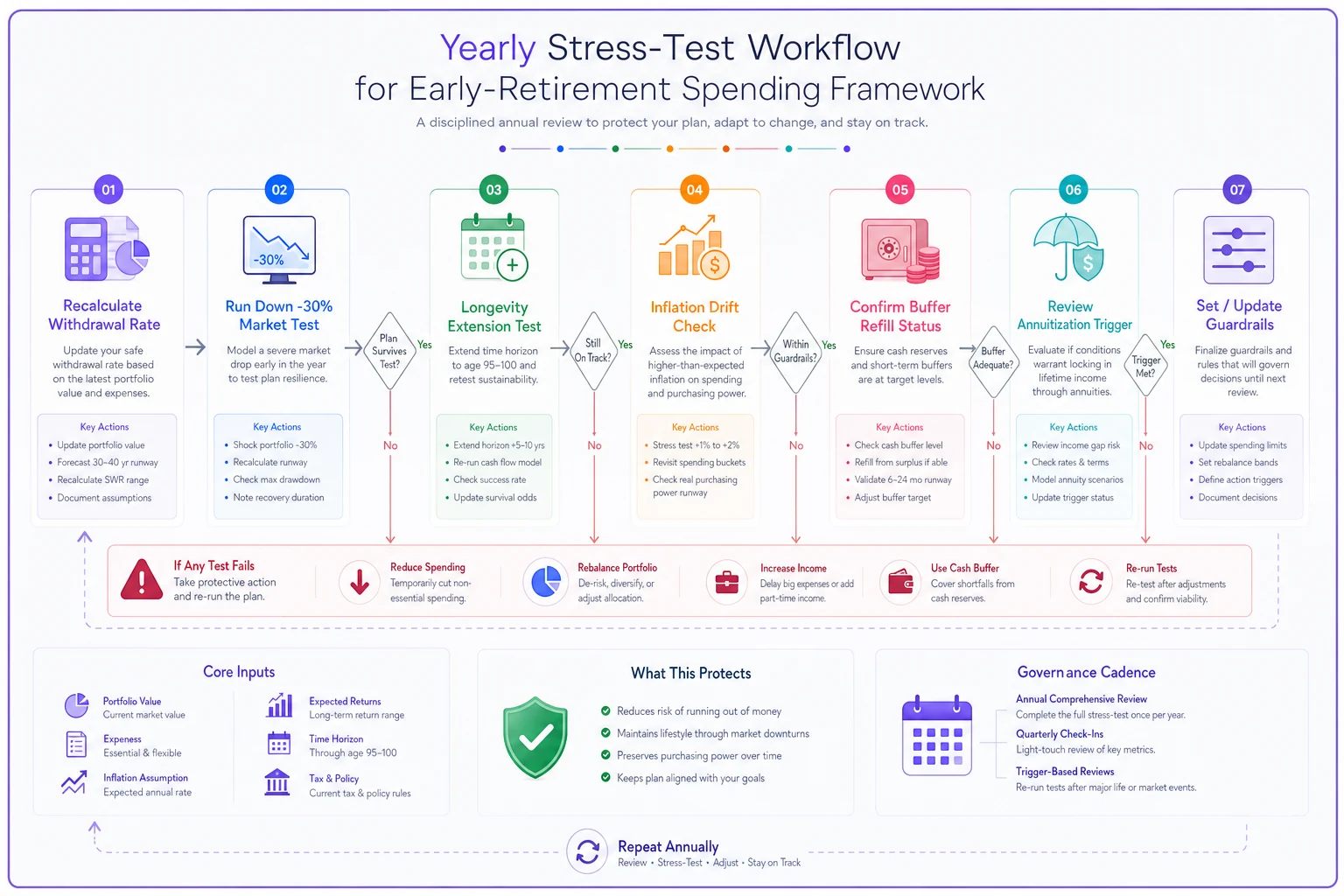
That last point — guardrails — is the quiet workhorse. A rule like "if the portfolio falls below the level that pushes my withdrawal rate above 5.5%, cut discretionary spending by 10% until it recovers" turns a vague anxiety into a pre-decided action. Deciding this in advance, when you're calm, is worth more than any forecast.
For the mechanics of sequencing withdrawals across account types once you've set the framework, the deeper rules on withdrawal sequencing, tax framing, and spending triggers pair directly with this ritual. And if your pre-retirement income is lumpy or uncertain, the approach in lean/base/stretch scenarios with trigger-based rules is a natural on-ramp to the guardrail logic here.
A real scenario: the 54-year-old couple
A couple retired at 54 and 52 with a portfolio around $1.35M, no pension, and Social Security they planned to delay to 67 and 70. Baseline spending ran roughly $66k a year, with maybe $18k of that discretionary — travel, dining, hobbies.
Their original plan was a flat 4% withdrawal, about $54k a year from the portfolio, with the rest coming from part-time income expected to fade by 60. On paper it worked. The problems: no buffer structure, annual calendar rebalancing, and no stress ritual. The entire plan assumed smooth-ish returns.
They restructured into the four-layer system:
-
Built Tier 1 and Tier 2 buffers covering about 36 months (~$160k combined).
-
Left annuitization on the ladder but didn't execute — too early, and rates and age didn't favor it yet. They set a trigger to revisit at 66.
-
Switched to band-based rebalancing with buffer-first refill.
-
Adopted a January stress-test ritual with a guardrail
cut discretionary by 15% any year the withdrawal rate crossed 5.25%.
Then markets did what markets do. A rough stretch hit in their third year — the portfolio dropped into the high $900ks. Under the old plan they'd have been selling equities into the decline to fund the full $54k withdrawal. Instead, they drained Tier 1 and Tier 2, triggered the guardrail, trimmed discretionary spending by about $2,700 for the year, and didn't realize a single equity loss. When markets recovered, the buffers refilled and the guardrail lifted.
The outcome wasn't dramatic. That's exactly the point. A plan that would have forced a demoralizing mid-50s "do we go back to work?" conversation instead produced a slightly leaner travel year. The framework absorbed the shock that a static plan would have passed straight through to their net worth.
Running this without it becoming a second job
The honest tension with any multi-layer framework is that it has moving parts, and moving parts get neglected. The buffer refill gets forgotten. The stress test slips from January to "sometime this spring" to never. The guardrail rule is written down somewhere but nobody checks the trigger.
What keeps a long-horizon plan alive is making the monitoring near-automatic — current withdrawal rate tracked against live portfolio value, buffer tiers flagged when they fall below target months, the stress-test checklist surfacing on schedule instead of waiting for you to remember it. This is the kind of recurring, rules-based monitoring that a solid financial operating system handles well: it watches the triggers so you only have to make the actual decisions. The framework defines what to check; the right setup makes sure the check actually happens every year for thirty years.
Track your buffer tiers and withdrawal rate on a simple monthly dashboard so the annual stress-test is a quick confirmation rather than a deep forensic exercise.
The tools matter less than the discipline. But a setup that removes friction — the main reason good frameworks fail isn't bad math, it's quiet neglect over a very long timeline — is worth building deliberately.
The takeaway
An early retirement spending framework isn't a withdrawal rate. It's a connected system where buffers absorb the early-year shocks, a floor protects you against living longer than you planned, glidepath rules keep the engine tuned, and an annual ritual catches drift before it compounds. Each layer covers a risk the others can't, and each one depends on the others to work properly.
Build it once, define the triggers and refill rules clearly, and then the job for the next few decades isn't forecasting the market — it's running the loop. Check the rate, check the buffers, run the stress test, honor the guardrails. Do that consistently, and a 35-year horizon stops being a leap of faith and starts being something you actually manage.
An early retirement spending framework isn't a withdrawal rate. It's a connected system where buffers absorb the early-year shocks, a floor protects you against living longer than you planned, glidepath rules keep the engine tuned, and an annual ritual catches drift before it compounds. Each layer covers a risk the others can't, and each one depends on the others to work properly.
Build it once, define the triggers and refill rules clearly, and then the job for the next few decades isn't forecasting the market — it's running the loop. Check the rate, check the buffers, run the stress test, honor the guardrails. Do that consistently, and a 35-year horizon stops being a leap of faith and starts being something you actually manage.
Ready to master your money?
Join thousands of users leveraging Savioly to build smarter budgets, save more efficiently, and plan for a secure financial future.