



Most families think they've done the estate work once the will is signed and the beneficiaries are named. The documents exist, the accounts are titled, everybody's technically covered. Then someone passes away and the family discovers the uncomfortable truth: the estate is worth $2.4 million on paper, but there's maybe $40k in actual spendable cash sitting in a checking account, and the first round of bills is already stacking up.
That gap — between what an estate owns and what it can pay — is the core of estate liquidity planning for families. It's the part nobody wants to model because it forces you to think about death and math at the same time. But it's also the part that quietly wrecks otherwise well-planned estates. Illiquid wealth is still wealth, but it doesn't pay the estate attorney, the property taxes on the second home, or the sibling who needs their share now instead of eighteen months from now.
Here's how liquidity actually breaks in real estates, how to size the reserve you need, and how to build funding paths that don't force a fire sale.
The Liquidity Gap Nobody Prices Until It's Too Late
The pattern shows up over and over: a family builds wealth in the least liquid things possible — a primary home, a rental property, a closely held business, a chunk of company stock, a retirement account with tax strings attached. All of that looks great on a net-worth statement. None of it turns into cash quickly or cleanly when someone dies.
Meanwhile, the bills that hit an estate are almost all cash bills, and many of them are time-sensitive:
-
Funeral and burial costs (typically $8k–$15k, due almost immediately)
-
Final medical bills and any uninsured care
-
Property taxes, insurance, and mortgage payments that don't pause just because probate is open
-
Legal and executor fees (often 2%–5% of the estate depending on complexity)
-
Estate or inheritance taxes, where applicable, due roughly nine months after death at the federal level
-
Debts and lines of credit the deceased was carrying
The math problem is timing. Assets settle slowly; obligations arrive fast. A house might take six to twelve months to sell in a soft market. A business interest can take years to value and transfer. But the estate tax filing deadline doesn't care about your comps.
A typical scenario looks like this: a widow inherits a $1.8M estate that's 70% tied up in a paid-off home and a small commercial building. On paper she's set. In reality she's got roughly $90k in liquid assets and about $130k in near-term obligations between fees, taxes on retirement withdrawals, and carrying costs on the buildings while they sit. She ends up selling the commercial property in a hurry, at a discount, to a buyer who smelled the urgency. That discount — call it 12%–15% off a patient-market price — is the real cost of skipping liquidity planning.
Titling Heuristics That Decide What Becomes Cash and When
Before you size any reserve, you need to understand how each asset transfers, because titling determines both speed and tax treatment. A lot of families think they're organized but aren't. They've named beneficiaries, sure, but they haven't thought about the sequencing of who gets liquidity and who gets stuck holding the illiquid stuff.
Take charge of your finances with clarity and confidence.
Savioly gives you real-time visibility and actionable steps to improve your money management.
- Automated expense tracking
- Goal-based saving plans
- Personalized financial insights
No credit card required
-
Assets that pass by beneficiary designation or payable-on-death (POD) are your fastest liquidity. Life insurance, IRAs, POD bank accounts, and TOD brokerage accounts skip probate and can be in an heir's hands within weeks. Treat these as your first-line cash sources.
-
Anything stuck in probate is slow liquidity — assume months, not weeks. Solely titled accounts with no beneficiary, real estate held in one name, personal property. Plan as if this cash won't be available for the first six months.
-
Jointly titled property transfers fast but concentrates the benefit. Joint tenancy with right of survivorship moves instantly to the co-owner, which is great for a spouse but can accidentally disinherit other heirs if you're not careful.
-
Business interests and real estate are illiquid until proven otherwise. Never count on them for near-term obligations. If they're your largest assets, that's exactly when you need a dedicated liquidity source.
The mistake families make is titling everything for tax efficiency or probate avoidance without asking a simpler question: when I'm gone, which of these can my heirs actually spend in the first ninety days? If the answer is "not much," you have a funding problem regardless of how clever the trust structure is.
This is also where beneficiary hygiene matters more than people realize — stale designations quietly undo the whole plan. If you haven't audited yours recently, the beneficiary-audit playbook walks through the 24-hour, 30-day, and annual checks that keep these designations from silently breaking your liquidity plan.
Sizing the Reserve: A Short Liquidity Worksheet
You don't need a $5,000 estate plan to run the core number. You need to estimate total near-term cash obligations, then compare them to fast-liquidity sources. This is something you can work through on a single page.
Step 1 — Total your near-term cash needs (first 12 months):
-
Funeral and final expenses
-
Estimated legal, executor, and administration fees (use 3%–5% of gross estate as a rough band)
-
Estate/inheritance tax exposure (federal, state, or both — many states have their own thresholds far below the federal one)
-
Carrying costs on illiquid assets while they settle (mortgage, insurance, property tax, maintenance × ~12 months)
-
Outstanding debts and lines of credit
-
Income replacement for any dependents during the settlement window
Step 2 — Total your fast-liquidity sources:
-
Life insurance death benefit
-
POD/TOD accounts
-
Cash and money-market balances
-
Marketable securities that can be sold within days without a tax disaster
Step 3 — Calculate the gap:
> Liquidity Gap = Near-Term Cash Needs − Fast-Liquidity Sources
If the gap is positive, that's the reserve you need to fund before anything else. A negative gap means you're covered — but re-run it every couple of years because both sides drift.
The part people consistently underestimate is the state tax layer. Several states impose estate or inheritance taxes at thresholds around $1M–$2M, well below the federal exemption. A family confident they're "under the limit" federally can still owe a six-figure state bill. Always run the worksheet against your state's rules, not the headline federal number.
Comparing the Three Main Funding Paths
Once you know the gap, you have to decide where the liquidity comes from. There are three main funding paths, and each has a different cost, tax profile, and control tradeoff.
| Funding Path | Speed to Heirs | Tax Treatment | Best For | Main Drawback |
|---|---|---|---|---|
| Taxable brokerage / cash reserve | Fast (days–weeks) | Step-up in basis at death; growth taxed while alive | Estates needing flexible, accessible liquidity | Drag from taxes on gains while funding it |
| Trust (revocable or irrevocable) | Fast if funded properly | Depends on structure; irrevocable can remove assets from taxable estate | Larger estates, control over timing, creditor/heir protection | Setup cost, complexity, must actually be funded |
| Donor-Advised Fund (DAF) | Immediate deduction, flexible grant timing | Charitable deduction now; grows tax-free | Charitable intent + reducing taxable estate | Money is irrevocably charitable — not for heirs |
The trust column has the biggest hidden trap. A trust that's drafted but never funded — meaning assets were never retitled into it — does nothing. The estate still runs through probate, the liquidity is still stuck, and the family paid legal fees for a document that sat in a drawer. Funding the trust is the operational step people skip because it's tedious paperwork with no immediate payoff.
Life insurance deserves a separate mention even though it isn't its own column. For estates where the wealth is genuinely illiquid — the family business, the farm, the rental portfolio — a properly owned life insurance policy (often inside an irrevocable life insurance trust, or ILIT) is frequently the cleanest way to manufacture liquidity exactly when it's needed, without forcing a sale. The death benefit lands as cash, tax-free to the beneficiaries, and can be structured to sit outside the taxable estate.
Sample Funding Scenarios
Numbers make this concrete. Three rough scenarios that cover most families.
Scenario A — The house-rich retiree. Estate around $1.6M, roughly 75% in a paid-off home and a rental. Fast liquidity: about $70k in cash and a $250k term policy. Near-term needs: roughly $180k (fees, carrying costs on two properties for a year, a modest state tax bill). The $250k policy plus cash comfortably covers the gap — as long as the policy hasn't lapsed. The failure mode here is a term policy that expired at 70 and was never replaced. Then the whole reserve evaporates and the rental gets dumped.
Scenario B — The business owner. Estate near $4.5M, with a closely held business worth roughly $3M. This is the classic liquidity trap. Fees, potential federal and state estate tax, and buyout obligations could run well past $700k in cash, none of which the business generates on short notice. An ILIT-owned policy sized to the tax and buyout exposure is usually the difference between heirs keeping the business and heirs selling it under pressure.
Scenario C — The blended family with charitable intent. Estate around $2.8M. The parents want to leave specific amounts to kids from prior marriages and fund a cause they care about. A DAF handles the charitable piece (deduction now, taxable estate reduced), a funded revocable trust controls the timing and amounts to each heir, and a modest cash reserve covers administration. The coordination is the whole point — get the titling wrong and one branch of the family gets liquidity while another waits on a property sale, which is exactly how estate disputes start.
Heir-Handoff Playbooks: The Part That Actually Fails in Practice
Funding the liquidity is only half the job. The other half is making sure heirs and executors can find and access it without a treasure hunt. This is where good planning quietly falls apart — the money exists, but nobody knows where, and the person who did know is gone.
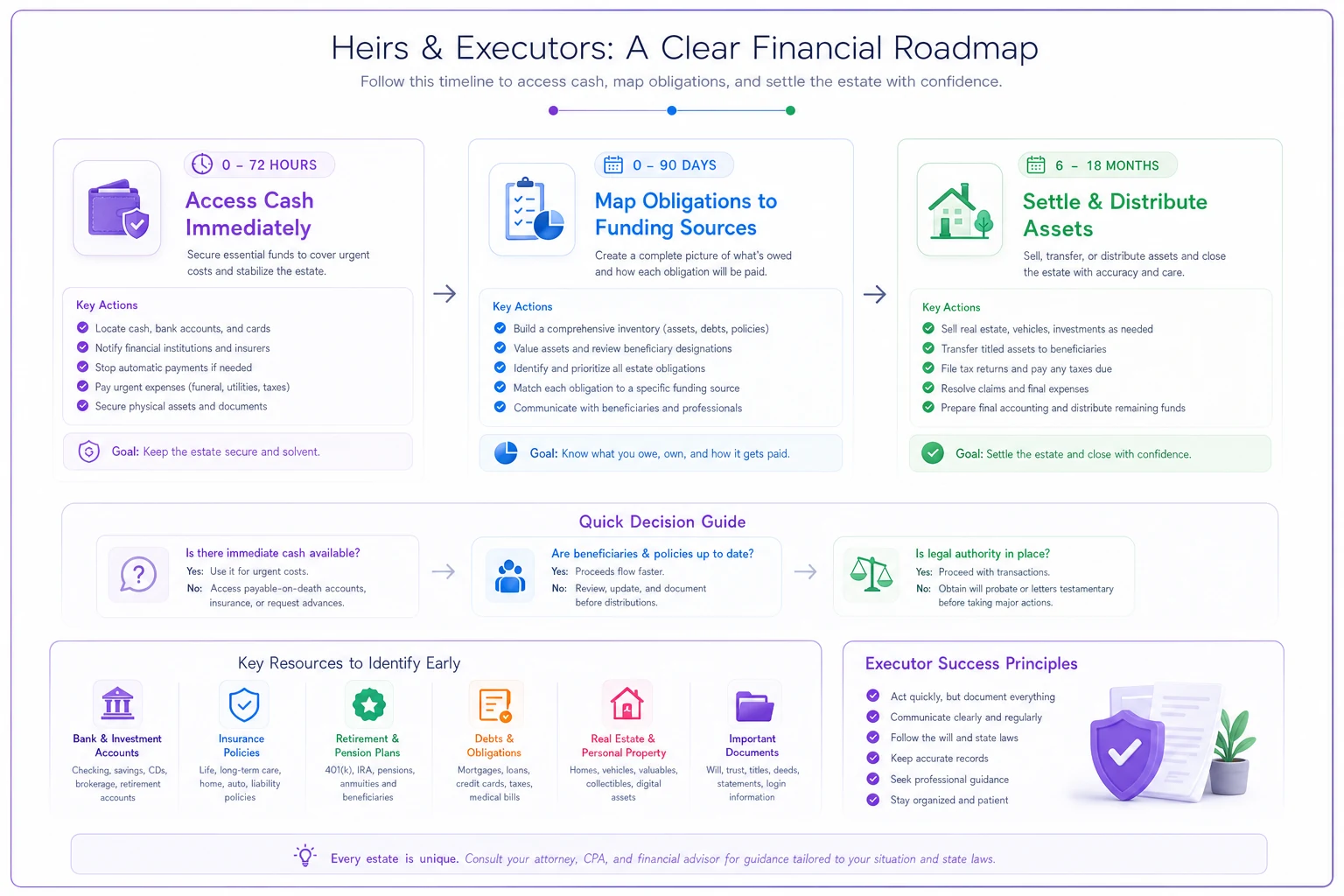
A workable handoff playbook covers three horizons:
-
First 72 hours. Where is the cash for immediate expenses? Who has authority to access it? This should be a single POD account or a small liquid reserve the executor can reach without a court order. Write down account numbers, institutions, and contacts in one place.
-
First 90 days. What obligations are coming due (mortgage, insurance premiums, tax filings), and which liquidity source pays each one? Map every bill to a funding source so the executor isn't guessing.
-
The settlement window (6–18 months). The plan for selling or transferring illiquid assets patiently, with the reserve covering carrying costs so nothing has to be dumped at a discount.
The visual below maps those three horizons.
The most common breakdown isn't a bad plan — it's a plan trapped in one person's head. The executor doesn't know there's a life insurance policy at a carrier the deceased used twenty years ago. Nobody knows the safe deposit box exists. The trust was funded but the account list is on a laptop nobody can unlock. In real settlements, this "where is everything" problem eats more time and money than the actual tax bill.
Maintain a single updated inventory document and make sure at least two trusted people know where to access it.
The fix is boring and effective: a maintained inventory. A living document listing every account, policy, property, its titling, how it transfers, and who to contact. This is the same discipline as running a regular financial close — the value is in keeping it current, not in having built it once. If you've already set up an annual review rhythm like the one in a compact annual financial close, fold the estate inventory into that same cadence so it never goes stale.
When Building a Big Liquidity Reserve Is a Bad Idea
Not every family needs a large reserve, and over-funding one has real costs.
-
When your estate is already liquid. If most of your wealth sits in cash, marketable securities, and POD/TOD accounts, you don't need a manufactured liquidity source. Buying a large life policy "just in case" is paying premiums to solve a problem you don't have.
-
When you're under every tax threshold and your assets transfer cleanly. A modest cash buffer for fees and final expenses is plenty. Don't over-engineer.
-
When the premiums would meaningfully hurt your own retirement. Estate liquidity is for your heirs, not something to fund by shortchanging your own decumulation years. If the insurance strategy only works by squeezing your current cash flow, it's the wrong strategy.
The families who should be aggressive about this are the ones with concentrated, illiquid wealth and a real tax or buyout exposure — business owners, multi-property landlords, farm families. For them, liquidity isn't optional; it's what keeps the assets in the family.
Where This Connects to the Rest of Your Financial System
Estate liquidity planning for families isn't a one-time legal event — it's a moving target that shifts every time your net worth, your state's tax rules, or your family structure changes. The reserve you sized three years ago may be badly wrong today because a property doubled in value or a policy lapsed.
The strongest approach treats it as a maintained system rather than a binder you file away. Keep a current asset inventory. Re-run the liquidity worksheet on a regular cadence. Confirm every trust that exists is actually funded. Verify beneficiary designations still match your intent. None of these are hard individually — they just require a rhythm so nothing drifts silently. Households that track their accounts, obligations, and titling in one organized place catch these gaps years before they matter, instead of discovering them during a settlement when there's no time left to fix anything.
The goal isn't a perfect estate plan. It's making sure that when the day comes, your heirs inherit cash they can use and assets they can keep — not a paper fortune and a stack of bills due in nine months.
The goal isn't a perfect estate plan. It's making sure that when the day comes, your heirs inherit cash they can use and assets they can keep — not a paper fortune and a stack of bills due in nine months.
Ready to master your money?
Join thousands of users leveraging Savioly to build smarter budgets, save more efficiently, and plan for a secure financial future.