


The freelancers who get burned by estimated taxes almost never get burned because they didn't know quarterlies existed. They get burned because income showed up unevenly, they eyeballed the reserve, and by the time January's 1099s landed they were staring at a number that didn't match what they'd set aside.
That gap — between what you owe and what you actually parked — is the whole game. It's usually the result of two or three small decisions made months apart that quietly compound. So instead of covering what estimated taxes are (you know), this is the defense system: a running estimated tax freelancers checklist, the safe-harbor math that keeps the IRS off your back even in a wild year, and the automation you can wire up so you stop making the reserve decision by feel.
Start with the two questions that decide everything
Before you calculate a single quarterly payment, two questions need answers. They change the entire approach.
Question one: Is this year going to look roughly like last year, or wildly different?
If your income is stable-ish, safe harbor is your friend and you can basically autopilot. If you're having a breakout year — or a collapse — safe harbor and actual-liability math point in very different directions, and picking the wrong one costs you either penalties or a year of unnecessarily starved cash flow.
Question two: Was your prior-year Adjusted Gross Income above or below $150k?
This one flips the safe-harbor percentage and people constantly miss it. Under $150k AGI, you're safe paying 100% of last year's total tax across your four payments. At or above $150k, that number jumps to 110%. Getting this wrong by 10% on a $40k tax bill is a $4k miscalculation baked in from day one.
Answer those two, and the rest of the checklist basically writes itself.
The safe-harbor heuristics, stated plainly
Safe harbor protects you from underpayment penalties — not from owing more in April. It means the IRS won't ding you for underpaying during the year as long as you hit one of these lines:
Take charge of your finances with clarity and confidence.
Savioly gives you real-time visibility and actionable steps to improve your money management.
- Automated expense tracking
- Goal-based saving plans
- Personalized financial insights
No credit card required
| Situation | Safe-harbor target (total for the year) | Best for |
|---|---|---|
| Prior-year AGI under $150k | 100% of last year's total tax | Stable or slightly-up income |
| Prior-year AGI $150k+ | 110% of last year's total tax | Higher earners, stable income |
| Any income | 90% of this year's actual tax | Down years, or first-year freelancers |
The move most people miss: you can pay the smaller of these. If you had a monster last year and this year is quieter, the 90%-of-current-year path lets you pay far less now instead of over-reserving against last year's inflated tax. If this year is your breakout, the 100%/110%-of-last-year path lets you legally defer the extra until April without penalty — a genuine, interest-free cash-flow advantage if you park the difference somewhere short-term.
One pattern worth naming: freelancers who use only the current-year 90% method during a growth year almost always underpay, because they're calculating quarterly off income they haven't earned yet and lowballing the trajectory. In a rising year, anchor to last year's number. Boring, and it works.
The conservative reserve formula (what to hold vs. what to send)
There's a difference between what you send the IRS each quarter and what you hold back so April doesn't hurt. The reserve is your buffer against the safe-harbor-vs-actual gap.
Reserve rate = federal effective rate + self-employment tax + state effective rate + a 3–4% cushion
The self-employment piece is the one that quietly wrecks first-year freelancers. It's roughly 15.3% on net earnings (with the ~92.35% adjustment), and it stacks on top of income tax. Someone netting around $70k who mentally budgeted for a "22% bracket" and forgot SE tax is off by nearly half their actual bill.
A realistic reserve rate for a lot of mid-income freelancers lands somewhere in the 28–34% range once you fold everything in. If you want the deeper version of building this kind of buffer as a running system, the runnable reserve formula and monthly checks approach breaks down the mechanics of holding vs. sending in more detail.
The cushion matters more than it looks. Estimated income during the year is always an estimate — a late invoice, a surprise 1099-K, a deduction that didn't materialize. That extra 3–4% is what keeps a small forecasting error from becoming a penalty.
The quarter-by-quarter checklist
The IRS quarters are not even calendar quarters, which trips people up constantly. Q2 covers two months. Q4 covers four. Here's the actual cadence with the running tasks.
Due dates (typical year):
-
Q1 — April 15 (covers Jan–Mar)
-
Q2 — June 15 (covers Apr–May)
-
Q3 — September 15 (covers Jun–Aug)
-
Q4 — January 15 of next year (covers Sep–Dec)
Run this same loop every quarter:
-
[ ] Pull your YTD net income (revenue minus deductible expenses, not gross)
-
[ ] Recompute your effective reserve rate if income has shifted meaningfully since last quarter
-
[ ] Compare two numbers your safe-harbor obligation-to-date vs. 90% of your actual YTD tax annualized
-
[ ] Pay the lower defensible number for that quarter
-
[ ] Confirm the payment cleared (IRS Direct Pay, EFTPS, or your state portal)
-
[ ] Log the confirmation number somewhere you'll find it in April
-
[ ] Move any reserve overage into a short-term holding spot instead of leaving it in checking
-
[ ] Flag anything unusual — a big new client, a lost retainer — for a mid-quarter recheck
The one people skip is the annualization comparison in the middle. If your income is front-loaded — say a big Q1 project then a quiet summer — the standard "divide the year by four" method makes you overpay early. The annualized income installment method lets you pay in proportion to when you actually earned. More work, but for seasonal or spiky freelancers it can free up real cash in the slow quarters.
> Pro tip: Set a recurring calendar block two days before each due date. That's enough lead time to pull your numbers, run the comparison, and send the payment without rushing.
Running this loop consistently is what separates freelancers who feel in control of their taxes from those who treat April like a surprise bill. The checklist itself isn't complicated — the hard part is actually doing it every quarter without letting it slip.
A real scenario: the freelancer who paid in the wrong direction
Consider a freelance UX designer — the setup is realistic even if the name isn't. Prior year: netted about $58k, total tax around $13k, AGI comfortably under $150k. Current year started hot — a big product launch client in Q1 pushed YTD net to roughly $34k by June.
Her instinct was to base Q2 payments on the current-year pace. She annualized that $34k out to something like $80k+ for the year and started sending quarterlies sized for a much bigger tax bill. Cash got tight over the summer when the launch client wrapped and nothing replaced it immediately.
By year-end she actually landed around $62k net — barely above last year. She'd sent in nearly $4,500 more across Q2 and Q3 than she needed to hit safe harbor. Money she could have kept liquid during a genuinely thin August.
The fix wasn't complicated. Anchoring her quarterly payments to 100% of last year's $13k tax (about $3,250 per quarter) would have kept her fully penalty-protected while leaving several thousand dollars in her account during the slow stretch. She still would have owed a bit in April on the true-up — but on her own timeline, with cash she controlled.
In a rising year, last-year's-number is usually the cheaper path, not the more expensive one. She'd assumed the opposite, and it cost her a stressful summer.
Automating the transfers and the reconciliation
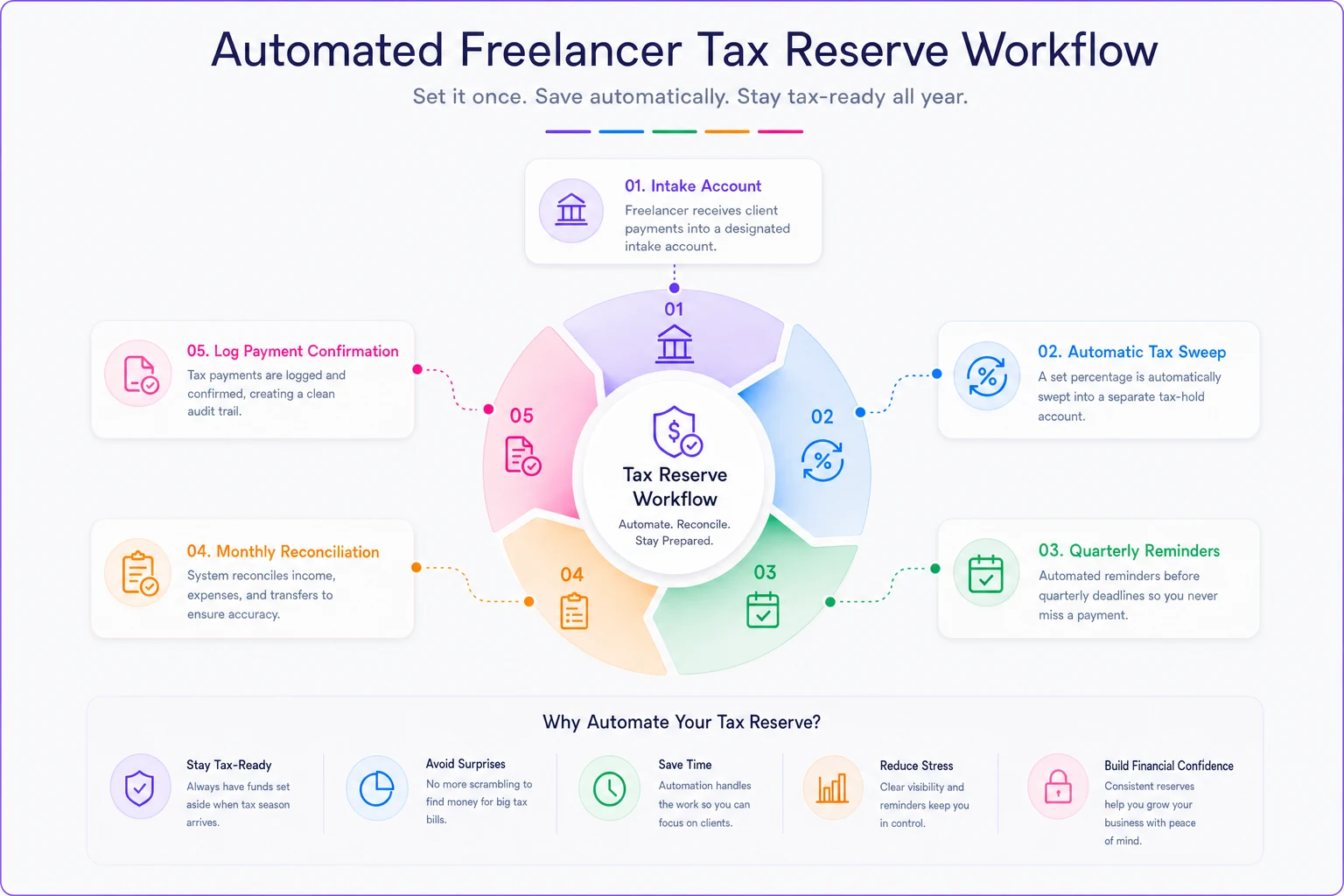
The reason quarterlies go sideways is rarely the math — it's that the reserve decision is manual and gets skipped when you're busy. Automating it means the reserve happens before the money feels like yours.
-
Route income into an intake account. Everything a client pays lands in one place first, not your spending account.
-
Trigger a percentage transfer on deposit. The moment a payment clears, an automation sweeps your reserve rate — say 30% — into a separate tax-hold account. This is the single highest-leverage step. You never manually decide to save for taxes.
-
Schedule the four quarterly payment reminders with a two-day lead so you can eyeball the numbers before sending.
-
Reconcile YTD monthly, not quarterly. A short monthly check catches a drifting reserve rate before it becomes a big miss. Waiting until the quarter is due means any error is already three months old.
-
Log every confirmation number automatically into the same sheet you'll hand to whoever files your return.
The percentage-on-deposit split is the backbone of most working freelancer systems — the same logic behind a side-hustle cashflow system that covers taxes, owner pay, and reinvestment. The tax reserve is just one lane of that split, but it's the lane that causes the most pain when it's missing.
Where lightweight operational software earns its keep is the boring reconciliation layer: pulling your deposits, tagging deductible expenses, and giving you a live YTD net number so the quarterly comparison takes two minutes instead of an afternoon of scrolling bank statements. You don't need anything heavy — you need the running total to already be calculated when the due date hits, so the decision is a glance, not a project.
When to just use safe harbor and stop optimizing
Safe harbor exists so you don't have to be precise.
If your income is reasonably stable and you're not trying to squeeze every dollar of short-term liquidity out of the deferral, pay 100%/110% of last year's tax in four equal chunks and move on. No annualization, no monthly recompute beyond a sanity check. The mental overhead of optimizing isn't worth it for most people, and safe harbor guarantees no penalty regardless of how big your actual bill grows.
When the simple approach breaks down
The equal-installments-off-last-year method breaks down in two situations. First, a collapsing income year — if you're going to earn far less, you're wildly overpaying by anchoring to a big prior year, and the 90%-of-current-year path is where you should be. Second, highly seasonal income where most earnings hit one or two quarters — the annualized installment method can meaningfully improve your cash flow in the lean quarters, and flat installments just strand money you actually need.
Neither situation is rare for freelancers. A retainer that drops out, a slow Q3 after a strong first half, a client that pushes a big project into the next calendar year — any of these can make the default approach look pretty dumb in hindsight.
Who should not run this solo
If you crossed into multi-state work this year, took on a partner, restructured as an S-corp, or had a large one-time event like an equity or property sale, the DIY quarterly heuristics stop being enough.
The safe-harbor lines still protect you from penalties, but the actual optimization gets complicated fast. A few hundred dollars for a real preparer to set your quarterly targets will pay for itself. The checklist above is built for a solo freelancer with reasonably normal income — not for a genuinely complex return.
Pulling it together
The freelancers who never sweat April aren't the ones with the fanciest spreadsheets. They're the ones who made two decisions early — which safe-harbor line to anchor to, and what reserve rate to sweep on every deposit — and then let a simple monthly reconciliation catch any drift.
Pick your safe-harbor path based on whether this year is rising or falling. Set a reserve rate that actually includes self-employment tax. Sweep it automatically before it feels spendable. Reconcile monthly so no error gets three months old. Do that, and the quarterlies stop being the thing you dread and become the most boring four dates on your calendar — which is exactly what you want them to be.
The freelancers who never sweat April aren't the ones with the fanciest spreadsheets. They're the ones who made two decisions early — which safe-harbor line to anchor to, and what reserve rate to sweep on every deposit — and then let a simple monthly reconciliation catch any drift.
Pick your safe-harbor path based on whether this year is rising or falling. Set a reserve rate that actually includes self-employment tax. Sweep it automatically before it feels spendable. Reconcile monthly so no error gets three months old. Do that, and the quarterlies stop being the thing you dread and become the most boring four dates on your calendar — which is exactly what you want them to be.
Ready to master your money?
Join thousands of users leveraging Savioly to build smarter budgets, save more efficiently, and plan for a secure financial future.