


Fertility treatment is one of the few big medical expenses where you often know it's coming months in advance, the costs arrive in uneven chunks, and you have real choices about how you pay. That last part is where most people leave money and flexibility on the table.
The problem isn't really about affording it — it's sequencing. A single IVF cycle might run $18k–$25k before meds, and meds alone can add $4k–$7k depending on your protocol. Then there's monitoring, anesthesia for retrieval, embryo freezing, storage fees that recur annually, and possibly a frozen transfer down the line. The money doesn't leave your account all at once, and neither should your decisions about it.
Most people either pay everything out of the HSA immediately and kill the tax-advantaged growth, or charge everything to a card and scramble later. Neither is optimal. What you actually want is a decision ladder — a repeatable set of questions you run each time a bill lands, so you're not re-deciding from scratch while already stressed.
## The core tension: cash now vs. reimburse later vs. borrow the gap
Your HSA lets you reimburse yourself for a qualified expense at any point in the future, as long as the expense happened after your HSA was opened and you kept the receipt. There's no deadline. You could pay a fertility bill out of pocket in 2024 and pull the reimbursement in 2031.
That single rule changes everything about sequencing. It means your HSA isn't just a payment account — it's an option you can exercise whenever the timing works best for you.
-
Pay directly from the HSA — simple, immediate, but you lose future tax-free growth on that balance.
-
Pay out of pocket, save the receipt, reimburse later — keeps the HSA invested and growing, gives you a tax-free withdrawal coupon you can cash anytime.
-
Borrow the gap short-term — a 0% medical financing offer or clinic installment plan, so you preserve both cash and HSA balance.
The decision ladder below tells you which one to reach for.
## The decision ladder
Run these questions in order every time a fertility invoice arrives. Stop at the first one that gives you a clear answer.
Take charge of your finances with clarity and confidence.
Savioly gives you real-time visibility and actionable steps to improve your money management.
- Automated expense tracking
- Goal-based saving plans
- Personalized financial insights
No credit card required
DECISION LADDER — FERTILITY BILL ARRIVES │ ▼ Step 1: Enough liquid cash outside the HSA to cover this without draining emergency reserve? │ ├── NO → Skip to Step 4 (borrowing options) │ └── YES ▼ │ Step 2: Is your HSA currently invested (not just sitting in cash)? │ ├── NO → Pay from the HSA directly. No growth to protect. │ └── YES ▼ │ Step 3: Will you need this money back within ~18 months? │ ├── NO → Pay out of pocket. Save receipt. Let HSA compound. │ Tag it as a long-term reimbursement coupon. │ └── YES → Pay out of pocket. Save receipt. Tag it as a near-term coupon in case a later cycle strains you. │ ▼ Step 4: If cash is tight — compare borrowing cost vs. HSA growth you'd give up. │ ├── 0% clinic plan or 0% intro card → Borrow. Keep receipts. Reimburse strategically. │ └── Interest above ~7–8% → Usually not worth it. Pay from HSA and rebuild.
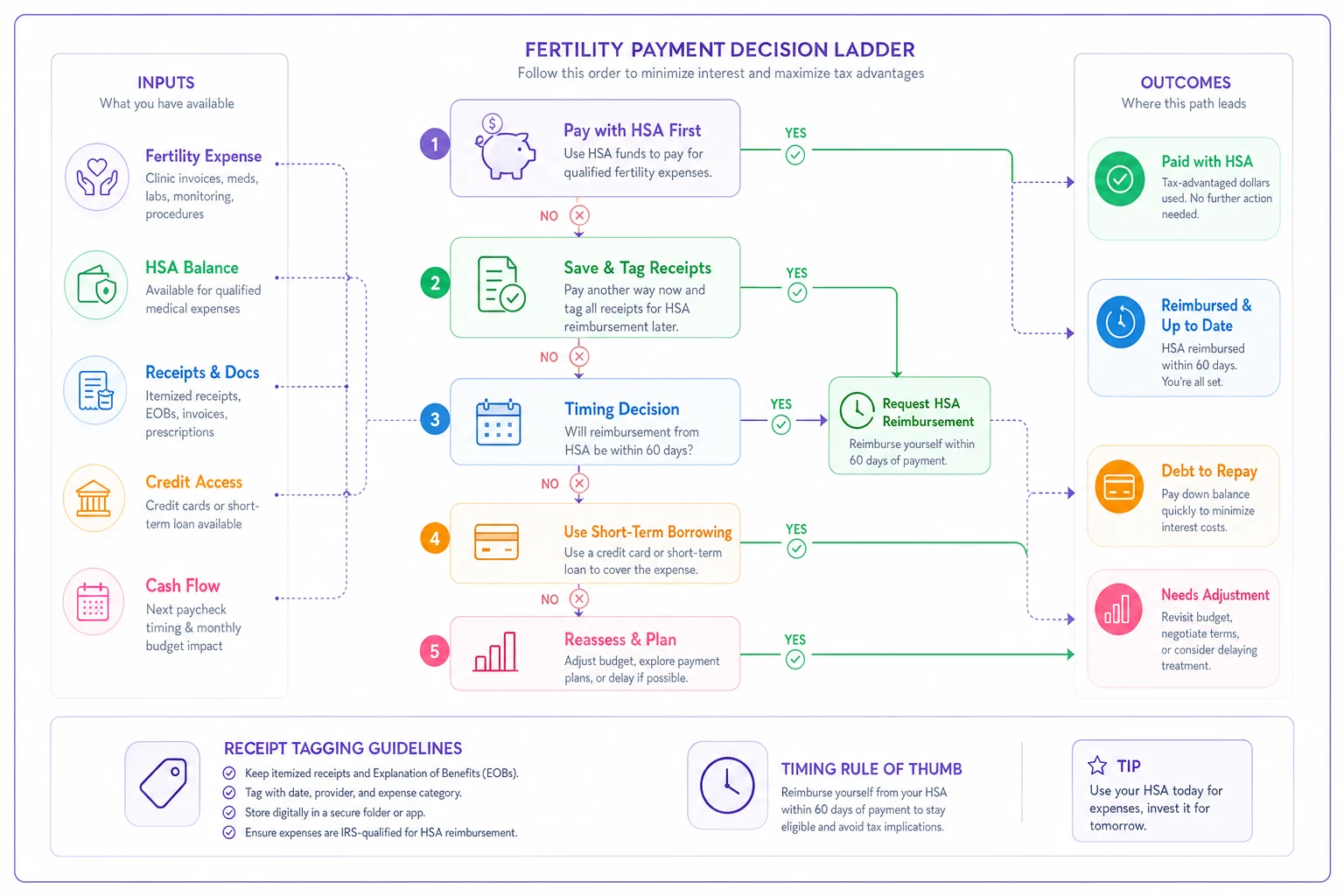
The part most people miss: the "pay out of pocket and reimburse later" path is strongest precisely when you can afford it easily. People instinctively save the HSA for when things get hard. But the HSA grows most when left alone, which means the best time to pay out of pocket is when cash is comfortable — not when you're already stretched thin.
## Receipts: the part that quietly determines whether the strategy even works
The reimburse-later approach completely falls apart without solid receipt capture. If you can't prove an expense was qualified and happened after your HSA opened, the IRS can disallow the reimbursement — and now you've got a taxable distribution plus a 20% penalty if you're under 65.
Fertility treatment makes documentation harder than normal medical spending because it's fragmented. You'll get an itemized clinic invoice, a separate pharmacy receipt for injectables, a lab bill, an anesthesia bill, and an EOB from insurance showing what they partially covered. HSA eligibility depends on the expense being a qualified cost not reimbursed by insurance, so you need both the bill and the EOB to prove what you actually paid.
A clean capture routine for each expense:
-
The itemized bill — not just the credit card charge; the IRS wants the medical detail
-
Proof of payment — card statement line, bank transfer, or a paid stamp on the invoice
-
The insurance EOB showing what wasn't covered
-
A one-line note with the date, provider, cycle number, and dollar amount you personally paid
-
A running total of unreimbursed qualified expenses — this is your reimbursement coupon balance
Store these somewhere you'll actually find them years later. A dedicated cloud folder named by date and provider works fine. The people who get this wrong almost always do it the same way: they capture nothing during treatment because they're overwhelmed, then try to reconstruct two years of bills afterward. Half the itemized invoices are gone by then.
If you want the deeper mechanics on when to leave the HSA invested versus spend it down, the HSA optimization playbook on when to pay out-of-pocket vs. invest covers the receipt-tracking habits that make the reimburse-later strategy actually safe to lean on.
## Timing heuristics that actually matter
A few timing rules that consistently show up as the smart call:
Front-load HSA contributions in a treatment year. If you know a cycle is coming, max the HSA early in the year so the balance is in place before the big bills hit. You get the full deduction either way, but having the balance available gives you more sequencing flexibility. Just make sure the cashflow math still holds — a treatment year often strains everything at once, and it's worth checking against your broader tax provisioning reserve formula so the extra HSA contribution doesn't leave you short on estimated taxes.
Let the recurring fees run through the HSA directly. Embryo storage runs somewhere around $600–$1,000 a year and recurs indefinitely. These are small, predictable, and not worth the receipt-tracking overhead of reimburse-later. Pay them straight from the HSA.
Save the reimbursement coupon for a strategic year. Because you can reimburse anytime, hold that stack of receipts for a year when you actually need tax-free cash — a job gap, a home down payment, a lower-income year. Pulling several years of unreimbursed fertility expenses out of the HSA tax-free during one of those stretches is genuinely powerful.
## Installment negotiation: what to actually say
Fertility clinics deal with payment plans constantly, and their default offer is rarely their best one. The financial coordinator usually has room to move, especially if you're committing to a full package rather than paying piecemeal.
On the package price:
> "I'm comparing a couple of clinics on total cost. If I commit to the full cycle package and pay the deposit today, is there a self-pay or prompt-pay discount you can apply?"
On medications:
> "Can you give me the itemized medication protocol so I can price it at a specialty pharmacy myself? I've found the same injectables at different prices and want to check before we finalize."
On the payment plan:
> "I'd like to spread the balance over the treatment months rather than pay it all at retrieval. What's the longest interest-free installment plan you offer, and is there a fee to set it up?"
When they quote financing:
> "Before I use your financing partner, what's the plain out-of-pocket price if I self-fund? I want to compare the all-in cost including any financing interest."
The pattern: always separate the price of the service from the cost of financing it. Clinics bundle them, and the bundle hides which piece is actually negotiable. A 0% in-house plan is genuinely useful. A "convenient" third-party medical loan at 12% is a price increase dressed up as a payment option.
## Worked example: a two-cycle sequence
Picture a couple planning IVF with a realistic chance of needing two rounds. Here's how the ladder plays out across the sequence.
| Expense | Timing | Amount (approx) | Decision | Reasoning |
|---|---|---|---|---|
| Initial consult + testing | Month 1 | $1,800 | Pay from HSA cash | Small, HSA held in cash anyway |
| Cycle 1 package | Month 3 | $19k | Pay out of pocket, save receipt | Cash comfortable, HSA invested, keep it growing |
| Cycle 1 meds | Month 3 | $5,200 | 0% clinic med plan | Preserve cash for cycle 2 buffer |
| Anesthesia + retrieval | Month 4 | $2,400 | Pay out of pocket, save receipt | Adds to reimbursement coupon |
| Cycle 2 package | Month 9 | $19k | Split: $9k out of pocket, $10k on 0% plan | Cash tighter now; borrow at 0% rather than drain invested HSA |
| Embryo storage | Annual | $750/yr | Pay from HSA directly | Small, recurring, not worth tracking |
By the end of this sequence, the couple has paid a significant chunk out of pocket while keeping their HSA fully invested. They're sitting on roughly $27k–$29k in documented, unreimbursed qualified expenses — a tax-free withdrawal coupon they can cash whenever it's most useful.
The 0% plans absorbed the cashflow crunch of the second cycle without forcing them to sell invested HSA assets. And because they captured every itemized bill and EOB as they went, the reimbursement option is actually usable, not theoretical.
## When this whole approach is a bad idea
The reimburse-later strategy is powerful, but it's not for everyone.
Don't do it if:
-
Your HSA is small or held entirely in cash. There's no growth to protect, so just pay from the HSA and skip the tracking burden.
-
You know you won't keep the receipts. An untracked reimburse-later plan is worse than just paying from the HSA — you'll either forget the money exists or fail an audit later.
-
Carrying the out-of-pocket bills on a card at real interest is the only way to "pay out of pocket." Credit card interest destroys the entire advantage. If preserving the HSA means expensive debt, just use the HSA.
-
The cashflow stress is genuinely harming you. This is optimization, not obligation. Draining the HSA to protect your peace of mind during an already exhausting process is a completely reasonable call.
When it clearly makes sense:
-
Your HSA is invested and you don't need it for current medical costs.
-
You have comfortable liquid cash to cover bills without touching your emergency reserve.
-
You're disciplined enough to capture and store receipts as you go.
-
You can foresee a future low-income or high-need year where tax-free cash would be genuinely valuable.
The gap between those two lists is worth sitting with before you commit to any sequencing strategy. Most people fall clearly into one camp or the other once they lay it out honestly.
## The one habit that ties it all together
Capture every fertility receipt in real time, tag it with the cycle and the amount you personally paid, and keep a running unreimbursed total. That number is the engine behind every timing decision above. Without it, the ladder is just theory.
Fertility cost planning with an HSA isn't really about being clever with tax rules. It's about giving yourself options during a stretch where you have very little control over anything else — the outcomes, the timeline, the emotional weight of it. Sequencing your payments well won't change the medical odds. But it can mean you come out the other side with your invested HSA intact, a tax-free coupon in your pocket, and no expensive debt hanging around from a period that was hard enough already.
Fertility cost planning with an HSA isn't really about being clever with tax rules. It's about giving yourself options during a stretch where you have very little control over anything else — the outcomes, the timeline, the emotional weight of it. Sequencing your payments well won't change the medical odds. But it can mean you come out the other side with your invested HSA intact, a tax-free coupon in your pocket, and no expensive debt hanging around from a period that was hard enough already.
Ready to master your money?
Join thousands of users leveraging Savioly to build smarter budgets, save more efficiently, and plan for a secure financial future.