


Most household money systems don't fail because the math is wrong. They fail because they live inside one person's head and three spreadsheets only that person understands. Everything works fine until it doesn't — a new job, a death, a divorce, a hospitalization, or a laptop that dies with the only copy of the master budget on it.
The spreadsheet isn't the enemy. Spreadsheets are genuinely good for thinking. The problem is treating a thinking tool like an operating system. An operating system has to keep running when the person who built it steps away. That's the whole point of a household financial operating system migration: you're not upgrading software, you're converting private knowledge into something durable, shareable, and recoverable.
This is a migration playbook, not a tool review. The goal is a system that a competent stranger — your spouse, an adult kid, an advisor, an executor — could pick up cold and run for six months without you.
Why spreadsheet households quietly become fragile
The failure mode is almost always the same, and it has nothing to do with financial literacy. It's a coordination problem.
One person becomes the "keeper." They know that the tab labeled Budgetv4FINALusethis is the real one, that the "misc" category actually holds the quarterly tax reserve, and that the formula in cell K12 breaks if you insert a row above it. None of that is written down. It's tribal knowledge held by exactly one person.
At small scale — one income, a couple of accounts, no dependents — this is fine. The keeper holds the whole picture in memory and patches problems in real time. But households don't stay simple. They accumulate. A brokerage account here, a 529 there, a HELOC, an HSA, an old 401(k) from two jobs ago, a rental, a side income, three credit cards, and two auto-pays nobody remembers setting up.
What breaks at scale isn't the money. It's the number of places knowledge has to live and the number of hands that need to touch it. A typical example: a couple where one partner manages everything through a personal Google Sheet. The other partner has never opened it. When the keeper travels for two weeks, a property tax bill and an insurance renewal both hit, and nobody knows which account they're supposed to come out of or whether they're on autopay. Two late fees and a lapsed policy later, they realize the system was never actually a system.
If you've read the case for building an operating system with monthly closes, KPIs, and decision rules, this is the structural layer underneath it. You can't run a monthly close on a system nobody else can open.
The minimum viable artifacts
You don't need to rebuild everything before you get value. Migration works best as a staged move, and the first stage is defining the minimum viable artifacts — the smallest set of documents that make the system runnable by someone other than you.
Take charge of your finances with clarity and confidence.
Savioly gives you real-time visibility and actionable steps to improve your money management.
- Automated expense tracking
- Goal-based saving plans
- Personalized financial insights
No credit card required
-
The account map. Every account, its institution, its purpose, its rough balance range, and who has access. Not passwords — the existence and purpose of each account. Most households can't produce this from memory, which is exactly the point.
-
The cashflow spine. Where money comes in, where it's supposed to go, and the transfer schedule that moves it. Not a line-item budget — the plumbing.
-
The obligations calendar. Every recurring bill, its amount range, its due date, its funding account, and whether it's on autopay.
-
The decision rules. The short list of "if X, then Y" logic the keeper runs automatically. "If checking drops below $4k, pause the extra investment transfer." "If a bonus lands, 40% to taxes reserve first."
-
The recovery note. A single plain-language document that tells a stranger how the other four fit together and where to find things.
Notice what's not on this list: detailed transaction history, elaborate charts, net-worth projections out to 2050. Those are nice. They're not load-bearing. In a real handoff, nobody needs your retirement Monte Carlo — they need to know which account the mortgage comes out of.
A useful test: could someone reconstruct your monthly obligations without asking you a single question? If not, the artifacts aren't done yet.
Migrating in stages, not all at once
The instinct is to spend a weekend building the perfect system and then never touch a spreadsheet again. That almost never survives contact with real life. A staged migration is more durable because each stage produces something useful even if you stall.
A sequence that actually holds:
Stage 1 — Inventory. Pull every account into the account map. This is the least fun and most valuable step. Households routinely discover two or three accounts they'd forgotten — including a dormant savings account holding a surprising balance or an old auto-pay quietly draining a few dollars a month.
Stage 2 — Plumbing. Document the cashflow spine and obligations calendar exactly as they currently work, not as you wish they worked. Migrate reality first, optimize later.
Stage 3 — Rules. Write down the decisions you make on autopilot. This is where tribal knowledge gets externalized. Expect it to take longer than you think, because most of these rules have never been spoken out loud.
Stage 4 — Redundancy. Add versioning, backups, and access for a second person. The system stops being fragile here.
Stage 5 — Handoff and hardening. Build the packages for heirs and advisors, then stress-test the whole thing.
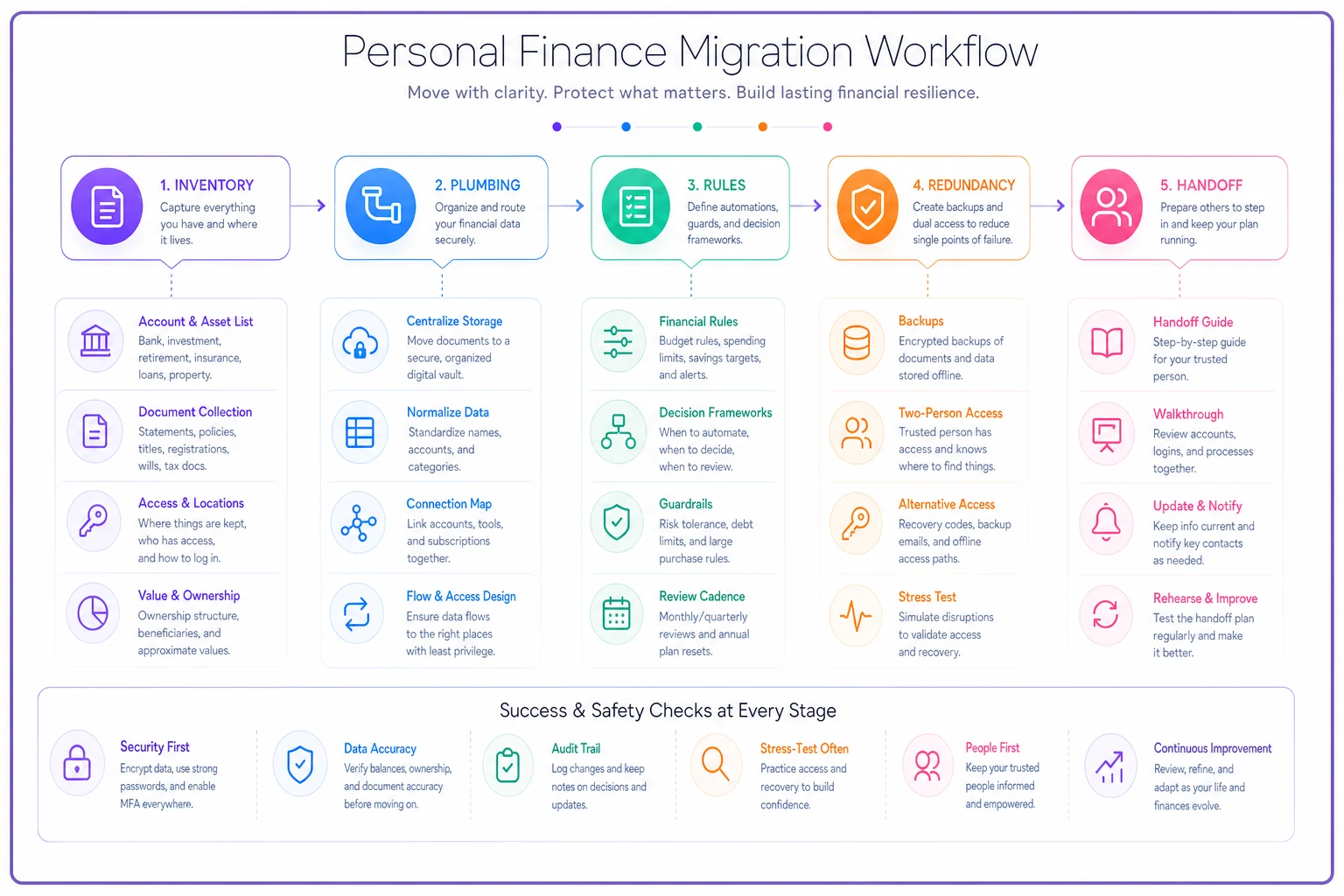
A quick visual of the staged migration workflow.
The mistake people make is trying to do Stage 5 quality work during Stage 1. You end up with a beautiful account map and no plumbing. Get each layer functional and rough before you polish anything.
Versioning and backups without turning it into a job
The trap: people either have zero backups or they have forty files named some variation of "final." Both are failure states. One loses data; the other loses authority — nobody knows which version is true.
The fix is boring on purpose:
-
One canonical location. There is exactly one live version, and everyone knows where it is. Everything else is a copy, clearly labeled as such.
-
Dated snapshots, not versioned filenames. Once a month, save a read-only snapshot with the actual date (
2024-11-household). You're not editing these. They're a time machine. -
Two locations, minimum. Cloud plus one local, or two independent cloud providers. A single provider outage or account lockout should never take out your entire financial history.
-
A recovery test twice a year. Actually try to open a backup from a different device, logged in as the other person. Backups you've never restored are theoretical backups.
The versioning principle that matters most: you should always be able to answer "what did our finances look like on this date, and why did we make the decision we made?" A monthly snapshot plus a one-line note in the recovery document does more for future-you than any dashboard.
The handoff package: building for the day you're not there
This is the part nearly everyone skips, and it's what separates a spreadsheet from an actual operating system.
A handoff package is a curated bundle designed for a specific reader who has no context. There are usually two versions, and they're different on purpose.
| Package element | Heir / executor version | Advisor version |
|---|---|---|
| Account map | Full — including access instructions | Full — usually read-only or view access |
| Cashflow spine | Simplified plain-language summary | Detailed, with transfer logic |
| Obligations calendar | Critical bills flagged as "must not lapse" | Complete list with amounts |
| Decision rules | The 5–6 that prevent disasters | Full ruleset for planning |
| Recovery note | Written for a stressed non-expert | Written for a professional |
| Legal / estate docs | Location and contact info | Reference only |
The heir version assumes the reader is grieving, overwhelmed, and not financially fluent. It should be almost embarrassingly simple: "These four bills must be paid or something bad happens. Here's how. Here's who to call." The advisor version assumes competence and prioritizes completeness.
A concrete detail that saves real pain: flag the irreversible obligations. A late credit card payment is annoying. A lapsed term life policy or a missed estimated-tax deadline is expensive and sometimes permanent. Those need to be unmissable in the handoff package.
Store it where the right people can reach it without you — that's the only test that matters. A perfect package locked behind your fingerprint is worthless in the exact scenario it was built for.
A governance calendar that keeps the system alive
Documents rot. An account map built in January is wrong by June if nobody updates it. The system stays durable only if there's a rhythm that keeps it honest.
You don't need a heavy process. A light governance calendar tied to things you already do is enough:
-
Monthly A short close — reconcile the plumbing, snapshot a backup, update anything that changed. This pairs naturally with a compact monthly and annual close routine, which handles the numbers while governance handles the structure.
-
Quarterly Review the obligations calendar for new subscriptions, rate changes, and anything that's drifted. Confirm the second person still has access.
-
Semi-annually Run a recovery test. Open the backups from another device as the other person.
-
Annually Refresh the full handoff packages, re-verify beneficiaries, and re-read the recovery note as if you'd never seen it.
Governance work is cheap when it's frequent and brutal when it's neglected. A ten-minute quarterly check prevents the "we haven't looked at this in three years and now nothing matches reality" situation that forces people to rebuild from scratch.
Hardening: stress-testing for the life changes that actually happen
Hardening is where you deliberately try to break your own system before life does it for you. The question isn't "does this work?" It's "does this survive specific bad days?"
Run your system against real scenarios and look for where it fails:
-
The keeper is unreachable for two weeks. Can the other person pay every critical bill using only the artifacts? If they'd have to guess, that's a gap.
-
A primary account gets frozen or compromised. Does the plumbing have a fallback, or does everything cascade because it all routes through one checking account?
-
Income drops suddenly. Do the decision rules actually tell someone what to cut first, or do they only describe the good times?
-
The keeper dies. Can an executor find the estate documents, the account map, and the recovery note without a scavenger hunt?
-
A move or job change scrambles the accounts. How much of the system has to be rebuilt versus updated?
A real hardening finding: a household ran the "unreachable for two weeks" test and discovered that four of their auto-pays drew from an account the second partner had never had login access to. Nothing was wrong with the money — the access was single-threaded. Fixing it took twenty minutes. Discovering it during an actual emergency would have cost late fees, panic, and a lapsed policy.
When you run a hardening test, simulate a normal billing cycle so the consequences and timing are realistic.
Hardening isn't a one-time event. Every major life change is a re-test. The system that survived last year might have a new single point of failure after a move, a new baby, or an inheritance.
When a full migration makes sense — and when it doesn't
When it clearly makes sense: two or more people depend on the finances, there are dependents or heirs, you've got more than a handful of accounts, or your income is variable enough that decisions actually need documented rules. The more people and moving parts, the higher the payoff.
When it's overkill: a single person, two accounts, one income, no dependents, and no one who'd need to step in. A clean spreadsheet plus a backup is genuinely enough. Don't build governance infrastructure for a system with no one else to govern.
Who should not rush this: anyone in the middle of an active crisis — a divorce in progress, an estate being settled, a job just lost. Stabilize first. Migration is a calm-weather project. Trying to build durable structure during chaos usually produces something as fragile as what you started with.
Where software fits — and where it doesn't
Plenty of this can live in spreadsheets forever if you're disciplined. The honest case for a dedicated household financial platform isn't features — it's the parts humans reliably neglect: consistent snapshots, controlled multi-person access, an audit trail of decisions, and handoff exports that don't depend on someone remembering to make them.
A system built to hold structure — the account map, the obligations calendar, versioned history, and role-based access for a partner or advisor — removes the single-keeper fragility that spreadsheets quietly reintroduce. The value isn't automation for its own sake. It's that the durable, survivable parts stop depending on one person's memory and discipline. If a tool makes the governance calendar and the recovery test happen on their own instead of on your willpower, that's where it earns its place. If it just adds dashboards you'll stop opening, it doesn't.
The real scenario
A dual-income household — combined income somewhere around $180k, roughly nine accounts across two banks, a brokerage, two retirement accounts, a 529, and an HSA — ran everything through one partner's spreadsheet. The other partner had never opened it.
The trigger was ordinary: the keeper had minor surgery and was out of commission for about ten days. In that window, two bills came due and a CD matured. The non-keeper couldn't tell which account funded what, didn't have access to the account holding two of the auto-pays, and didn't know the CD needed a reinvestment decision. One late fee, one missed rollover window, and a genuinely stressful week later, they decided to migrate properly.
The migration took about six weeks of light work — not a heroic sprint, just a couple of evenings a week. They built the five artifacts, added dated monthly snapshots across two cloud locations, and gave both partners full access. The hardening test surfaced three single points of failure they fixed on the spot.
The outcome wasn't a dramatic number. It was qualitative and it was the whole point: the next time one of them was unavailable — a work trip, not surgery — the other paid everything, made a transfer decision using the written rules, and didn't have to call anyone. The system ran without its author. That's the only metric that matters here.
The takeaway
Migrating from spreadsheets to a durable household financial operating system isn't about better formulas or prettier charts. It's about converting knowledge that lives in one person's head into something that survives that person's absence — planned or unplanned.
Start with the five minimum viable artifacts. Migrate reality before you optimize it. Add versioning and a second set of hands. Build handoff packages for the people who'd actually need them. Keep it alive with a light governance rhythm, and stress-test it against the life changes you know are coming. Do that, and you end up with something spreadsheets can never quite be on their own: a system that keeps working even when you're not there to run it.
Ready to master your money?
Join thousands of users leveraging Savioly to build smarter budgets, save more efficiently, and plan for a secure financial future.