


The financial mess of moving abroad rarely comes from the big obvious decisions. Most people spend weeks agonizing over which international bank to open while completely forgetting that their brokerage will freeze or restrict their account the moment their address updates to a foreign country. Or they wire a huge chunk of savings the week they arrive, catching the worst exchange rate of the year because they never staggered it.
This is a timing problem more than a knowledge problem. Almost everything on the pre-move financial list depends on when you do it relative to your residency change, your last domestic paycheck, and your account address updates. Do things in the wrong sequence and you lock yourself out of accounts, trigger tax residency early, or strand money you can't move.
So this is a 90-day calendar, working backward from departure, with decision ladders for the parts where "it depends" actually matters. It's built for DIY households — people managing this themselves, not handing it to a cross-border wealth firm.
Why the sequence matters more than the checklist
You can have a perfect list of everything to do and still get burned, because several of these actions close doors once completed.
The clearest example: updating your address to a foreign one. Feels harmless. But do it before you've confirmed your brokerage allows non-resident accounts, and you may find your U.S. brokerage restricts new purchases, forces liquidation, or drops you entirely. Some fund families won't let overseas residents buy. If you've already moved the address, you're now solving a problem you created.
Same with tax residency. In a lot of countries, residency starts on a specific day count or a "center of life" test — and once you cross it, income earned after that point may be taxable there. If you sell a big appreciated asset after becoming resident somewhere with high capital gains rates, you can pay far more than if you'd sold two weeks earlier while still resident in your home country.
The pattern across households who did this smoothly versus painfully is almost always sequencing, not effort. The painful ones did all the right things — in the wrong month.
The 90-day calendar, working backward from departure
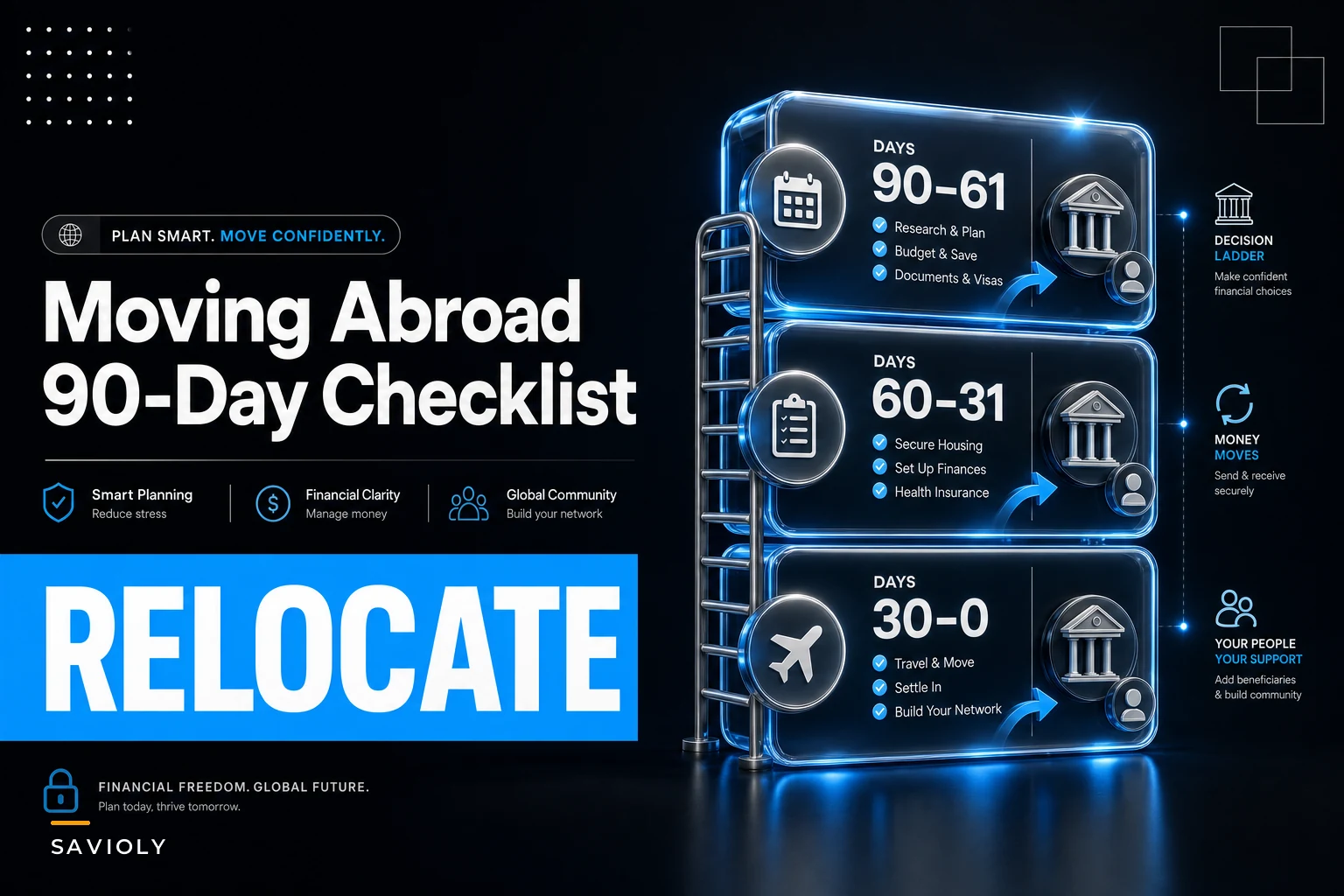
Think in three blocks: Days 90–61 (setup and reconnaissance), Days 60–31 (execution), and Days 30–0 (final moves and freeze-outs).
Take charge of your finances with clarity and confidence.
Savioly gives you real-time visibility and actionable steps to improve your money management.
- Automated expense tracking
- Goal-based saving plans
- Personalized financial insights
No credit card required
Days 90–61: Reconnaissance and quiet setup
This is the phase where you don't change anything yet. You gather constraints.
-
Call every financial institution and ask one question
"What happens to my account if I become a resident of [country]?" Do this for banks, brokerages, retirement accounts, and credit cards. Write down the actual answer, not what you assume.
-
Map your tax-residency start date in the destination country. Find the specific test — day count, first-day-of-arrival rule, or center-of-vital-interests. This date anchors everything else.
-
Check whether a tax treaty exists between your home and destination country, and skim the residency tie-breaker and pension/dividend articles. You don't need mastery, just to know where the landmines are.
-
Open any accounts that are easier to open while you're still resident. Some domestic banks and brokers become nearly impossible to open once you have a foreign address. If you'll want a home-country account to keep, open it now, while your paperwork is clean.
-
Start pricing your remittance path. Note the rate and fees on the amount you'll actually move. Don't transfer yet — you're building a baseline.
The mistake here is acting too early. People open the shiny new destination-country account first and update everything to it, then discover their home brokerage needed to stay linked to a home address. Reconnaissance first.
Days 60–31: Execution while you still have full access
Now you act, because you still hold a domestic address and domestic residency — which is when you have the most flexibility.
-
Decide which assets move and which stay (decision ladder below).
-
Execute any pre-move asset sales you've decided on before the residency clock starts, if the tax math favors it.
-
Update beneficiaries and titling while documents are easy to sign, notarize, and file domestically. Getting a document notarized abroad often means a consulate appointment weeks out.
-
Begin staggered remittance if you're moving a large lump sum, rather than dumping it in one transfer.
-
Set up address-of-record strategy — decide which accounts get the foreign address and which keep a domestic mailing address (a trusted family member or a mail-forwarding service). Do this deliberately, account by account.
Days 30–0: Final moves and the freeze-out window
-
Final remittance tranche timed to arrival cash needs.
-
Update address on accounts that must reflect residency (usually for tax reporting).
-
Confirm card and account access works from abroad — test logging in with a VPN off, confirm your phone number for 2FA won't break when your SIM changes.
-
Photograph or scan every account statement dated near your departure. Cost-basis and balance snapshots matter later for tax filings in both countries.
-
Note your exact departure/arrival dates — these feed the residency day count you mapped in week one.
A quick visual can help keep the three blocks and their decision points straight.
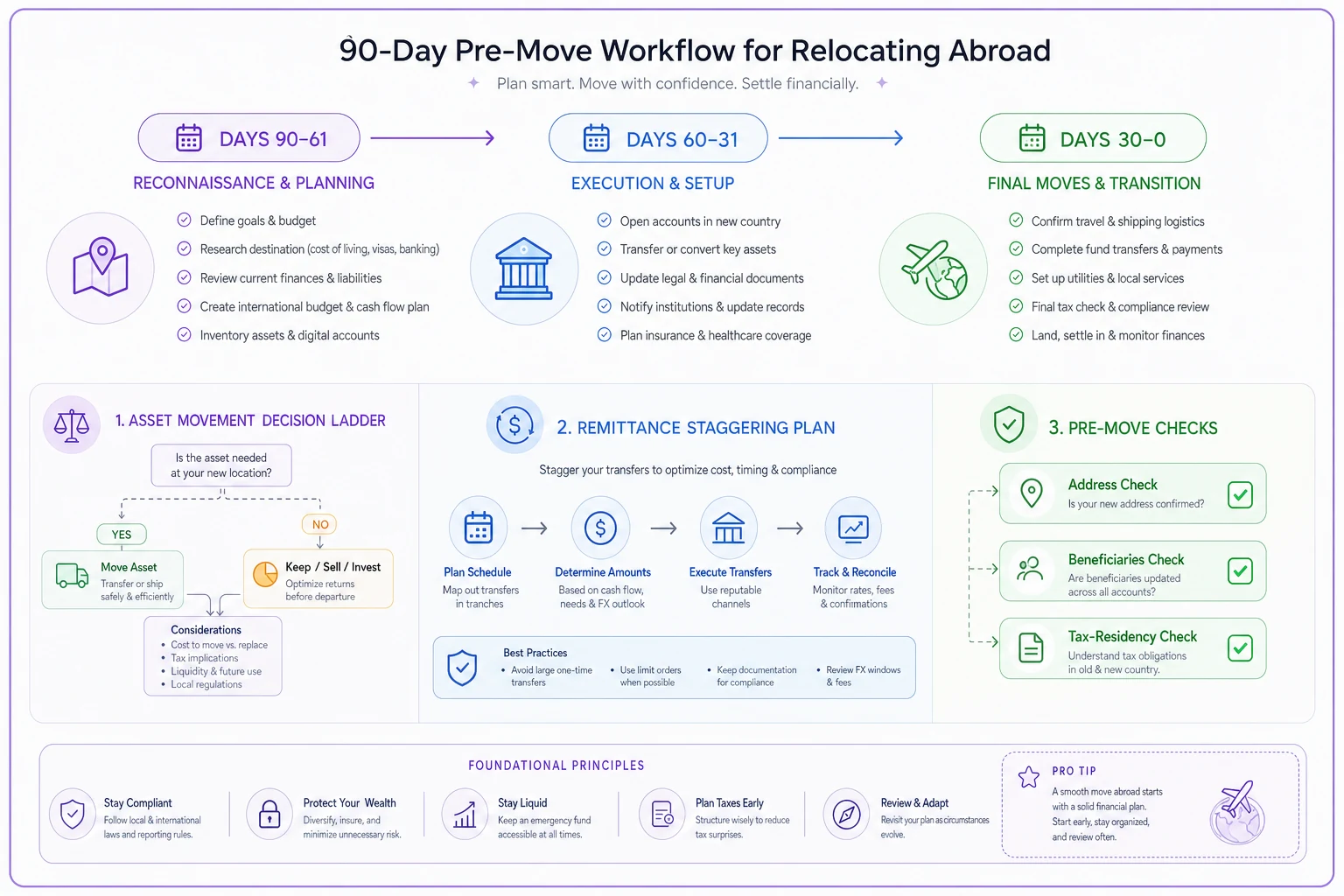
Use the visual to track order and dependencies as you move through the checklist.
The decision ladder: which assets to move, keep, or close
Run each asset class through the same ladder.
Step 1 — Does this account survive a foreign address? If no → decide whether to keep a domestic address for it or close it before you leave. Closing under pressure at the last minute is where people eat surrender fees and tax hits.
Step 2 — Is it tax-advantaged in my home country but ignored (or penalized) in the destination? Retirement accounts are the classic trap. A tax-sheltered account at home may be treated as a fully taxable brokerage account abroad, or worse, flagged as a reportable foreign trust. If so → don't reflexively liquidate, but understand the ongoing reporting cost before you decide to keep it.
Step 3 — Will I need this money in local currency within 12 months? If yes → it's a remittance candidate, and timing and rate both matter. If no → leaving it invested in home currency may be the better call, and you avoid moving money twice.
Step 4 — Does selling it before residency save meaningful tax? If the destination taxes gains at a much higher rate and you plan to sell anyway → the pre-residency window is your cheapest exit point.
| Asset type | Usually move | Usually keep at home | Watch out for |
|---|---|---|---|
| Everyday cash for arrival | Yes, staggered | — | Exchange rate timing |
| Emergency fund | Partial | Partial | Split currency risk |
| Taxable brokerage | Rarely (move value, not account) | Often | Non-resident restrictions |
| Home retirement accounts | Almost never move | Yes | Foreign tax/reporting treatment |
| Appreciated single stock | Consider selling pre-residency | — | Capital gains timing |
| Property | No | Yes | Rental income taxed in both places |
The most common error in DIY moves is treating retirement accounts like ordinary savings — either draining them (huge tax hit) or ignoring the fact that the destination country may not honor the tax shelter at all.
Remittance heuristics: don't move it all at once
Moving a large sum in a single transfer means you're betting your whole exchange rate on one random Tuesday. A cleaner approach for anything beyond immediate needs:
-
Move only what you need for the first 60–90 days first. Rent deposit, initial living costs, buffer.
-
Stagger the remaining balance across three or four transfers over the following months. You're not trying to time the market — you're averaging out the rate and avoiding a single bad day.
-
Compare the true cost, not the advertised fee. The "no fee" transfer often hides its margin in the exchange rate. Take the amount you'd send, run it through two providers, and compare the final delivered amount. That's the only number that matters.
-
Keep a currency buffer at home. Don't move 100% of liquid savings out of home currency, especially if you might return or have ongoing home-country obligations.
Compare the final delivered amount across providers to choose the best remittance path.
A realistic example: someone moving roughly $80k in savings who wired it all on arrival could easily lose a few thousand dollars versus staggering four transfers over the prior two months — not because they predicted rates, but because they stopped concentrating the risk into one transaction and actually shopped the delivered amount instead of the headline fee.
Beneficiary and titling updates — do these before you lose easy notary access
This gets skipped constantly because it feels non-urgent, and then becomes a nightmare to fix from abroad.
Two things drive the urgency:
-
Notarization and witnessing get hard overseas. Updating a beneficiary form, re-titling an account, or signing an estate document often needs a notary or specific witnesses. From abroad that can mean a consulate visit or an apostille process that eats weeks.
-
Cross-border estates get messy fast. If your accounts, beneficiaries, and any will don't line up cleanly before you go, sorting a mismatch across two legal systems is far harder than a five-minute form today.
Your pre-move beneficiary checklist:
-
[ ] Confirm beneficiaries on every retirement account, brokerage, and insurance policy
-
[ ] Verify titling/ownership on joint accounts and property matches your intent
-
[ ] Update or confirm any transfer-on-death designations
-
[ ] Make sure a trusted person at home can access and act if needed
-
[ ] Store copies of everything somewhere reachable from abroad
If you've already built a habit of an annual financial close where you reconcile accounts and update goals, fold the beneficiary and titling review into that same pass so it's not a scramble the month before you leave.
Banking and tax-residency timing: the part people get wrong
The single most expensive timing mistake is realizing large income or gains on the wrong side of the residency line.
If your destination taxes gains higher than home: any big planned sale is usually better done before residency starts. This isn't exotic tax planning — it's just not leaving money on the table by accident.
If your destination taxes gains lower (or not at all) on some categories: you may want to wait until after residency — but only if you're genuinely past the threshold, not straddling it.
The straddle year is the dangerous one. In your move year you may be partially resident in two places, and both may claim a slice of your income. This is exactly what tax treaties and tie-breaker rules exist to resolve, which is why you checked for one back in week one. It doesn't always work out cleanly, but at least you're not surprised.
On the banking side, the freeze-out risk is real and specific:
-
Some home brokerages restrict trading once your address is foreign.
-
Some banks close accounts for non-residents entirely.
-
2FA tied to a home phone number can lock you out the day your SIM changes.
Test every access path before you leave, while you can still walk into a branch to fix it. That last point sounds obvious until it happens to you at midnight from a different time zone.
When handling this yourself makes sense — and when it doesn't
DIY is reasonable when: your assets are mostly cash and standard brokerage or retirement accounts, you're moving between countries with a clear tax treaty, and you don't have property or business income in play. The calendar above covers you.
Bring in a cross-border professional when: you own property in more than one country, hold significant appreciated single-stock or business equity, have a trust, or are moving to or from a country with aggressive worldwide-income or exit-tax rules. The cost of one consultation is trivial next to a mistimed six-figure sale.
Who should not wing it entirely: anyone giving up or acquiring U.S. tax status, or moving to a country with an exit tax or wealth tax. Those situations have irreversible steps, and the margin for error is basically zero.
Keep it in one place, or it falls apart
The reason these moves go sideways isn't that any single task is hard — it's that they're spread across banks, brokers, a calendar, tax dates, and a dozen login credentials, and nobody's tracking the dependencies between them. When people run their whole household finances out of scattered spreadsheets, a relocation is exactly the event that exposes the gaps.
Whether you use a shared doc, a tracker, or a proper household financial operating system with monthly closes and decision rules, the point is the same: keep the calendar, the account inventory, the beneficiary list, and your residency dates in one view so the sequencing doesn't fall through the cracks.
The households that move abroad cleanly aren't the ones who worked hardest. They're the ones who could see the whole board at once and did each thing in the right month.
The short version
Work backward from your departure date. Spend the first month gathering constraints, not changing anything.
Execute sales, titling, and beneficiary updates while you still have full domestic access. Stagger your remittances and shop the delivered amount, not the fee. Watch the residency line carefully, because which side of it you realize income on can cost or save you real money. Get the order right, and a move abroad is just logistics. Get it wrong, and you spend your first six months overseas untangling problems you created before you left.
Work backward from your departure date. Spend the first month gathering constraints, not changing anything.
Execute sales, titling, and beneficiary updates while you still have full domestic access. Stagger your remittances and shop the delivered amount, not the fee. Watch the residency line carefully, because which side of it you realize income on can cost or save you real money. Get the order right, and a move abroad is just logistics. Get it wrong, and you spend your first six months overseas untangling problems you created before you left.
Ready to master your money?
Join thousands of users leveraging Savioly to build smarter budgets, save more efficiently, and plan for a secure financial future.