



Three years ago, my neighbor got rear-ended and discovered his collision coverage had a $2,500 deductible he couldn't remember choosing. Last month, a friend found out her renter's insurance wouldn't cover the $8,000 bike stolen from her apartment garage—the policy capped "sporting equipment" at $1,500. Another colleague has been paying $340 monthly for whole life insurance he'll probably cancel before it ever pays out.
These aren't edge cases. This is what happens when you make insurance decisions without any real framework. You pick coverages based on whatever the agent suggests, choose deductibles to lower monthly payments, and hope nothing expensive breaks.
Most personal finance advice treats insurance like a checkbox: get it, pay for it, forget it. But insurance is a risk-transfer tool that needs sizing rules, clear trade-offs, and honest thresholds for when self-insurance makes more sense than a policy. The gap between smart risk management and expensive guessing can run thousands per year—both in premiums you shouldn't be paying and claims you can't collect.
Why standard insurance advice creates expensive problems
Traditional guidance basically tells you to "get adequate coverage" without defining what adequate actually means for your situation. Agents push comprehensive packages. Financial advisors say "protect your assets." Meanwhile you're left wondering whether that $100,000 umbrella policy makes sense or if raising your auto deductible from $500 to $1,000 is worth the $15 monthly savings.
The real problem: insurance decisions require comparing probabilities, costs, and liquidity in ways that don't come naturally. A $1,000 deductible might save you $180 a year on premiums, but if you file three claims over five years, you've lost money. That dental plan charging $65 monthly with a $1,500 annual maximum means you're essentially prepaying for cleanings unless you need serious work done.
Without clear rules, people either over-insure—paying for coverage they'll never use—or under-insure and face catastrophic gaps when something actually goes wrong. Both mistakes compound over decades.
Effective personal risk management needs the same systematic thinking businesses use: coverage formulas tied to real assets and income, deductible calculations based on claim frequency, and self-insurance thresholds linked to available reserves.
The coverage sizing formula that actually works
Here's the framework I've refined after working through hundreds of insurance decisions across different income levels and life stages:
Take charge of your finances with clarity and confidence.
Savioly gives you real-time visibility and actionable steps to improve your money management.
- Automated expense tracking
- Goal-based saving plans
- Personalized financial insights
No credit card required
Base Coverage = (Annual Income × Years to Replace) + Outstanding Debts + Emergency Buffer
For life insurance, "Years to Replace" typically runs 5–10 years depending on dependents and a spouse's earning potential. Outstanding debts include mortgage, student loans, and co-signed obligations. The emergency buffer covers immediate costs like funeral expenses and estate settlement.
For a household earning $85,000 with a $240,000 mortgage and two kids:
-
Income replacement
$85,000 × 8 years = $680,000
-
Outstanding mortgage
$240,000
-
Emergency buffer
$25,000
Total coverage need: $945,000 (round to a $1 million term policy)
Property Coverage = Replacement Cost (not market value) + Additional Living Expenses + Contents Value
That $450,000 house might only cost $320,000 to rebuild. But if rebuilding takes 18 months and comparable rentals run $3,500 monthly, you need $63,000 in additional living expense coverage. Add $80,000 for contents, and your actual coverage need lands around $463,000—not the market value.
Liability Coverage = Net Worth + (Annual Income × 3) + Legal Defense Buffer
Someone with $400,000 net worth earning $120,000 should carry at least $760,000 in liability coverage—usually achievable through auto and home policies plus a $1 million umbrella.
The deductible trade-off math nobody explains
Choosing deductibles isn't about monthly payment comfort. It's about claim probability and liquidity. This table clarifies the actual trade-offs:
| Deductible Level | Annual Premium Savings | Break-Even Claims | Best For |
|---|---|---|---|
| $250 → $500 | $120–180 | 1 claim every 2 years | Frequent claimers, tight budgets |
| $500 → $1,000 | $180–300 | 1 claim every 3 years | Average drivers, stable emergency funds |
| $1,000 → $2,500 | $300–500 | 1 claim every 5 years | Safe drivers, strong liquidity |
| $2,500 → $5,000 | $500–800 | 1 claim every 8 years | High earners, self-insurance mindset |
The calculation: Deductible Increase ÷ Annual Savings = Years to Break Even
Raising your auto deductible from $500 to $1,000 and saving $200 yearly means you break even after 2.5 claim-free years. But here's what most people miss: you need liquid reserves equal to your maximum deductible across all policies. If you're carrying $1,000 deductibles on auto, home, and health, you need at least $3,000 accessible—preferably closer to $6,000 in case two claims hit at once.
Higher deductibles without the reserves just create a different kind of problem: you can't actually afford to use your insurance when you need it.
Self-insurance thresholds tied to your liquidity buckets
Self-insurance makes sense when the cost of coverage exceeds the probable loss and you have reserves to absorb the exposure. The threshold shifts based on your overall liquidity structure.
The basic framework splits liquid assets into three buckets:
Bucket 1: Operating Float (1–2 months expenses) Never touch this for insurance claims. It handles regular cash flow timing.
Bucket 2: Emergency Reserves (3–6 months expenses) Can be tapped for true emergencies, but needs an immediate replenishment plan.
Bucket 3: Self-Insurance Pool (varies by exposure) Specifically set aside for predictable losses you've decided not to insure.
-
Extended warranties
Self-insure when Bucket 3 > $5,000
-
Dental/Vision insurance
Self-insure when Bucket 3 > $8,000
-
Collision coverage (older vehicles)
Self-insure when Bucket 3 > vehicle value × 2
-
Umbrella liability
Never self-insure regardless of wealth
If you're near a Bucket 3 threshold, redirect short-term policy savings into that pool for a month or two before dropping coverage.
Someone with $15,000 in Bucket 3 could reasonably drop collision on a $6,000 vehicle, skip dental insurance running $780 a year for a $1,500 maximum benefit, and decline all extended warranties. Those savings—roughly $1,400 annually—keep growing Bucket 3.
This connects directly to your broader emergency fund strategy, where insurance deductibles become one trigger for accessing reserves.
Real scenario: how the framework changes decisions
Take Marcus, a software developer earning $115,000 with $45,000 in liquid savings spread across regular savings, a money market account, and Roth IRA contributions he could withdraw if needed.
-
Life insurance
$250,000 group policy through work
-
Auto insurance
$500 deductible, full coverage on a 2018 Honda Accord
-
Renter's insurance
$30,000 coverage, $250 deductible
-
Health insurance
$750 deductible, $3,000 out-of-pocket max
-
Dental insurance
$65/month through work
His actual life insurance need: $115,000 × 5 years = $575,000. He's single, no dependents—just needs to cover student loans and final expenses. The group policy falls $325,000 short, so he adds a $350,000 term policy for $28 monthly.
For auto, with strong liquidity and one claim in the past eight years, he raises the deductible to $1,500, saving $280 annually.
Renter's insurance stays as-is—already appropriately sized.
He drops dental after running the numbers: $780 in annual premiums for roughly $400 in covered cleanings doesn't make sense with $45,000 in reserves. He redirects $100 monthly into his self-insurance pool instead.
Net result: $44 monthly more for proper life coverage, $280 saved on auto, $780 saved on dental. He ends up with better coverage where it actually matters, $552 less per year in total costs, and a growing self-insurance reserve.
The claim-avoidance checklist that pays for itself
Insurance is for catastrophes, not maintenance. Every claim affects future premiums, sometimes for years. Here's a systematic approach to avoiding unnecessary ones:
Before filing any claim:
-
Calculate the true cost
Claim amount − Deductible − Premium increases over 3 years
-
Check your claims history
More than 2 claims in 5 years is usually the trigger for rate shopping
-
Consider paying out-of-pocket if true cost is under $1,000
-
Document everything anyway for potential future issues
Maintenance that prevents claims:
-
Home
Annual roof inspections, quarterly gutter cleaning, sump pump battery backup
-
Auto
Tire rotations every 5,000 miles, brake checks every 15,000, defensive driving course every few years
-
Health
Annual physicals, preventive screenings, dental cleanings twice a year
-
Tech
Surge protectors on everything, cloud backup for data, device cases
Documentation system:
-
Policy numbers and contact info
-
Premium amounts and payment dates
-
Deductibles and coverage limits
-
Claims history with amounts and dates
-
Maintenance performed with receipts
It takes a few hours to build. It saves dozens of hours and potentially thousands of dollars when you're switching insurers, filing large claims, or dealing with estate issues.
How systematic risk rules connect to broader financial plans
Personal risk management doesn't operate in isolation. Deductible levels affect your savings ladder structure—higher deductibles mean you need more in liquid reserves before locking money into longer-term tiers. Self-insurance thresholds influence how much you need accessible versus invested.
The framework also shifts as life changes. That $1 million term policy might drop to $500,000 once the mortgage is half paid. A $1,000 auto deductible might come back down to $500 if you're entering a tighter cash flow period. The whole point is having clear rules that adapt instead of guessing every time a renewal comes up.
Building your personal risk-management system
Start with a coverage audit. List every policy, its premium, deductible, and what it actually covers. Compare current coverage to the sizing formulas above. Most people find gaps in the places that matter and waste in the ones that don't.
Then stress-test your deductibles. Can you handle the maximum deductible on every policy if claims hit at the same time? If not, either lower deductibles or build reserves before raising them.
After that, establish your self-insurance thresholds. Calculate what you're paying for warranties, dental, vision, and other optional coverages against probable claims. When the math favors self-insurance and reserves are in place, make the switch.
Finally, set a monitoring cadence. Review coverage annually before renewals. Update calculations when income, assets, or family situation changes. Track claims and maintenance to support future decisions.
Here's a simple workflow to visualize those steps.
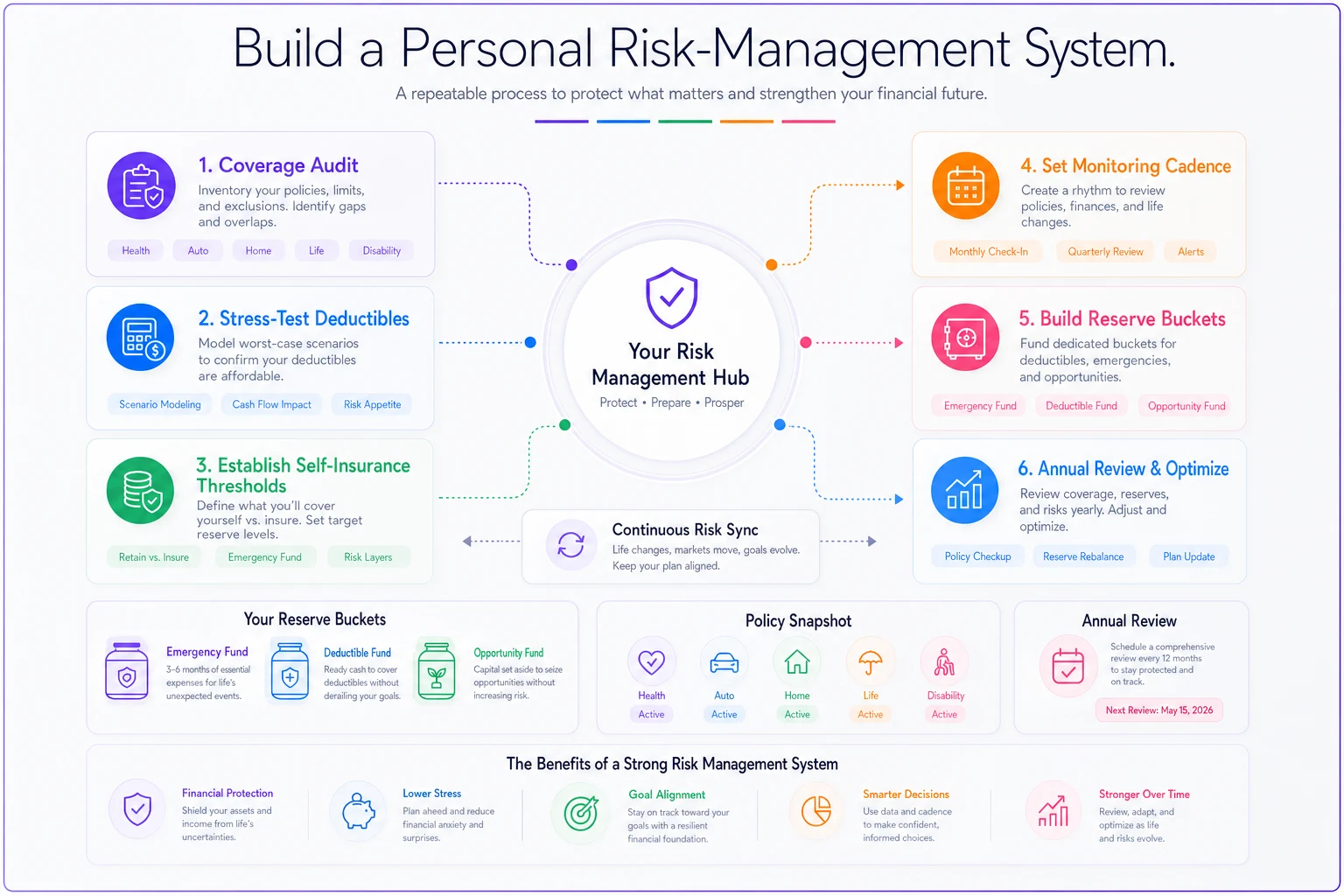
Review coverage annually before renewals. Update calculations when income, assets, or family situation changes. Track claims and maintenance to support future decisions.
Personal risk management isn't about becoming insurance-obsessed. It's about making confident decisions based on clear frameworks instead of sales pitches and guesswork. The difference shows up in monthly cash flow and in your protection when something actually goes wrong.
The math isn't that complicated once you have the formulas. The discipline of applying consistent rules—rather than making emotional decisions at renewal time—is what turns insurance from a confusing expense into a precise risk-transfer tool.
Ready to master your money?
Join thousands of users leveraging Savioly to build smarter budgets, save more efficiently, and plan for a secure financial future.