



Most people don't fail at prioritizing financial goals because they're lazy or bad with money. They fail because every goal feels urgent at the same time and there's no honest mechanism to rank them. Emergency fund, debt paydown, retirement match, house down payment, replacing a dying car, maybe a kid's 529 — they all get a vague "yes, important" and then the money just kind of goes wherever the loudest emotion points that month.
The fix isn't more willpower. It's a scoring system that forces you to be specific, and a reforecast rhythm that stops you from re-litigating the same decision every payday. That's what this piece builds: a repeatable goal-scoring grid, a couple of allocation templates you can actually run, and a small set of triggers that tell you when to change course.
I'll assume you already know your take-home income and have some sense of your fixed obligations. What you're missing is the ranking layer.
Why unranked goals quietly wreck your progress
The core problem with competing goals is that they don't compete on equal terms in your head. Recency and emotion distort everything. A friend buying a house makes the down payment feel urgent. A scary headline makes the emergency fund feel urgent. A raise somehow makes retirement feel less urgent than it should.
In practice this usually plays out as goal drift. You fund whatever's top of mind, and because no goal ever gets consistent money, none of them cross a finish line. Six months later you've spread roughly $12k across five goals and completed none — instead of finishing two and actually building momentum.
The opposite failure mode is over-focus. Someone throws everything at credit card debt, ignores building even a $1,000 buffer, and the first surprise car repair goes right back onto the card they just paid down. Progress erased. Both problems come from the same root: there's no scoring model separating goals by urgency, return, and cost of delay.
A spreadsheet fixes this not because spreadsheets are magic, but because a scoring grid forces you to assign numbers to things you'd otherwise feel your way through. When you prioritize financial goals with explicit criteria, the arguments get shorter and the decisions get repeatable.
The goal-scoring grid
Here's the grid. Every goal gets scored across five dimensions, each on a 1–5 scale. Multiply by a weight, sum it, and you get a priority score. Higher score funds first.
Take charge of your finances with clarity and confidence.
Savioly gives you real-time visibility and actionable steps to improve your money management.
- Automated expense tracking
- Goal-based saving plans
- Personalized financial insights
No credit card required
| Dimension | What it measures | Weight | Score 1 (low) | Score 5 (high) |
|---|---|---|---|---|
| Cost of delay | What waiting actually costs you | 3 | Delay costs nothing | Every month of delay is expensive |
| Guaranteed return | Certainty of the payoff | 3 | Speculative / market-dependent | Locked, known return |
| Downside protection | Does this reduce catastrophic risk? | 2.5 | Nice-to-have | Prevents financial ruin |
| Deadline pressure | Is there a hard date? | 2 | No date | Fixed, near, unmovable |
| Emotional weight | How much it drags on your mental bandwidth | 1 | Neutral | Keeps you up at night |
Emotional weight is weighted lowest but not zero. That's deliberate. Ignoring the emotional side is how people build technically optimal plans they abandon in three weeks. It gets a voice — just a quiet one.
A worked scoring example
Take a household with five goals. Here's how the scoring plays out:
| Goal | Cost of delay (×3) | Guaranteed return (×3) | Downside protection (×2.5) | Deadline (×2) | Emotional (×1) | Total |
|---|---|---|---|---|---|---|
| Employer 401(k) match | 5 → 15 | 5 → 15 | 2 → 5 | 3 → 6 | 2 → 2 | 43 |
| Starter emergency fund ($2k) | 4 → 12 | 4 → 12 | 5 → 12.5 | 2 → 4 | 4 → 4 | 44.5 |
| Credit card debt (22% APR) | 5 → 15 | 5 → 15 | 3 → 7.5 | 1 → 2 | 3 → 3 | 42.5 |
| House down payment | 2 → 6 | 2 → 6 | 1 → 2.5 | 4 → 8 | 4 → 4 | 26.5 |
| Vacation fund | 1 → 3 | 1 → 3 | 1 → 2.5 | 2 → 4 | 3 → 3 | 15.5 |
Worth noticing: the starter emergency fund, employer match, and high-interest debt cluster within two points of each other at the top. That's not a coincidence — those three almost always land in a tight band, and the right answer is usually to run all three in parallel at small amounts rather than sequence them strictly. The house and vacation are clearly lower, which means they get whatever's left, not what gets grabbed first.
The scoring didn't make the decision for you. It made the decision legible. Now you can defend it to your partner, or to yourself six months from now when the vacation starts calling.
Two runnable allocation templates
Once goals are ranked, you need a rule for splitting money. There's no universal split — it depends on whether your cashflow is tight or comfortable. Two templates cover most situations.
Template A: Constrained cashflow (money is tight)
Use this when your discretionary surplus after fixed costs is thin — say under a few hundred dollars a month. The logic is sequential with a small parallel hedge. You don't spread thin; you concentrate, but you never leave zero in the safety bucket.
-
Capture the full employer match first. It's an instant return you can't get anywhere else. This comes off the top before anything.
-
Put a small fixed floor into the emergency fund — even $50/month. This is the hedge that stops surprises from undoing your debt work.
-
Everything remaining goes to the highest-scored payoff goal (usually high-interest debt).
-
Once the top goal is cleared, the freed-up money rolls entirely to the next goal on the grid.
-
Re-score quarterly (more on cadence below).
A realistic constrained split for a household with around $350/month of surplus might look like: match handled via payroll, $50 to the emergency floor, $300 to the credit card. Boring. Concentrated. It works because $300/month at one target beats $70 spread across five.
Template B: Growth-focused cashflow (you have room)
Use this when you've got real surplus — enough that pure sequencing would leave slower long-term goals starved for years. The logic switches to weighted parallel funding by score.
Convert each goal's priority score into a percentage of your monthly allocation. Using the earlier scoring example (dropping the vacation), the top four goals sum to 156.5 points:
-
Emergency fund
44.5 / 156.5 ≈ 28%
-
401(k) match top-up
43 / 156.5 ≈ 27%
-
Credit card debt
42.5 / 156.5 ≈ 27%
-
House down payment
26.5 / 156.5 ≈ 17%
If your monthly investable surplus is around $1,800, that's roughly $500 / $490 / $490 / $310. Every goal moves. Nothing stalls. The higher-scored goals just move faster.
The mistake people make with the growth template is applying it while carrying 22% debt. Don't. If you've got expensive debt, run the constrained template until it's gone, then switch to weighted parallel. Percentage-based splitting is a comfort feature, not a math optimization.
If windfalls enter the picture — bonus, tax refund, inheritance — don't jam them through the monthly template. Route them through a separate one-time process, since lump sums deserve their own decision path. There's a full breakdown in this windfall decision flow with a percent-allocation template that pairs well with these monthly rules.
Reforecast cadence: how often to actually re-decide
Most people either never revisit their plan, or they revisit it every time they feel anxious — which amounts to continuous re-litigation. Both are bad. The goal is a fixed cadence so decisions happen on schedule, not on impulse.
Monthly Check-In (10 min) ↓ Automations fired correctly? Balances moved as planned? ↓ Quarterly Re-Score (30–45 min) ↓ Re-score the grid Adjust template if needed Reweight percentages ↓ Annual Full Reset ↓ Retire completed goals Add new ones Sanity-check weights
The cadence that holds up in practice looks like this:
-
Monthly (10 minutes) Check that automations fired correctly and balances moved as planned. No decisions. You're auditing execution, not strategy.
-
Quarterly (30–45 minutes) Re-score the grid. A raise, a rate change, a paid-off card — these shift scores. This is where you'd flip from constrained to growth template, or reweight percentages.
-
Annually (deeper) Full reset. Retire completed goals, add new ones, sanity-check whether the weights still reflect your actual life.
Separating audit from decision is mostly behavioral. If every monthly check-in is a chance to redecide, you'll churn. Fixed decision windows create a healthy friction — when the vacation goal starts nagging in week two of a quarter, the answer is "we'll re-score in six weeks," not an immediate reshuffle.
A visual of the cadence helps keep checks vs decisions clear.
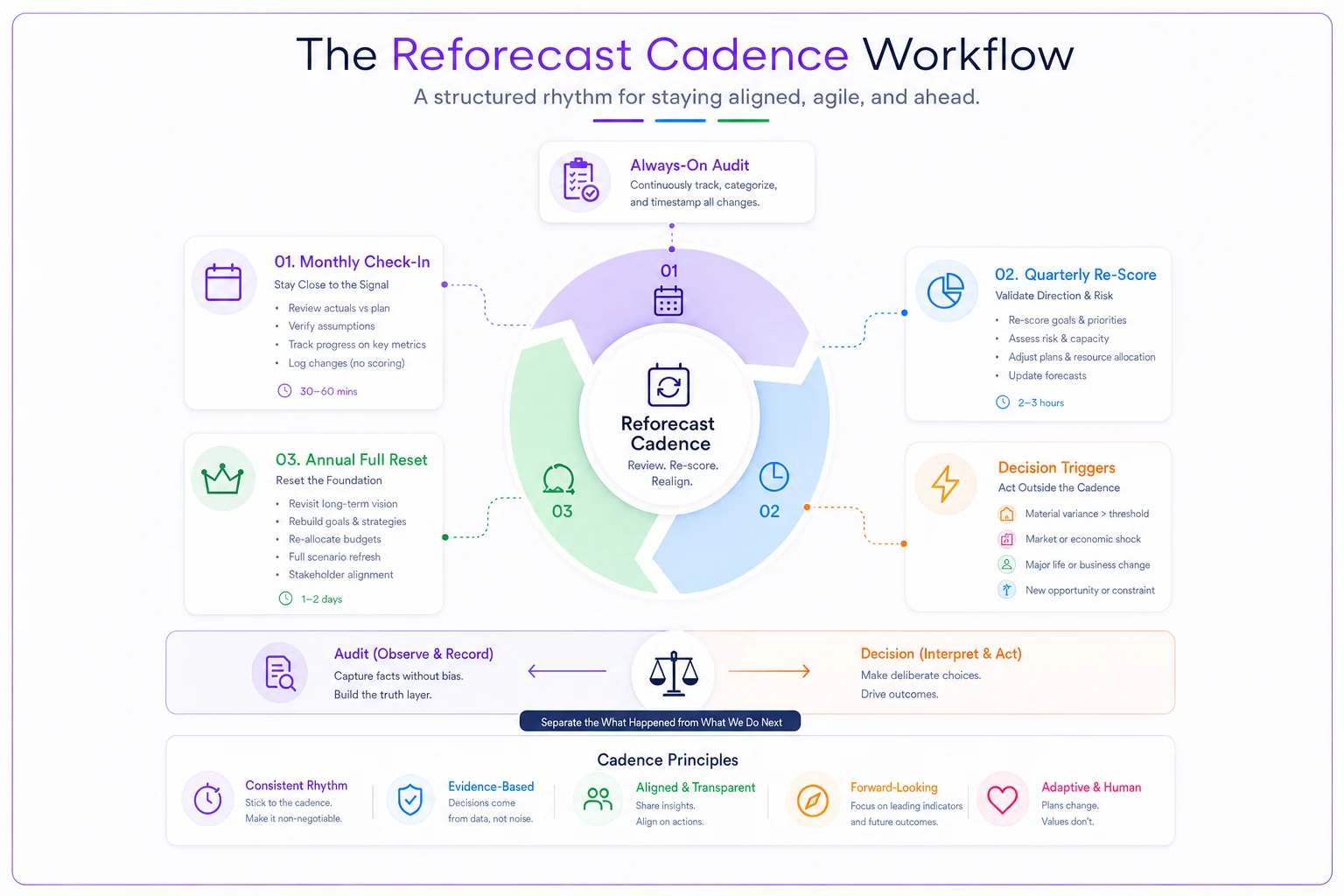
Keep the visual simple: boxes for Monthly / Quarterly / Annual with arrows, and a callout for the few triggers that force an early re-score.
Decision triggers: when to break the cadence
Cadence handles the routine. Triggers handle the exceptions. These are specific, pre-committed conditions that justify changing priorities outside the quarterly window — because waiting would be genuinely irresponsible.
Trigger the grid early if any of these fire:
-
Emergency fund drops below one month of expenses. Downside protection score jumps; it moves back to the top regardless of other goals.
-
A new interest rate above ~18% enters your life (new card balance, variable rate reset). High-interest debt re-scores upward immediately.
-
Income drops by more than ~20%. Switch to the constrained template on the spot, cut all non-safety goals to zero, protect liquidity.
-
A hard deadline moves inside 12 months (a lease ending, a known large expense). Deadline pressure jumps two points minimum.
-
A goal completes. Don't wait to redirect freed-up cash — roll it the next payday, or it evaporates into lifestyle spending.
That last one is the sneakiest. Finishing a car loan frees up, say, $340/month, and if you don't have a rule that immediately reassigns it, it quietly disappears. The trigger is the rule: completion forces a re-allocation within one cycle.
When strict prioritization is a bad idea
A few honest caveats. Rigid scoring breaks down if your income is highly irregular — gig work, commissions, seasonal swings. In those cases, fund goals off a sustainable run-rate rather than each paycheck, otherwise you'll whipsaw between templates monthly.
It's also the wrong tool if you haven't built the underlying buffer structure yet. Prioritization assumes you have somewhere to put the money. If your savings architecture is still a single account doing five jobs, fix that first — a proper tiered setup like the one in this savings ladder with sizing rules and rebalancing cadences gives the allocation templates something real to plug into.
A real scenario
A dual-income couple in their early thirties, roughly $6,800/month combined take-home, had the classic spread-thin problem: a little toward five goals, finishing none. Emergency fund stuck around $900 for over a year. Credit card balance drifting near $7k at 21%.
They scored the grid and landed on the same top cluster most people do — buffer, match, high-interest debt. Switched to the constrained template: full match via payroll, $75/month to the emergency floor, roughly $650/month concentrated on the card. Vacation and down payment went to zero temporarily.
The card cleared in about eleven months. When it did, that ~$650 rolled to the emergency fund, which hit a full three-month cushion a few months after. Only then did they flip to the growth template and start funding the down payment and retirement in parallel. Nothing exotic. They stopped spreading money across goals that were all standing still, and let a scoring grid make the call instead of their mood.
Putting it into practice this week
You don't need software to start — a single spreadsheet does the whole job. Build the five-column scoring grid, list your goals, score them honestly, and pick the template that matches your cashflow. Set a recurring calendar block for the quarterly re-score so it actually happens.
The point isn't precision for its own sake. It's removing the constant low-grade decision fatigue of choosing between goals every payday.
Set a recurring calendar block for the quarterly re-score so it actually happens.
Once the grid decides and the cadence protects that decision, your only real job is keeping the automations running and showing up for the quarterly review. Score it, rank it, fund it in order, and let the triggers handle the rest — that's a system built to survive raises, layoffs, surprise repairs, and the vacation that will absolutely keep whispering.
The point isn't precision for its own sake. It's removing the constant low-grade decision fatigue of choosing between goals every payday. Once the grid decides and the cadence protects that decision, your only real job is keeping the automations running and showing up for the quarterly review. Score it, rank it, fund it in order, and let the triggers handle the rest — that's a system built to survive raises, layoffs, surprise repairs, and the vacation that will absolutely keep whispering.
Ready to master your money?
Join thousands of users leveraging Savioly to build smarter budgets, save more efficiently, and plan for a secure financial future.