



Most hosts don't have a bookkeeping problem. They have a timing problem that masquerades as a bookkeeping problem.
The payout hits your checking account on the 2nd. The cleaner invoices on the 5th. The platform fees already came out, so the number looks clean. Property tax is a once-a-year gut-punch you forgot was coming. And somewhere in there you're supposed to pay yourself, set aside income tax, and keep enough cushion for the January-through-March stretch where the calendar goes quiet.
When all of that runs through one account, every deposit feels like money you earned. That's the trap. By the time the tax bill or the HVAC repair shows up, the money's already been spent on a version of "profit" that was never actually profit.
This post is a tight, runnable system for one specific thing: splitting each payout into the right buckets automatically, sizing your reserves so seasonality doesn't wreck you, and closing the month in about 30 minutes. Not a philosophy. A template.
Why single-account hosting quietly bleeds money
Short-term rental revenue is lumpy and pre-committed. A $4,100 payout isn't $4,100 of yours. Some of it already belongs to the tax authority, some belongs to the next cleaning, some belongs to the "the water heater died" fund — only what's left is actually yours to pay yourself.
When everything lands in one account, three things reliably go wrong:
-
You overestimate how well you're doing. Gross payouts feel like income. A host grossing roughly $62k–$68k a year on a single unit often feels like they're clearing $50k, when the real owner-pay number after tax reserve, maintenance, and platform costs is closer to $22k–$28k.
-
Reserves never get funded. There's always something more urgent than moving money into a maintenance account you can't see a reason for today. Until there is.
-
Tax season becomes a crisis. With no reserve, Q1 estimated taxes land right when bookings are at their lowest. That overlap is extremely common and genuinely painful.
The fix isn't discipline. Discipline fails under lumpy cash flow. The fix is structure — accounts and percentages that do the dividing before you get a chance to spend.
The lean account structure (keep it to four or five)
You don't need eleven accounts. Hosts who build elaborate account trees abandon them within two months. Four is enough for a single unit; five once you have two or more properties or a co-host situation.
Take charge of your finances with clarity and confidence.
Savioly gives you real-time visibility and actionable steps to improve your money management.
- Automated expense tracking
- Goal-based saving plans
- Personalized financial insights
No credit card required
| Account | What it holds | Funded by | Touch frequency |
|---|---|---|---|
| Operating (inflow) | Every payout lands here first | Platform deposits | Daily (pass-through only) |
| Tax reserve | Income tax + any lodging/occupancy tax you remit | % of net payout | Quarterly out |
| Maintenance & turnover | Cleaning, restocking, repairs, replacements | % of net payout | Weekly/monthly out |
| Owner pay | Your actual take-home | Remainder after splits | Monthly out |
| Seasonal smoothing (optional 5th) | Buffer that funds slow months | % during peak months only | Seasonal |
The key rule: Operating is a pass-through, not a wallet. Money arrives, gets split within a day or two, and the account sits near zero. The moment you start "leaving a little in Operating just in case," the whole system collapses because that account becomes the one you spend from.
If you want the deeper logic behind why owner pay should be a residual rather than a target, the mechanics in this side-hustle cashflow system covering taxes, owner pay, and reinvestment carry over almost directly to a rental — the percentages differ, but the "split before you spend" principle is identical.
Percent-split defaults that actually hold up
Here's the part people want: the numbers. These are starting defaults for a single, self-managed unit. Adjust after two or three months of real data — but start with something rather than winging it.
Work off net payout — meaning after the platform has already taken its service fees, since you never see that money anyway. Split what actually lands.
Default split of net payout:
-
Tax reserve — 25–30%. This covers federal income tax, self-employment or state income tax exposure, and in many areas the occupancy/lodging tax you collect and remit. If your platform already handles lodging tax on your behalf, drop this to 20–25% — it's now just income tax. If you remit lodging tax yourself, keep it at the high end or carve it into its own sub-bucket, because that money is never yours and commingling it is how hosts end up short at remittance time.
-
Maintenance & turnover — 20–28%. Cleaning is the big line. If a turnover runs $90–$130 and you're getting 8–12 bookings a month, cleaning alone can eat 18–22% of revenue. Add restocking (coffee, paper goods, toiletries) and a repair sinking fund, and 25% is a realistic average. Furnished units wear out faster than owners expect — mattresses, linens, and kitchenware on a short-term rental age in dog years.
-
Seasonal smoothing — 5–10% during peak months only. More on this below. In your slow months, this percentage flips to zero — you're drawing from it, not funding it.
-
Owner pay — whatever remains. This is the number that tells you the truth about your unit's economics.
A worked example on a $4,100 net payout month:
-
Tax reserve (27%)
~$1,107
-
Maintenance & turnover (24%)
~$984
-
Seasonal smoothing (8%, peak month)
~$328
-
Owner pay (remainder)
~$1,681
That $1,681 is the honest number. It's a lot less exciting than "$4,100 came in," which is exactly why hosts who skip this step feel rich in July and broke in February.
One thing worth flagging: hosts consistently set the maintenance percentage too low because they anchor on cleaning fees and forget the long-tail stuff — the replacement couch, the appliance that dies, the deep clean after a rough guest. If you're going to err, err high on maintenance and true it up later.
Reserve-sizing rules: how big should each bucket get?
Percent-splits control flow. Reserve-sizing controls floor — the minimum balance each bucket should hold before you let owner pay take everything above it.
Maintenance reserve floor: aim for enough to cover one full turnover-heavy month plus one meaningful repair. For a single unit that's often $1,500–$2,500. Below that floor, you're one broken dishwasher away from dipping into tax money. Once the bucket is above the floor, you can safely reduce the ongoing split percentage.
Tax reserve floor: this one isn't a floor so much as a running tally. It should always hold at least your projected tax owed on year-to-date net income. If you're setting aside 27% and your effective rate turns out to be 22%, the overage becomes a nice buffer or a Q4 top-up. If it's closer to 31%, you catch that in your monthly close before it becomes a shortfall. For the quarter-by-quarter mechanics of not getting caught short, this estimated-tax defense checklist for freelancers maps cleanly onto rental income.
Seasonal smoothing target: this is the one most hosts skip and most regret skipping. Size it to cover your fixed costs during your slowest consecutive months. If mortgage, insurance, utilities, and software run roughly $1,900/month and you have three genuinely dead months, your smoothing target is somewhere around $5,000–$6,000 — enough that the quiet season doesn't force you to raid owner pay or, worse, tax reserve.
A simple seasonal smoothing routine
The mistake isn't not having a buffer — it's funding it evenly year-round, which doesn't work because you don't have even cash flow. Smoothing has to be front-loaded into your strong months.
-
Identify your three strongest and three weakest months from last year's calendar (or a comparable local unit if you're new).
-
In peak months, fund smoothing at 8–10% of net payout. This is surplus you're deliberately not paying yourself yet.
-
In shoulder months, fund at 0–4%.
-
In your weakest months, draw from smoothing to cover the gap between actual net payout and your fixed costs — not to pad owner pay.
-
Reset the target each year after your annual close, since rate strategy, costs, and occupancy all shift.
A host doing roughly $62k a year might pull $900–$1,100 a month in July–September into smoothing and spend it back down over January–March. The money doesn't grow — it just moves from "months you have too much" to "months you have too little." It's not an investment account; it's a time machine for cash.
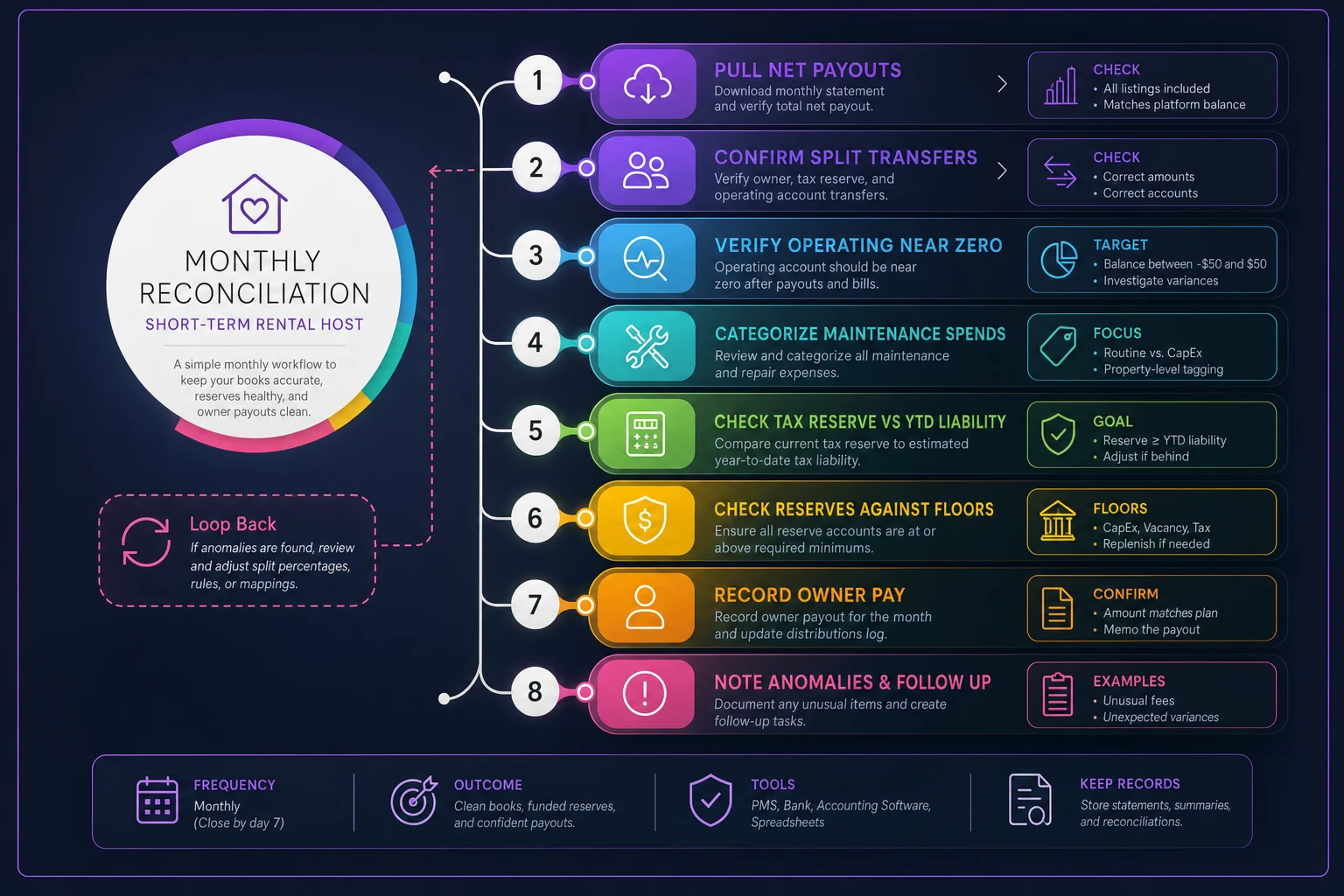
The monthly reconciliation routine (about 30 minutes)
Do this on the same day each month — the 1st or 2nd works well, once the prior month's final payouts have settled. Treat it as non-negotiable, because the system only works if the splits actually happened and the numbers actually tie out.
Monthly close checklist:
A quick visual of the monthly reconciliation flow:
-
- [ ] Pull total net payouts for the month from each platform (and direct bookings, if any).
-
- [ ] Confirm the split transfers happened — tax, maintenance, smoothing all moved out of Operating.
-
- [ ] Verify Operating is near zero. A lingering balance means a split got skipped.
-
- [ ] Categorize every maintenance spend — cleaning, restock, repairs — so you can see if your 24% is actually enough.
-
- [ ] Check the tax reserve against year-to-date liability. Adjust the split up or down for next month if it's drifting.
-
- [ ] Check each reserve against its floor. Below floor → raise the split temporarily. Comfortably above → you can release a bit to owner pay.
-
- [ ] Record owner pay actually taken vs. the residual available. These should roughly match.
-
- [ ] Note anything unusual — a chargeback, a double-charged cleaning, a guest-damage reimbursement — so it doesn't get buried.
-
- [ ] Log one number
owner pay for the month.
Twelve of these tell you whether the unit is actually worth running.
The reconciliation isn't just arithmetic. It's where you catch the slow leaks — the cleaner who quietly raised rates, restocking that crept from $40 to $90 a month, the occupancy tax you forgot you're on the hook for. None of those show up as a crisis. They show up as owner pay slowly shrinking while gross revenue looks fine. The monthly close is how you see that gap before it becomes a year-long blind spot.
A real scenario: the host who felt broke on a "good" year
A single-unit host in a seasonal lake town grossed somewhere around $66k over twelve months. Felt like a strong year. But money was constantly tight, and a $2,400 plumbing repair in February nearly wiped out the checking account.
The problem wasn't income. Everything ran through one account. Payouts came in, bills went out, owner pay was "whatever was left in checking," and tax was an annual scramble funded partly by a credit card.
-
The February plumbing bill came out of a maintenance reserve that actually had money in it — a non-event instead of a panic.
-
Q1 estimated taxes were already sitting in the tax account. No credit card, no scramble.
-
Owner pay became a steady monthly number (roughly $1,400–$1,900 depending on the month) instead of a feast-or-famine swing.
The honest owner-pay total for the year landed near $24k — lower than the host felt like they were making, but a number they could actually plan around.
Nothing about the business changed. Same unit, same bookings, same costs. The only change was that the money got divided before it could lie to them about how much was actually theirs.
When this system makes sense — and when it's overkill
This makes sense when:
-
You have one or more units generating real, recurring payouts.
-
Your income is seasonal or lumpy (nearly all short-term rentals are).
-
You remit any occupancy/lodging tax yourself, or owe meaningful income tax on the earnings.
-
You've ever been surprised by a tax bill or a repair you couldn't comfortably cover.
This is overkill when:
-
You rent a spare room a handful of nights a year for pocket money. A single sub-account for taxes is plenty; don't build five accounts for $3k of annual income.
-
The platform already handles your lodging tax and your total earnings are small enough that one reserve bucket covers everything.
Who should NOT bother with the full five-account version: brand-new hosts in month one or two. Start with just two accounts — Operating and a combined Reserve — and split the Reserve into tax/maintenance/smoothing once you have enough real data to set percentages that aren't guesses. Building the full structure before you know your actual turnover costs just means you'll be re-tuning numbers you invented.
The one habit that holds it all together
Make the split automatic, and keep Operating empty. Every system that fails, fails at the same spot — a deposit lands, the splits are "manual for now," and three busy weeks later the money's gone and the buckets are empty.
Set transfers to run the day after final platform payouts clear so you never forget to move the splits.
Whether you automate the transfers through your bank's rules, a scheduled routine, or a tool that reads your payouts and moves the percentages for you, the mechanism matters less than the principle: the money should divide itself before you're tempted to touch it. The percentages do the thinking. The monthly close keeps them honest. And the reserves make sure a slow February or a dead water heater is a minor annoyance instead of the thing that makes you question whether hosting is worth it.
Your payouts aren't your income. They're a mix of your income, the government's money, the next cleaner's fee, and a repair you haven't been billed for yet. Split them like it, and the whole operation gets a lot calmer — especially in the quiet months.
Ready to master your money?
Join thousands of users leveraging Savioly to build smarter budgets, save more efficiently, and plan for a secure financial future.