



Most people who sell a side hustle mess up the same part. Not the negotiation. Not the valuation. It's the gap between "we agreed on a number" and "that money is sitting in my checking account, taxes handled, working toward something real." That gap is where side-hustle exits quietly leak thousands of dollars and months of confusion.
A side hustle exit playbook isn't about maximizing sale price — plenty of writing covers that. What almost nobody covers is the operational sequence. The order you do things in so the sale doesn't blow up your taxes, strand your cash, or leave you three months later wondering where the proceeds went. That's what this is.
Why exits go sideways even when the deal is good
The core problem is that a side hustle is a hybrid animal. Half business, half personal finance, and the two are usually tangled together in ways you don't notice until you try to separate them.
Think about what a typical Etsy shop, freelance client book, small Shopify brand, or local service operation actually looks like under the hood. Personal card used for a few inventory buys. Home internet split between work and Netflix. A PayPal balance that's part revenue, part reimbursement. Maybe a spouse who occasionally helped pack orders and never got formally paid.
When you sell — even for a modest $15k–$40k, which is where most side-hustle exits land — a buyer's due diligence or your own accountant starts pulling threads. And every tangled thread is either a delay, a tax surprise, or a reason the buyer knocks the price down.
The pattern is almost always the same: people treat the exit as a single event (sign, get paid) when it's really a sequence of overlapping financial states. You go from operating → winding down → holding a lump sum → owing tax on it → allocating it. Skip the order and things collide.
The five phases, and where each one breaks
Here's the whole arc before we get into the pieces. This is the skeleton of the playbook.
Take charge of your finances with clarity and confidence.
Savioly gives you real-time visibility and actionable steps to improve your money management.
- Automated expense tracking
- Goal-based saving plans
- Personalized financial insights
No credit card required
| Phase | What you're actually doing | Most common failure |
|---|---|---|
| 1. Financial cleanup | Untangling business from personal, producing clean records | Commingled accounts make the business look messier (and worth less) than it is |
| 2. Tax provisioning | Estimating what you'll owe on the sale before you spend a dime | Treating the whole check as spendable, then panicking in April |
| 3. Sale structure | Choosing asset sale vs. lump vs. earnout vs. installment | Picking whatever the buyer suggests without seeing the tax difference |
| 4. Cashflow lockdown | Freezing the proceeds so they don't get absorbed into normal spending | Money hits checking, gets treated as "extra," disappears |
| 5. Reintegration | Deliberately routing proceeds into household goals | No plan, so it becomes a slow-motion lifestyle bump |
These phases overlap in time. You should be doing tax provisioning while you negotiate structure, because the structure changes the tax. That's the part people consistently get wrong — they run it linearly.
A quick visual of the workflow can help.
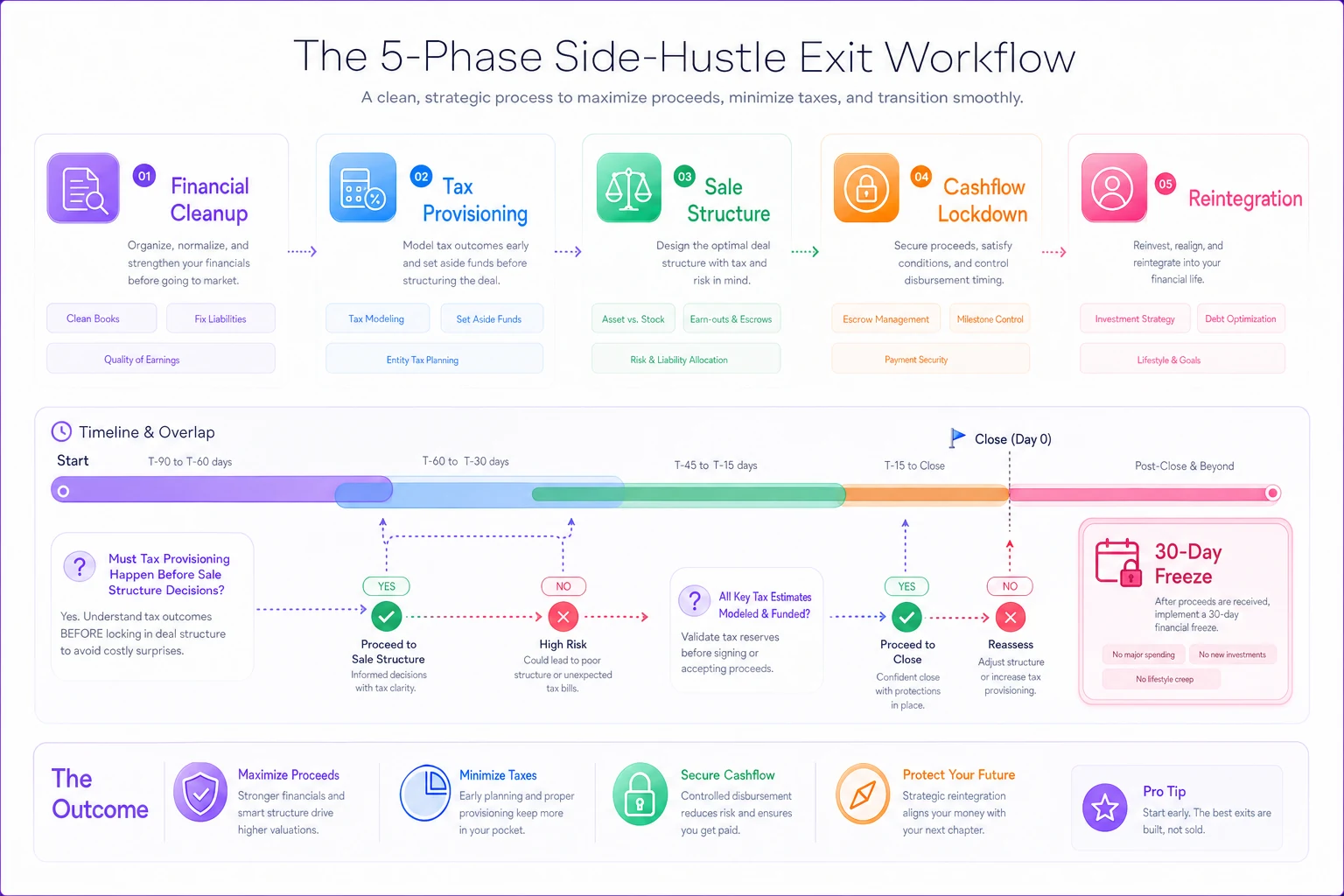
Keep the sequence visible while you plan so you don't treat it as a single event.
Phase 1: Getting the financials clean enough to sell
You don't need audited statements to sell a $25k side business. But you do need records clean enough that a reasonable buyer trusts them, and clean enough that you can calculate gain accurately later.
The realistic minimum:
-
12–24 months of revenue by month, pulled from your actual payment processors (Stripe, PayPal, Shopify Payments), not reconstructed from memory
-
A real expense list, separated into "true business costs" vs. "personal stuff that snuck onto the business card"
-
An asset inventory — inventory on hand, equipment, domain names, email lists, social accounts, any software or templates you built
-
A basis figure for anything you're selling
what you originally paid for inventory, equipment, or the domain
That last one matters more than people think. Your basis is what you subtract from the sale price to figure taxable gain. If you bought $6k of inventory that's part of the deal, that's $6k you generally don't pay tax on again. Lose track of basis and you overpay tax on your own money.
Something worth flagging: the messier your books, the more a buyer discounts. In practice, a shop that can hand over clean monthly revenue and a straight P&L often closes 10–20% higher than an identical shop where the seller is reconstructing numbers from screenshots. Clean books aren't bureaucracy — they're negotiating leverage.
If your business and personal money have been living in the same account this whole time, that's the first thing to fix, and it's a bigger job than it sounds. There's a full breakdown on how to run ultra-lean separation rules for micro-entrepreneurs with percent-splits and a monthly reconciliation checklist — worth reading before you list, not after.
Phase 2: Provision for tax before you feel rich
This is the phase people emotionally resist, because the money finally arrived and now someone's telling them a chunk isn't theirs.
A side-hustle sale usually generates a mix of:
-
Ordinary income on things like recaptured depreciation or inventory sold at a markup
-
Capital gain on goodwill and the business value above your basis
-
Possibly self-employment implications depending on how the final operating year nets out
You don't need to compute this perfectly yourself. But you need a reserve estimate so you don't spend money you owe.
A rough provisioning process:
-
Take your total expected proceeds.
-
Subtract your basis (inventory, equipment, domain purchase price, etc.).
-
That difference is your rough taxable gain.
-
Multiply the gain by a blended rate — for most side-hustle sellers, reserving 25–35% of the gain is a reasonable starting bracket depending on your income and state.
-
Move that dollar amount into a separate holding account the same week the sale closes. Not later. Same week.
A concrete version: say you sell for $30k, your basis across inventory and equipment is $7k, so your gain is roughly $23k. Reserve 30% and you're setting aside about $6,900. That leaves ~$23k of genuinely usable proceeds. Now you're planning with a real number instead of a fantasy one.
The mistake that shows up repeatedly: people plan around the $30k. They allocate the $30k. Then the tax bill arrives and they're pulling from savings to cover it, which quietly undoes the whole point of selling.
If you've been running quarterly estimates already, factor the sale into your next payment so you're not hit with an underpayment penalty on top of the bill.
Phase 3: Structure changes everything — pick deliberately
Buyers propose whatever's convenient for them. Your job is to understand what each structure does to your money and your risk.
For small side-hustle deals, four structures cover almost everything:
Lump-sum asset sale. Buyer pays once, takes the assets, done. Cleanest exit, fastest cash, simplest to provision for. Downside: all the tax lands in one year, which can push you into a higher bracket if it's a bigger sale.
Installment sale. Buyer pays over 12–36 months. This spreads your tax across years and can keep you in lower brackets. The catch is real: you're now a lender to someone who just bought a business they might run into the ground. If they stop paying, you're chasing money.
Earnout. Part of the price depends on the business hitting targets after you leave. Common when the buyer isn't sure the revenue will hold without you. Great in theory, frustrating in practice — you have no control but a financial stake. For a side hustle where you were the business, earnouts often disappoint.
Hybrid (partial lump + short installment). Get a meaningful chunk up front, the rest over 6–12 months. Often the sweet spot for micro-businesses: real cash now, some tax smoothing, limited counterparty risk.
When each actually makes sense
-
Take the lump sum when the deal is small enough that bracket impact is minor, or when you don't trust the buyer to keep paying. Certainty beats optimization at this size.
-
Consider an installment when the sale is large enough to push you up a tax bracket and the buyer has real assets or a track record.
-
Avoid an earnout if the business's value was mostly your personal skill, relationships, or hustle. You'll spend a year watching a stranger determine your payout.
The thing most sellers miss: structure is a tax and risk decision, not a price decision. Two deals at the same $30k headline number can leave you with meaningfully different take-home once tax timing and default risk are factored in.
Phase 4: Cashflow lockdown — the phase everyone skips
This is the most underrated part of the entire playbook, and it's purely behavioral.
The moment proceeds hit your primary checking account, your brain re-baselines. Suddenly there's a big number in the balance, and every normal purchase feels smaller by comparison. The $80 dinner doesn't register when there's $23k sitting there. This is how people "spend" a business sale without ever making a single decision to spend it.
Lockdown means the proceeds never touch your operating account. Practically:
-
Route the net proceeds (after your tax reserve) into a separate high-yield savings or holding account the buyer's payment doesn't naturally flow into.
-
Give it a name that isn't "savings." Name it after the actual goal — "House down payment," "Debt kill," "Runway." Named money is harder to raid.
-
Set a decision deadline — usually 30 days — where you're not allowed to allocate anything. Let the emotional charge fade before you make permanent moves.
-
Keep only a small "breathing room" slice accessible (somewhere around $500–$1,000), so you're not white-knuckling it and don't feel the urge to crack the whole thing open.
The 30-day freeze does something quietly useful: it separates the event of getting paid from the decision of what the money does. Those should never be the same moment. The same logic behind handling any large one-time inflow applies here almost exactly — the percent-allocation template and 30-day checklist for windfalls maps cleanly onto business proceeds, because to your household balance sheet, a sale is a windfall.
Name the holding account after the actual goal — named money is harder to raid.
The 30-day freeze separates emotion from decision and prevents slow erosion of the proceeds.
Phase 5: Reintegration — routing proceeds into actual household goals
After the freeze, you allocate. And "allocate" needs to mean specific dollars to specific jobs, not a vague sense of being ahead.
A reintegration template that works for most households:
-
Backstop first. If your emergency fund is below target, top it to a full number before anything else. A business sale is often the cleanest chance you'll get to fully fund it.
-
Kill high-cost debt. Any balance above roughly 8–10% interest gets attacked here. Highest guaranteed return available.
-
Advance one concrete goal. Down payment, retirement catch-up contribution, a kid's education account — one named goal that moves visibly.
-
Reserve a reinvestment slice if you're planning to start something new, so the next venture is funded without dipping into household money later.
-
Deliberate spending, on purpose. A small, pre-decided amount (5–10%) for something enjoyable. Naming it prevents the whole sum from slowly becoming this.
The percentages flex with your situation. Someone with no emergency fund and credit card debt puts almost everything into steps 1 and 2. Someone financially solid can weight toward step 3.
A real scenario
A woman ran a small handmade candle and home-goods shop as a side hustle for about three years. Revenue was roughly $2k–$3k a month, decent margins, but she was starting a full-time job and couldn't keep up.
She found a buyer for $28,000 — inventory, brand, Instagram account, supplier relationships, and product templates.
What she almost did: treat it as $28k of extra money, pay off a chunk of a car loan, put some toward a vacation, and figure out taxes later.
What she actually did, running the sequence:
-
Reserved about $6,000 for tax (gain was roughly $20k after ~$8k basis in inventory and equipment; she reserved around 30%).
-
Took a hybrid structure — $20k up front, $8k over six months — which kept the sale from pushing her into a higher bracket the year she also started a salaried job.
-
Locked the ~$22k net into a named holding account and didn't touch it for a month.
-
After the freeze
topped her emergency fund by about $5k, paid off a $9k credit balance sitting at 22%, and moved the rest toward a house down payment fund.
The vacation didn't happen that year. But the 22% card disappeared, and roughly a year later that down payment fund was the reason she qualified for the mortgage she wanted. Same $28k. Radically different outcome — entirely because of order and provisioning, not because she negotiated a higher price.
Who should NOT rush an exit
A few honest cautions.
-
If the business is still growing fast, selling at a small-business multiple may leave real money on the table. Sometimes the right move is one more year, not an exit.
-
If your books are a genuine mess, spend 60–90 days cleaning before you list. A rushed sale of a messy business gets discounted hard, and you'll carry the tax confusion for months.
-
If you're selling emotionally — burnout, a bad month, a fight with a co-founder — apply the 30-day-freeze logic before the sale, not just after. Sell in a flat mood, not a spike.
Sell in a flat mood, not a spike.
The thing to hold onto
A side-hustle exit isn't a single transaction. It's a short project with a specific order of operations. Clean the books, provision for tax before you spend, choose structure for tax and risk rather than headline price, lock the cash down before it evaporates into normal life, then route it into named household goals on purpose.
Get that sequence right and a modest sale — $20k, $30k, $40k — can genuinely move your household forward instead of quietly dissolving into a slightly nicer few months. The number you sold for matters far less than what you did in the ninety days after.
Get that sequence right and a modest sale — $20k, $30k, $40k — can genuinely move your household forward instead of quietly dissolving into a slightly nicer few months. The number you sold for matters far less than what you did in the ninety days after.
Ready to master your money?
Join thousands of users leveraging Savioly to build smarter budgets, save more efficiently, and plan for a secure financial future.