



Most families don't blow their finances through one bad decision. They lose ground because the money setup that worked when the kid was in diapers never got rebuilt when that same kid hit high school and started costing four times as much. The insurance didn't get updated. The titling never got touched. The 529 kept auto-contributing at the newborn rate while tuition inflation quietly outran it.
That gap — the space between what your financial system was built for and what your current stage actually demands — is where families get caught. And it almost always shows up as a surprise, not a slow warning.
A real parenting stage financial playbook isn't a set of tips for each age. It's a governance layer: a set of timelines, triggers, and cashflow rules that hand off cleanly as your child moves from newborn to school-age to college. The pieces connect. When one changes, others should move automatically. When they don't, you get funding gaps.
Here's how the whole thing works, where it tends to break, and how to build it so it survives the handoffs.
Why stage transitions are the real failure point
The newborn stage is usually the most financially disciplined period parents ever have. New life insurance, a will drafted, a 529 opened, a beneficiary form or two filled out. Everyone's paying attention because the change is dramatic and emotional.
Then nothing gets touched for a decade.
The financial system gets set up at the moment of maximum attention, but the costs ramp gradually over years. So the system is calibrated to the lowest-cost version of parenting and never recalibrated as expenses climb. A $250k term policy felt generous when you had a toddler and a small mortgage. By the time there are two teenagers, braces, travel sports, and four years of tuition on the horizon, that same policy covers a fraction of the actual liability if one parent is gone.
What breaks as things get more complex — more kids, higher incomes, bigger obligations — is coordination. Each financial component drifts independently:
-
The insurance assumes the liabilities from stage one.
-
The titling and beneficiary setup assumes the family structure from stage one.
-
The college funding assumes the contribution capacity and timeline from stage one.
-
The monthly cashflow quietly absorbs rising costs with no formal reallocation.
None of these are catastrophic alone. Together, they create a household that looks organized but is calibrated to a child who no longer exists.
The three stages as governance zones
Think of each stage as having its own operating rules, its own triggers for review, and a defined handoff to the next. Here's the high-level map before we dig into each.
Take charge of your finances with clarity and confidence.
Savioly gives you real-time visibility and actionable steps to improve your money management.
- Automated expense tracking
- Goal-based saving plans
- Personalized financial insights
No credit card required
| Stage | Primary financial risk | Insurance/titling focus | Funding focus | Cashflow posture |
|---|---|---|---|---|
| Newborn (0–5) | Income loss, no safety net | Set up term life, disability, guardianship, beneficiaries | Open & automate 529, prioritize emergency fund | Low child-cost, high savings-rate window |
| School-age (6–17) | Cost creep, underfunded policies | Re-size coverage, update guardians, review titling | Accelerate 529, layer activity/braces reserves | Rising variable costs, tighter margins |
| College (18–22) | Cashflow shock, aid missteps | Shift titling/ownership, verify beneficiaries | Drawdown sequencing, gap funding | Large predictable outflows, decumulation-like |
The table makes it look neat. In real households it's messy, because the transitions don't happen on tidy birthdays — they happen when a trigger fires.
Newborn stage: build the foundation, but build it to be rebuilt
The mistake here isn't failing to set things up. It's setting things up as if they're permanent.
A typical newborn-stage setup looks like this: one parent takes parental leave, income dips, and the family opens a 529 with a $100/month auto-contribution because that's what felt affordable during a lean year. They buy a term policy sized to the current mortgage. They name guardians in a will. Good so far.
The problem is that none of those numbers were ever tagged with a review date. The $100/month becomes the default forever. The will names a guardian who, ten years later, has moved across the country and had three kids of their own.
What the newborn-stage governance layer should actually contain:
-
Term life and disability coverage sized to future peak liability, not current. If you know college is coming, your coverage math should already include it.
-
Guardianship and a basic will, with a hard review trigger (more on triggers below).
-
Beneficiary designations on every retirement and life account — and then an actual audit confirming they're correct, because this is one of the most common silent errors. A quick read through a beneficiary-audit playbook saves families from the classic mistake of an ex-spouse still listed on a 401(k).
-
A 529 opened early, with the contribution amount flagged as a variable to revisit — not a fixed-and-forget number.
One thing worth noting about how this plays out: families who start the 529 early but keep the contribution flat often do worse than families who start later but index contributions to income. Time in the market matters, but so does the contribution curve. A flat $100/month over 18 years and a contribution that steps up with raises are two completely different outcomes.
When the newborn-stage approach is a bad idea
If your emergency fund is thin and you're carrying high-interest debt, aggressively funding a 529 in the newborn stage is the wrong move. Liquidity comes first. A 529 is not an emergency fund, and the penalty structure on non-qualified withdrawals makes it a terrible place to park money you might need. Fund the floor before you fund the future.
School-age stage: the silent cost-creep zone
This is the stage nobody writes governance rules for, and it's where the slow damage happens.
Between roughly ages 6 and 17, the direct cost of a child climbs steadily — childcare shifts to after-care and activities, then to sports, instruments, tutoring, phones, orthodontics, and eventually a car and insurance. None of these are shocking individually. That's exactly the problem. Each one gets absorbed into the monthly budget without triggering a formal review of whether the whole system still fits.
A realistic example: a two-earner household with two school-age kids sees combined child-related variable costs rise from around $600/month to somewhere in the $1,400–$1,700 range over about six years. Their income went up too, so it never felt like a crisis. But the savings rate quietly dropped, the 529 contributions never increased, and the term policy still reflected the mortgage balance from when the first kid was born. The system looks stable. It's actually eroding.
School-age governance should force these reviews:
-
Re-size insurance against current and projected liability. Add the remaining years of anticipated education cost into the coverage calculation. If the number has drifted more than roughly 20% from your current coverage, that's a signal to adjust.
-
Revisit guardianship and titling. Relationships change. The guardian you picked for a newborn may not be the right choice for a 12-year-old, and your estate titling may need updating if you've bought property or changed marital structure.
-
Step up 529 contributions on a schedule. Tie increases to raises or annual reviews so the funding curve bends upward as college gets closer.
-
Create named reserves for lumpy costs. Braces, a first car, a big sports season. These are predictable years in advance — treat them as scheduled outflows, not surprises.
The coordination insight here: school-age is when the different parts of the system are most likely to drift apart because everything is still "working." There's no forcing event. Which is exactly why you need calendar-based triggers instead of event-based ones during this stage.
College stage: from accumulation to drawdown
The college stage is financially closer to retirement decumulation than most parents expect. You've spent 18 years accumulating; now you're sequencing withdrawals against a large, predictable, time-boxed cost. The skills are different, and the mistakes are expensive.
The biggest one: treating all funding sources as interchangeable. They're not. The order you draw from matters for taxes, for financial aid calculations, and for what's left over.
A few drawdown principles that actually change outcomes:
-
529 funds should generally be spent in the years the qualified expenses occur. Timing the withdrawal to the tuition payment keeps the qualified-expense matching clean and avoids penalty exposure.
-
Custodial accounts (UGMA/UTMA) hit financial aid harder because they count as the student's asset. If aid is in play, knowing the ownership structure before senior year of high school matters — this is where the earlier titling decisions pay off or punish you. The tradeoffs across account types are worth revisiting in a college-savings decision matrix before the first tuition bill lands.
-
Gap funding needs a rule, not a reaction. If the 529 covers roughly 70% of the four-year cost, decide in advance where the other 30% comes from — current cashflow, a brokerage drawdown, parent loans, or the student's own contribution. Deciding this in real time, mid-semester, is how families end up tapping retirement accounts they shouldn't touch.
The titling handoff people forget
When a kid turns 18, legal reality shifts. They're an adult. Your ability to access their medical and financial information changes. Custodial accounts transfer to their control at the age of majority. This is a titling and documentation trigger, not just a birthday — a moment to confirm healthcare proxies, powers of attorney, and account structures reflect the new legal status.
The trigger system that holds it all together
Timelines fail because life doesn't run on schedule. A governance layer needs triggers — specific events that force a review of specific components. This is the connective tissue between stages.
Event-based triggers (fire a review when these happen):
-
New child or change in family structure → re-size insurance, update beneficiaries, review guardianship
-
Home purchase or move → review titling, update coverage, confirm will reflects new assets
-
Income change over roughly 15% → recalibrate 529 contributions and savings rate
-
Child turns 18 → titling/custodial handoff, healthcare and POA documents
-
First college acceptance → activate drawdown sequencing plan
Calendar-based triggers (because school-age has no natural events):
-
Annual review of coverage adequacy against projected liability
-
Annual 529 contribution step-up check
-
Every 2–3 years, a full beneficiary and titling audit
The pattern that separates families who stay funded from families who develop gaps: the funded families have both trigger types wired in. Event triggers catch the dramatic changes. Calendar triggers catch the silent drift. Rely on only one and something slips through.
Here's a quick visual of the trigger workflow.
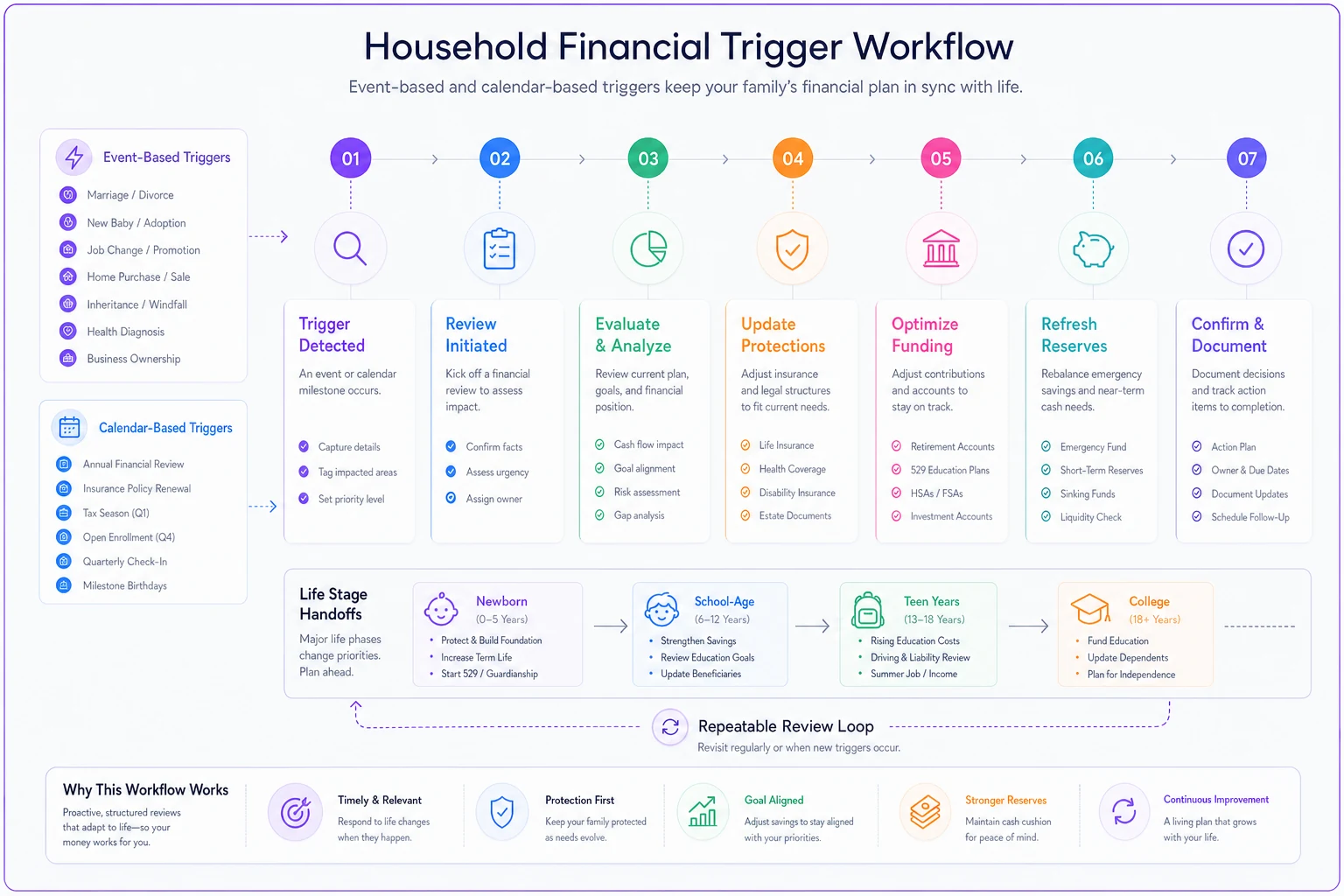
Use the visual to map your own household triggers and review cadence.
How this plugs into the household operating system
None of this works as a loose collection of reminders. It works when it's part of how the household actually runs its money — reviewed on a cadence, with decisions made deliberately instead of reactively.
Families that hold this together tend to run some version of a recurring money meeting where these triggers get checked against an agenda, not left to memory. If you don't have that rhythm yet, the structure in a household financial governance playbook gives you the meeting cadence, decision ladders, and KPI tracking to make stage transitions a normal agenda item rather than an emergency.
In practice, the annual review works like this: you pull up the current stage, check each component — insurance, titling, beneficiaries, funding contribution, reserves — against its trigger rules, and ask one question per component: does this still match the child we have now? Anything that's drifted past its threshold gets flagged, assigned, and dated. The next review confirms it closed. That's the entire discipline. Boring, and that's why it works.
Align the stage review with your annual tax or insurance renewal so it's built into an existing financial rhythm.
Where software earns its place is in the tracking — keeping the contribution curves, the review dates, and the trigger thresholds visible so they don't quietly expire. The tool isn't the plan. It's the thing that makes sure the plan doesn't rot between stages.
A short real scenario
A household with two kids, ages 4 and 7, combined income around $150k. They set everything up at the newborn stage of the older child and barely touched it since. On paper, organized: 529 open, term policy in place, will drafted.
What a stage review surfaced: the term policy still reflected their first mortgage and didn't account for roughly $180k–$220k of projected future education cost across two kids. The 529 for the older child was still auto-contributing at the original $75/month despite two significant raises. And the named guardian had relocated out of state years earlier and hadn't been reconsidered.
The fixes weren't dramatic. They increased term coverage to close the liability gap at a modest premium bump. They stepped the 529 contributions up and set them to index to future raises. They updated guardianship and re-ran the beneficiary audit, which caught one account still listing an outdated contingent beneficiary.
No single change was urgent. Together, they closed a funding and protection gap that would have surfaced — badly — exactly when the family could least afford the surprise. That's the whole point of stage-based governance: you pay attention in calm years so the transition years don't blow up.
Who should not over-engineer this
If you have one young child, stable income, and a simple financial picture, you don't need an elaborate multi-stage apparatus yet. A term policy, a will, correct beneficiaries, and a 529 with a review reminder is enough for now. Building a heavy governance layer prematurely usually means it gets abandoned.
The complexity should scale with the stakes. Add structure as the liabilities grow, the kids multiply, and the transitions get closer together. The goal isn't maximum process — it's making sure the handoffs between stages happen on purpose instead of by accident.
The families that avoid funding gaps aren't the ones with the most money or the most sophisticated plan. They're the ones whose financial setup gets rebuilt to match the child they actually have, at each stage, instead of the child they had when they first paid attention.
Ready to master your money?
Join thousands of users leveraging Savioly to build smarter budgets, save more efficiently, and plan for a secure financial future.