



Big life changes don't fail people because the decisions are hard. They fail because everything comes due at once and the sequence gets scrambled. A new job, a new marriage, a new baby, a layoff, or the last day of your working life all hit the same four levers — liquidity, insurance, titling, and taxes — but they hit them in different orders and on different clocks.
Why the days right after a life event decide most of your outcome
The mistake almost everyone makes is treating these events as one big to-do list. You end up with a 40-item dump where "update beneficiary" sits next to "buy a stroller," and the $200 task and the $40,000 task look identical. Some things genuinely need to happen in 48 hours or you lose money or coverage permanently. Most things can wait 30 days. A few only matter once a year — but skip them and they quietly compound.
This is a matrix, not a list. Each trigger maps to three time horizons and a priority ladder. The point is that you shouldn't have to think in the first 48 hours after something big — you should just execute what's already been sequenced.
The four levers every life event touches
Before the checklists, it helps to understand why the same four things keep showing up. Once you internalize the ladder, you can build the checklist for any event, even ones not covered here.
Take charge of your finances with clarity and confidence.
Savioly gives you real-time visibility and actionable steps to improve your money management.
- Automated expense tracking
- Goal-based saving plans
- Personalized financial insights
No credit card required
-
Liquidity — Can you cover the next 60–90 days without selling something at a bad time or triggering a penalty? Life events almost always create a cash gap or a cash windfall, and both are dangerous if unmanaged.
-
Insurance — Coverage gaps are the most expensive mistakes because they're invisible until something goes wrong. Most life events open a special enrollment window that closes fast.
-
Titling & beneficiaries — Whose name is on the account, the deed, the policy, the car. This is the lever people ignore for years and then pay for at exactly the wrong moment.
-
Taxes — Withholding, filing status, estimated payments, and the timing of income all shift. Tax mistakes rarely hurt in the moment; they hurt in April, or years later.
The priority ladder is always the same: liquidity first, insurance second, titling third, taxes fourth. Not because taxes don't matter, but because a liquidity or coverage gap can wipe you out this month, while a tax mistake is usually fixable over a longer window.
How the matrix works
Think of it as a grid. Rows are the event. Columns are the clock: 48 hours, 30 days, annual. Inside each cell you run the four levers in ladder order, but only the ones that actually apply on that clock.
The 48-hour column is deliberately short. If it has more than four or five items, something's been mis-sequenced. The 30-day column does the heavy lifting. The annual column is the maintenance loop — the stuff that breaks silently if you never revisit it. Same logic behind a proper annual financial close, where you reconcile accounts and reset allocations on a fixed cadence instead of reacting to problems after they surface.
| Event | 48-hour priority | 30-day priority | Annual maintenance |
|---|---|---|---|
| New hire | Confirm start-date coverage gaps, set 401(k) default | Elect benefits, tune withholding (W-4), set contribution % | Re-check contribution vs. match, HSA/FSA reset |
| Job loss | Freeze non-essential outflows, map COBRA/marketplace clock | Decide health coverage, 401(k) rollover plan, file for benefits | Review runway assumptions, rebuild reserve |
| Marriage | Nothing urgent — resist the rush | Update beneficiaries, decide filing approach, merge/keep accounts | Re-run withholding jointly, title review |
| New baby | Add to health plan (special enrollment clock), confirm leave pay | Life insurance, beneficiary/guardian, dependent tax updates | Contribution re-check, 529 decision |
| Retirement | Lock the first 12 months of spending liquidity | Sequence account draws, roll over, Medicare timing | Withdrawal-rate review, RMD planning |
If your 48‑hour column has more than five items, you probably mis-sequenced.
Notice how few things are truly 48-hour. That's the whole point.
New hire: the withholding and coverage window most people fumble
Starting a job feels like paperwork you sign once and forget. Two levers move immediately, and both have quiet costs.
48 hours — liquidity and coverage clock. Find out the exact date your new health coverage starts. Employers love saying "first of the month after 30 days," which can leave a real gap. If your old coverage ends before the new one begins, you either bridge it or you gamble. Also confirm your 401(k) default enrollment — many plans auto-enroll at 3%, which sounds fine until you realize it might be below the match threshold.
30 days — insurance elections and the W-4. This is where the money lives. A common scenario: someone earning around $85k accepts the default withholding, doesn't account for a spouse's income, and ends up either overwithholding (an interest-free loan to the government) or badly underwithholding and eating a penalty in April. The 30-day task is to model your actual tax picture and set the W-4 accordingly — not "single, zero" muscle memory.
The insurance elections matter just as much. HSA-eligible plans, FSA elections, disability coverage — these lock for the year. A pattern worth flagging: people underfund the HSA because it feels like another deduction, then miss the one account that's triple tax-advantaged.
Annual — the drift check. Contribution percentages drift out of alignment as your salary changes. If you got a raise, your flat percentage might now be leaving match on the table, or you might be on pace to hit the annual 401(k) cap too early and miss late-year matching. Once a year, run the math again.
When to slow down
If your new job comes with equity comp or a signing bonus, resist making big allocation decisions in week one. The 48-hour job is coverage and cash — not investing the bonus. That decision belongs in the 30-day window once you can see the full tax picture.
Job loss: the liquidity clock runs faster than the paperwork clock
Getting laid off inverts everything. Now liquidity is the whole game, and the dangerous mistake is treating the health-insurance decision as urgent when it's actually a 30-day decision with a 60-day safety net.
48 hours — stop the bleeding, map the clocks. Freeze discretionary automations before the next billing cycle. Not permanently — you can restart them — but the first 48 hours is about controlling outflow while you get your bearings. This is also the moment to figure out your real runway: how many months does current cash cover essential spending? That number drives every decision after it.
Knowing when to draw your emergency fund and how to rebuild it without derailing everything else matters a lot here. If you've pre-decided your trigger rules, you're not improvising during the worst week.
30 days — coverage and rollover decisions. COBRA is expensive but you have a window, and loss of coverage opens a special enrollment period for marketplace plans. A realistic scenario: a household with roughly $22k in accessible cash and about $4,800/month in essential spending has a ~4.5-month runway. COBRA at $650/month burns that faster than a marketplace silver plan at, say, $410/month with a subsidy — but the marketplace plan might change your doctors. That's a real trade-off, and it belongs in the 30-day window, not a panic decision on day one.
The 401(k) rollover is not urgent. Leaving it in the old plan for a few weeks costs nothing. Rushing it into a poorly chosen IRA — or worse, cashing it out and eating the penalty plus taxes — costs a lot.
Annual — rebuild the assumptions. Once you're re-employed, the reserve you drained needs a rebuild plan, and your "how much runway do I actually need" number probably changed. Job loss teaches most people their old emergency fund was thinner than they thought.
Who should not rush the health decision
If you have a spouse with employer coverage, the layoff itself is a qualifying event to hop onto their plan — often cheaper than COBRA. People forget this and pay COBRA for months out of inertia.
Marriage: the event where doing nothing for 48 hours is correct
Marriage is the clearest example of why urgency and importance aren't the same thing. There is genuinely almost nothing you need to do in the first 48 hours. The dangerous move is the opposite — rushing to merge everything, retitle accounts, and combine finances while the honeymoon glow is still fresh.
30 days — the real work. Update beneficiaries. This is the single most-skipped item and the one that causes the ugliest outcomes years later. Decide your filing approach — married filing jointly vs. separately actually matters in specific situations like income-driven student loan repayment. Decide what to merge and what to keep separate, which is more of a governance conversation than a financial one.
Couples who set up a light household financial governance rhythm — shared agendas, decision ladders, and clear ownership tend to handle the merge far better than couples who wing it. The merge decision becomes a scheduled conversation instead of a fight in month three.
Annual — the withholding re-run. Two incomes combined can push you into "marriage penalty" territory where your combined withholding is off. Once a year, re-run it jointly. The first joint tax season is where most couples discover their W-4s were never updated.
A worked example
A dual-income couple earning roughly $70k and $95k keeps their withholding on "single" out of inertia. Combined, they underwithhold by a few thousand dollars and get hit with an unexpected April bill plus a small penalty. The fix costs ten minutes on the W-4 in the 30-day window. The failure costs real money and a stressful spring.
New baby: the special-enrollment clock is the whole 48-hour job
A newborn triggers a hard deadline that no other event has quite as sharply: you typically have a limited window — often 30 or 60 days depending on the plan — to add the child to health coverage, and missing it can mean waiting until open enrollment.
48 hours — coverage and leave confirmation. Start the paperwork to add the baby to your health plan. Confirm exactly how your parental leave pays out — full pay, partial, unpaid, or a patchwork of PTO and short-term disability. That number drives your liquidity plan for the next several months.
30 days — the protection and beneficiary layer. This is when term life insurance suddenly matters, often for the first time. A young family's replacement-income need can be significant — someone earning around $75k might need coverage in the mid-six-figures to low-seven-figures depending on debt and dependents. Update beneficiaries and name a guardian in writing. The guardian decision has nothing to do with money and everything to do with the one thing money can't fix.
Annual — the tax and savings adjustments. A dependent changes your tax picture and may make a college-savings vehicle worth opening. That's an annual-cadence decision, not a 48-hour scramble.
Retirement: sequencing the first year is everything
Retirement flips the entire framework. For your whole working life, the levers were about accumulation. Now they're about decumulation and timing, and mistakes are harder to reverse.
48 hours — lock near-term spending liquidity. Before anything else, make sure the first 12 months of spending is sitting in something safe and accessible, not exposed to a market drop you'd be forced to sell into. Retiring into a downturn and drawing from stocks at the bottom is one of the most damaging sequencing mistakes there is.
30 days — draw order, rollovers, and Medicare. Decide which accounts you draw from first — taxable, then tax-deferred, then Roth is the common default, but it's situational. Handle rollovers deliberately. Medicare timing is genuinely deadline-driven; miss the enrollment window and you can face permanent premium penalties.
Annual — withdrawal rate and RMDs. Your withdrawal rate needs an annual review against portfolio performance, and required minimum distributions eventually force taxable income whether you want it or not. Planning the years before RMDs kick in — using low-income windows for Roth conversions — is where the real tax savings hide.
A repeatable process for any life event
Life Event Occurs │ ▼ Name the event → Start the external clocks │ ▼ Run the four levers in order: Liquidity → Insurance → Titling → Taxes │ ▼ Sort each item: 48-hour / 30-day / Annual │ ▼ Identify the one true 48-hour task → Do it first │ ▼ Schedule 30-day items as calendar blocks (not a list) │ ▼ Add annual items to your existing yearly review
-
Name the event and start the clocks. Write down the date. Identify which deadlines are externally imposed — enrollment windows, benefit filing dates.
-
Run the four levers in order. Liquidity → insurance → titling → taxes. For each one, ask: does this event change it?
-
Sort each item into 48-hour, 30-day, or annual. Be ruthless. If it's not deadline-driven or money-losing this week, it's not a 48-hour item.
-
Assign the one true 48-hour task. Usually there's only one thing that genuinely can't wait. Do that first.
-
Schedule the 30-day items as calendar events, not a list. A list gets ignored. A calendar block gets done.
-
Add the annual items to your yearly review. Fold them into whatever recurring financial review you already run.
A simple visual of the process helps keep the sequence clear.
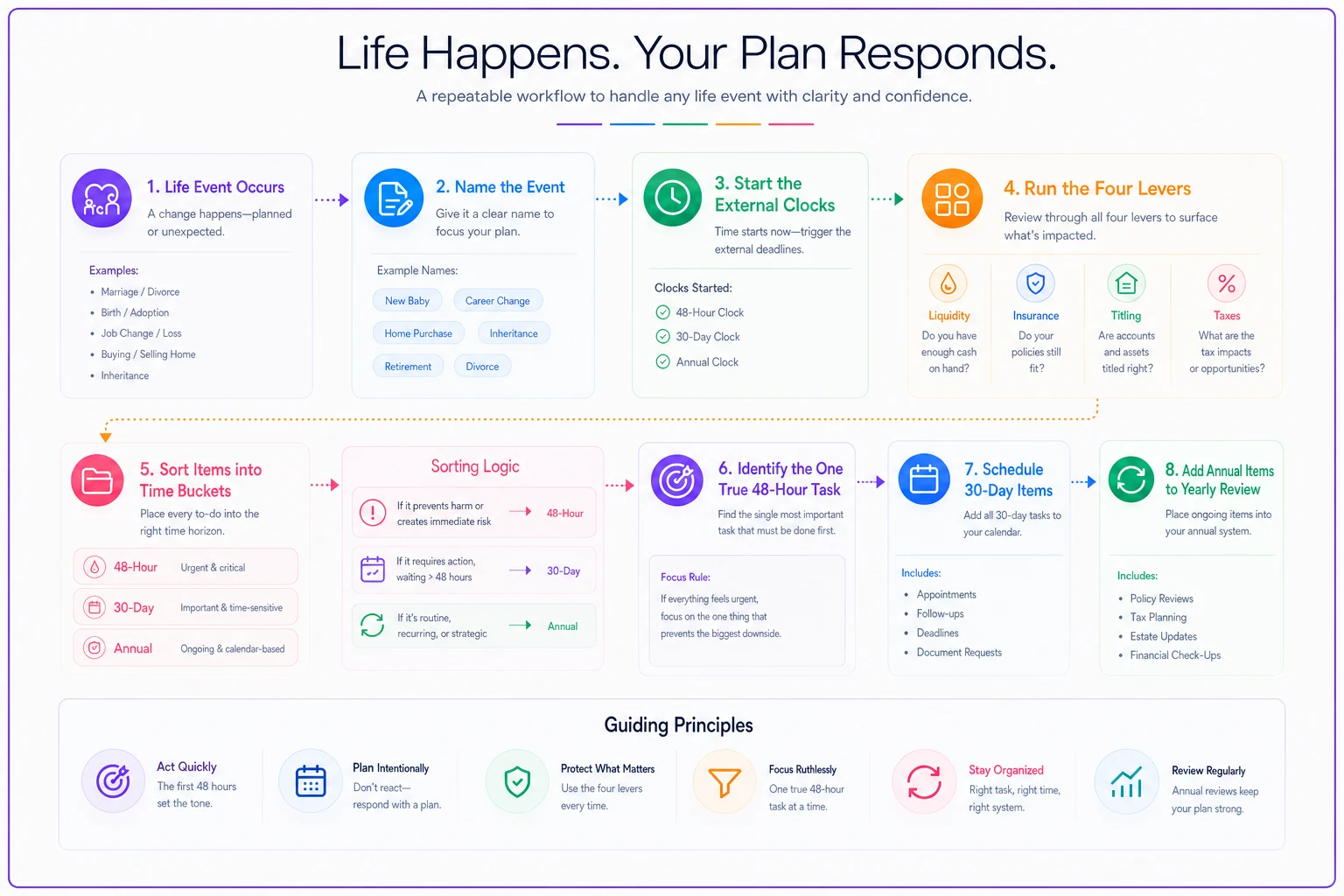
Running this process once per event takes less than an hour. Skipping it can cost months of cleanup.
A quick sanity checklist before you close out any event
A quick sanity checklist before you close out any event
-
Is there a coverage gap in the next 30 days? (Health, disability, life)
-
Did any account, deed, or policy change whose name should be on it?
-
Are beneficiaries current on every retirement account and policy?
-
Does my withholding or estimated-tax situation still match reality?
-
Do I have enough liquid cash for the next 60–90 days without selling at a bad time?
-
Did I schedule the 30-day items instead of just writing them down?
-
Is there anything I'm rushing that would be better as a 30-day decision?
A short real scenario
A short real scenario
A single parent, freelance graphic designer, earning somewhere around $68k–$72k a year, had a second child. No system in place. The health-plan addition slipped past the enrollment window, beneficiaries still listed a parent from a decade earlier, and there was no term life policy at all. Nothing "went wrong" for two years — which is exactly why it felt fine.
When the finances finally got mapped onto a trigger-based matrix, three things got fixed in about a month: the newborn got added at the next open enrollment, beneficiaries got updated across two accounts and an old 401(k), and a modest term policy — roughly $35–$45 a month for meaningful coverage — closed the biggest gap. No dramatic income change. Just three quiet failure points removed before they became expensive.
The difference wasn't knowledge. The designer knew all of it mattered. The difference was having the sequence decided in advance so the decisions got made instead of deferred.
The takeaway
Life-event financial planning goes wrong not because of ignorance — it's timing and sequence. Everything arrives at once, the urgent and the important look identical, and the items with hard external deadlines get buried under things that felt more emotionally pressing.
A trigger-driven matrix fixes that by deciding the order before the event, so the first 48 hours run on rails. Build the grid once. Map each event to the four levers, sort every task into its real time horizon, and fold the annual items into a review you already do. Then the next time your life changes, you're not staring at a 40-item pile wondering what to do first — you already know.
Ready to master your money?
Join thousands of users leveraging Savioly to build smarter budgets, save more efficiently, and plan for a secure financial future.